
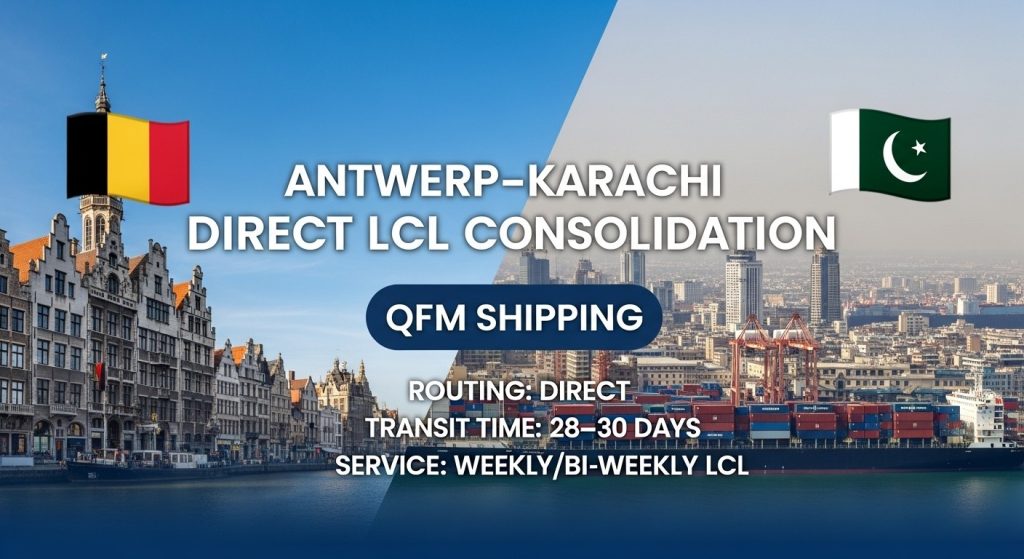
Antwerp–Karachi Direct LCL Consolidation | QFM Shipping
Routing: Direct • Transit Time: 28–30 days • Service: Weekly/Bi-Weekly LCL
When every day counts and full containers aren’t required, QFM Shipping brings you a direct LCL (Less-than-Container Load) consolidation from Antwerp to Karachi—purpose-built for SMEs, mid-market importers, and enterprise supply chains that need speed, reliability, and cost control without the commitment of a full box.
Why This Lane Matters
-
Europe’s gateway to South Asia: Antwerp is one of Europe’s largest break-bulk and container hubs, with dense feeder networks and predictable cut-offs—perfect for building tight LCL consolidations.
-
Direct routing to Karachi: Our direct service reduces intermediate handovers, minimizing risk of mis-stow and transshipment delays.
-
Predictable lead time: Door-to-port in 28–30 days (port-to-port leg optimized), giving your planning and inventory teams a dependable arrival window.
-
Total landed-cost visibility: Consolidation = lower ocean cost per CBM, shared surcharges, and less surprises.
Who Benefits
-
SMEs & e-commerce sellers shipping 1–12 CBM per lot who want ocean savings without long, variable routings.
-
Industrial MRO & spares needing steady replenishment to Karachi without chartering air or waiting to fill an FCL.
-
Retail & lifestyle brands balancing seasonal launches with predictable ETAs.
-
Project cargo (light/medium) that fits LCL specs—panels, fixtures, parts—requiring careful handling and documentation.
Service Snapshot
-
Origin CFS (Antwerp): Consolidation hub near the port with daily receiving.
-
Cut-off: Typically 3–4 days prior CY closing (final cut-off issued on each sailing notice).
-
Sailing frequency: Weekly/Bi-Weekly (seasonal peaks accommodated with overflow legs).
-
Transit time (port-to-port): 28–30 days.
-
Destination CFS (Karachi): Fast de-group, IGM filing, customs facilitation, and quick local dispatch.
-
Carrier partners: Major ocean lines with strong Med/Suez coverage and Karachi berthing windows.
-
Tracking: Milestone visibility—CFS in, Vessel onboard, Suez passed, Arrival notice, CFS out.
What “Direct” Means for you
“Direct consolidation” means your cargo is built into a master LCL box at Antwerp CFS and moves as one unit all the way to Karachi CFS—no mid-route devanning/re-stuffing. Benefits:
-
Lower risk: Fewer handovers, fewer damages.
-
Faster exception handling: If something needs attention, we control the box and the milestones.
-
Predictability: Direct berthing windows and Karachi CFS slots are pre-secured for our consolidated box.
Typical Timeline (example week)
-
Day −7 to −4 (Antwerp): Cargo receiving at CFS; packing check, labeling, measurement verification (CBM / weight).
-
Day −3: CFS cut-off. Export docs checked (commercial invoice, packing list, HS codes, EORI validation).
-
Day 0: Vessel sails; onboard confirmation shared.
-
Day 12–16: Suez passage milestone (for live ETA calibration).
-
Day 28–30: Vessel arrival Karachi; IGM filed; CFS de-group within standard window.
-
Day 30–33: Customs release; local delivery to consignee (door options available).
Cargo Acceptance & Restrictions
Accepted: Cartons, pallets, crates, machinery parts, textiles, consumer goods, electronics (non-haz), auto parts, furniture (KD), and general merchandise within LCL dimensional norms.
Limitations: Perishable, temperature-controlled, certain batteries, and DG (IMO classes) require pre-approval. Oversized pieces may need break-bulk or OOG solutions—we’ll advise.
Optimal packing tips:
-
Use export-grade cartons or 4-way entry pallets; banding and stretch-wrap required.
-
Mark piece count, consignee, PO#, gross/net weight, CBM on at least two adjacent sides.
-
Inner protection for fragile items (foam/edge boards) to withstand multi-handling at CFS.
Documentation Checklist (origin)
-
Commercial Invoice & Packing List (matching piece count & weights).
-
HS codes (EU export + PK import alignment).
-
EORI (shipper) and consignee’s importer credentials (Pakistan).
-
Certificates (if applicable): COO, Fumigation, CE/Conformity, MSDS for battery-containing items.
-
Letter of Credit / Incoterms clauses where applicable (we review for consistency with delivery terms).
Customs & Compliance (Pakistan)
-
IGM & Indexing: Filed promptly post-arrival; avoid invoice/HS discrepancies to prevent holds.
-
Valuation & Duties/Taxes: Based on HS code; ensure accurate itemization to avert delays.
-
Inspection: Random or risk-based; proper packaging and clean documents speed release.
-
Post-clearance: We coordinate CFS out, gate pass, and local delivery to your warehouse.
Cost Model (how LCL pricing works)
-
Ocean Freight: Charged per revenue ton (W/M)—the higher of weight (1,000 kg) or measure (1 CBM).
-
Origin: CFS handling, documentation, export customs, pick-up (if door).
-
Destination: CFS handling, de-group, import docs, customs brokerage, local delivery (if selected).
-
Surcharges (typical): BAF, VLS, WRS (if applicable), PSS in peak season. We publish these transparently in your quote so your landed cost is clear.
Tip: Pre-advice your forecast for the next 2–3 sailings; we’ll reserve CBM inside the box and protect your space in peak weeks.
Incoterms Guidance for this Lane
-
EXW/FOB Antwerp: Buyer controls ocean leg; we can arrange EXW pick-up → CFS → Karachi CFS/door.
-
CIF Karachi: Seller includes ocean & insurance; buyer handles destination costs/clearance.
-
DAP Karachi (Door): We manage door delivery after clearance; great for importers wanting one invoice, one SLA.
We’re happy to review your contract wording to align risk/insurance with your operational reality.
KPI you can Expect
-
On-time vessel departure adherence: Target >95%.
-
Port-to-port variance: Typically ±2 days outside force majeure.
-
Damage/shortage ratio: <0.3% on consolidated boxes with compliant packing.
-
Customs release (post-docs in order): 1–3 working days typical.
Value-Added Options
-
Door pick-up across the EU to Antwerp CFS.
-
Photo proof at CFS (carton condition, pallet build).
-
Cargo insurance (All-Risk, Institute Cargo Clauses A).
-
SKU-level barcoding for retail programs.
-
Priority de-group at Karachi for time-sensitive lines.
Frequently Asked Questions
Q: What’s the minimum size for LCL?
A: No strict minimum; pricing per CBM/W/M. We usually recommend 0.5–1.0 CBM minimum for cost-efficiency.
Q: Can I ship mixed HS codes in one lot?
A: Yes—declare each line properly on invoice/packing list. We’ll guide HS and valuation separation.
Q: Are batteries/electronics allowed?
A: Non-DG electronics are fine. Lithium batteries and other DG items require prior approval and compliant packing/labels.
Q: How do you keep the 28–30 day promise?
A: By direct build at Antwerp, fixed carrier windows, and Karachi CFS de-group slots reserved for our master box.
How to Get Started (simple 4-step flow)
-
Request a quote: Share CBM, gross weight, HS codes, pick-up ZIP, and Incoterms.
-
Book & deliver: Receive booking + labels; deliver to Antwerp CFS or request door pick-up.
-
Track: Get milestone updates through sailing + Suez + arrival + de-group.
-
Clear & deliver: We coordinate customs and move to your Karachi location.
Ready to Move Cargo from Antwerp to Karachi?
QFM Shipping — Fast. Reliable. Global.
Get your Antwerp–Karachi LCL quote with sailing date, CFS cut-off, and a transparent landed-cost breakdown.
Book Your Space Today
Contact Us:
Email: info@qfmshipping.com
Phone: +92-21-34540153 & 54
+92-21-34540135 & 36
Website: www.qfmshipping.com
Tags:
Antwerp to Karachi LCL, direct consolidation, LCL shipping Pakistan, 28–30 days transit, QFM Shipping, Karachi CFS, Europe to Pakistan logistics, QFM Shipping
