Bill of Lading (BOL) and Waybill: Key Documents in Shipping and Freight
In the world of shipping, trade, and logistics, accurate documentation is the backbone of smooth cargo movement. Two of the most essential documents are the Bill of Lading (BOL) and the Waybill. While both serve similar purposes—providing details about the shipment—they differ in their legal role, function, and usage.
1- Bill of Lading (BOL)
Definition:
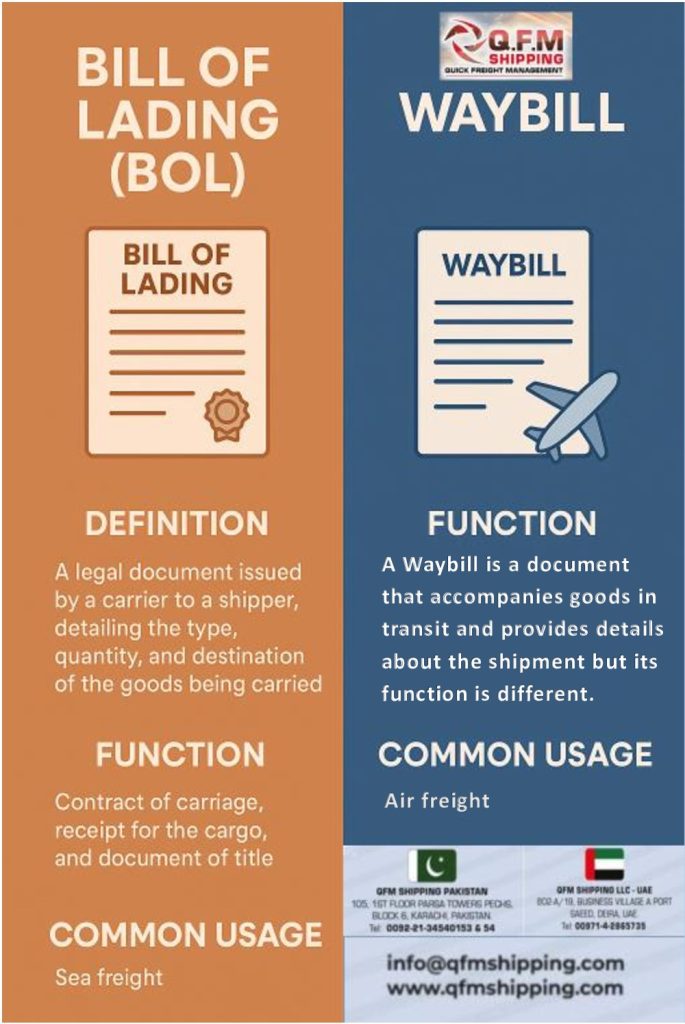
A Bill of Lading is a formal legal document issued by a carrier to a shipper that outlines the type, quantity, and destination of the goods being transported. It acts as a triple-purpose document:
-
Contract of Carriage:
It establishes the agreement between the shipper and the carrier, stating the terms and conditions under which the goods will be transported. -
Receipt for the Cargo:
Once the goods are loaded onto the vessel, truck, or plane, the carrier issues the BOL as proof that the cargo has been received in good order (unless otherwise noted). -
Document of Title:
The BOL grants ownership rights over the goods to whoever holds the original document. This means it can be used in trade transactions, transferred to another party, or serve as collateral for financing.
Key Features:
-
Can be negotiable (transferable) or non-negotiable depending on the trade terms.
-
Required for customs clearance in many countries.
-
Often used in sea freight, though there are also air and land versions.
2- Waybill
Definition:
A Waybill is a document that accompanies goods in transit and provides details about the shipment—such as the destination, contents, and transportation terms. While similar to a BOL in listing shipment details, its function is different.
Key Characteristics:
-
Not a Document of Title:
A waybill does not represent ownership of the goods. It simply instructs the carrier to deliver the shipment to the named consignee. -
Simplified Process:
Since it doesn’t need to be presented to claim the goods, delivery can be faster and more straightforward. -
Common in Air Freight:
The Air Waybill (AWB) is widely used in aviation logistics and often serves as the standard shipping document for air cargo.
3- Key Differences Between BOL and Waybill
| Aspect | Bill of Lading (BOL) | Waybill |
|---|---|---|
| Legal Status | Contract, receipt, and document of title | Contract and receipt only |
| Ownership Rights | Can transfer title to goods | No transfer of title |
| Requirement to Claim Goods | Usually requires presenting the original BOL | Delivery made to named consignee without original |
| Speed of Delivery | May be slower due to document handling | Generally faster |
| Common Usage | Sea freight, some land freight | Air freight, courier services, and express shipping |
4- Choosing Between a BOL and a Waybill
The choice depends on the shipment’s nature and the transaction’s complexity:
-
Use a BOL when:
-
You need to retain ownership control until payment is made.
-
The goods will be sold in transit or ownership will change hands.
-
International sea shipments require negotiable trade documents.
-
-
Use a Waybill when:
-
Speed and simplicity of delivery are more important than ownership transfer.
-
The shipment is between trusted parties.
-
You’re shipping goods by air or courier where the consignee is fixed.
-
Conclusion
Both the Bill of Lading and the Waybill are critical in ensuring smooth transportation, but they serve different legal and operational purposes. A BOL offers control and legal proof of ownership, while a Waybill provides a faster, more direct method of shipment without ownership transfer.
For shippers and consignees, understanding these distinctions helps in selecting the right document to meet commercial, legal, and logistical needs—ultimately reducing delays, disputes, and costs in the supply chain.
Getting Started is Easy
Ready to simplify your shipping? Contact us today for a free consultation and a custom quote. Our team is ready to design a logistics plan that will save you time, reduce costs, and give you peace of mind.
Contact Us:
- Email: info@qfmshipping.com
- Website: www.qfmshipping.com
