
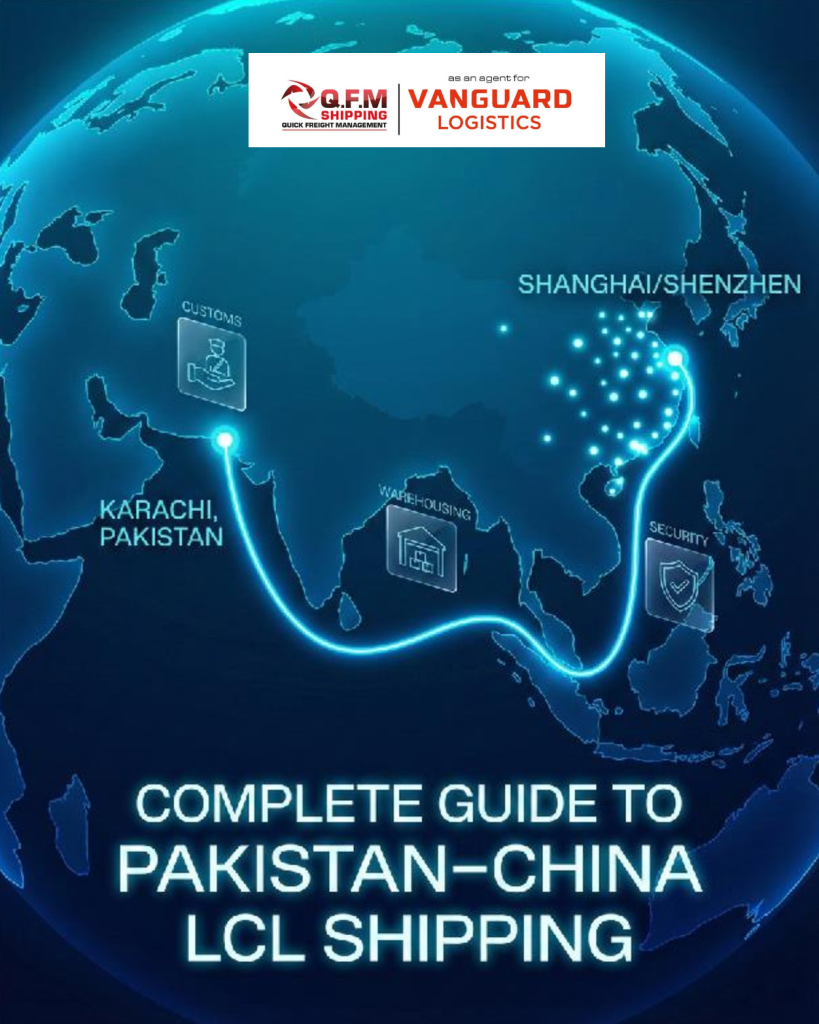
Complete Guide to Pakistan–China LCL Shipping (Shanghai/Shenzhen → Karachi)
How QFM Shipping + Vanguard Logistics Make LCL Faster, Safer, and More Predictable
If you import from China into Pakistan, LCL (Less-than-Container Load) is often the smartest option when your shipment is too large for air freight but not big enough to justify a full container (FCL). This guide explains how Pakistan–China LCL shipping works from Shanghai and Shenzhen to Karachi, what documents you need, how pricing is structured, common delays to avoid, and how QFM Shipping (Pakistan)—leveraging Vanguard Logistics’ global consolidation network—helps importers reduce risk, improve visibility, and keep cargo moving.
1) What “China → Karachi LCL” really means
LCL is a shared-container model:
-
Your cartons/pallets are received at a CFS (Container Freight Station) in China.
-
Multiple shippers’ cargo is consolidated into one ocean container.
-
The container sails to Karachi (usually KICT/PICT terminals).
-
At destination CFS, cargo is deconsolidated, customs is completed, and you receive your cargo.
Why LCL is popular for Pakistan importers
-
Lower cash outlay vs booking a full container
-
More flexible ordering from multiple suppliers
-
Frequent departures from major China hubs
-
Suitable for SME importers, repeat buyers, and mixed SKUs
2) Route coverage: Shanghai/Shenzhen to Karachi
Shanghai (East China powerhouse)
Best for cargo coming from:
-
Shanghai, Suzhou, Hangzhou, Ningbo corridor
-
Industrial, machinery, electronics, spare parts, garments
Shenzhen (South China export engine)
Best for cargo coming from:
-
Shenzhen, Dongguan, Guangzhou, Foshan, Zhongshan
-
Consumer electronics, accessories, general merchandise, packaging, lighting
QFM Shipping supports both origins and aligns bookings through Vanguard Logistics’ consolidation hubs to keep cut-offs, receiving, and documentation disciplined—crucial for LCL reliability.
3) The end-to-end workflow (step-by-step)
Here is the practical flow most Karachi-bound importers follow:
Step A — Booking & planning (before cargo leaves supplier)
QFM Shipping will confirm:
-
Origin (Shanghai or Shenzhen)
-
Cargo details (pieces, weight, CBM, HS codes if available)
-
Preferred sailing window
-
Incoterms (EXW / FOB / FCA etc.)
Best practice: Ask your supplier to provide final packing list + carton dimensions early. LCL depends heavily on correct CBM.
Step B — Cargo receiving at China CFS
Your supplier delivers to the nominated CFS warehouse (or QFM can coordinate pickup if required).
At receiving:
-
Cargo is checked against packing list
-
Cartons are labeled
-
Measurements are verified (CBM confirmation)
-
Any issues (damaged packing, missing marks) are flagged immediately
Why Vanguard matters: A structured consolidation network means disciplined warehouse SOPs, predictable cut-offs, and standardized handling—key to avoiding “my cargo missed the container” surprises.
Step C — Consolidation, stuffing, and export documentation
Cargo is consolidated with other shipments into a container. Then:
-
Export clearance is arranged (as per shipment terms)
-
Ocean BL / HBL is issued
-
Pre-alert is prepared for Karachi
Tip: If your invoice values, consignee details, or HS codes are inconsistent, fix them before the BL is released to prevent clearance disruption in Pakistan.
Step D — Ocean transit to Karachi
During transit, QFM provides:
-
Sailing confirmation
-
ETA updates
-
Document guidance for customs preparation
Step E — Karachi arrival: deconsolidation + customs clearance
After arrival:
-
Container goes to destination CFS
-
Cargo is devanned (deconsolidated)
-
Delivery order process begins
-
Customs clearance and duties/taxes are managed (directly or via your appointed clearing agent)
QFM Shipping advantage: When origin documentation is clean and pre-alerts are timely, destination handling becomes significantly smoother—especially in LCL where a single missing document can delay release.
Step F — Delivery (Door / warehouse pickup)
Options typically include:
-
Pickup from CFS (for your transport)
-
Local delivery to your warehouse (arranged through QFM’s network)
4) Documents you need for China → Karachi LCL
At minimum, expect:
-
Commercial Invoice
-
Packing List (with accurate weights, carton count, dimensions)
-
House Bill of Lading (HBL) / Sea Waybill (as applicable)
-
Certificate of Origin (if required by product/industry)
-
Insurance Certificate (recommended)
-
Any product-specific certificates (e.g., conformity, MSDS where applicable)
Pro tip: For faster customs work, keep these details consistent across all documents:
-
Consignee name and address
-
NTN/STRN (if applicable)
-
HS codes and item descriptions
-
Quantity and unit values
5) How LCL pricing works (clear and honest)
Pakistan–China LCL costs are typically structured as:
A) Origin charges (China)
-
CFS receiving / handling
-
Export documentation
-
Local origin fees (varies by station)
B) Ocean freight
-
Charged mainly on W/M (Weight or Measurement)
-
1 CBM ≈ 1,000 KG rule-of-thumb for W/M in many LCL tariffs
-
You pay on whichever is higher: volume or weight basis
-
C) Destination charges (Karachi)
-
CFS handling / devanning
-
DO / documentation fees
-
Terminal-related charges (as applicable)
-
Customs-related costs (separate from freight)
D) Optional
-
Delivery to door
-
Cargo insurance
-
Special handling (fragile, oversized, DG—if accepted)
Key warning: Many importers compare only “ocean rate per CBM” and get surprised by destination charges. A reliable forwarder will show full landed logistics costs upfront.
6) Transit time expectations (and what affects them)
While exact schedules vary, transit time is influenced by:
-
Cut-off discipline at origin CFS
-
Sailing frequency and space
-
Port congestion or blank sailings
-
Weather disruptions
-
Customs/document readiness in Pakistan
What QFM focuses on: Reducing “avoidable” delays—cargo readiness, correct CBM, timely SI filing, clean documentation, and proactive pre-alerts—so the only variable left is the ocean schedule itself.
7) Common delay points—and how to avoid them
Delay #1: Wrong carton dimensions = wrong CBM
Fix: Confirm dimensions before cargo goes to CFS. CBM drives LCL cost and space planning.
Delay #2: Cargo delivered late and misses cut-off
Fix: Plan supplier dispatch 1–3 days before receiving cut-off (more during peak seasons).
Delay #3: BL holds due to consignee/invoice mismatch
Fix: Ensure consignee name, address, and tax identifiers are consistent.
Delay #4: Mixed suppliers, mixed paperwork
Fix: Consolidate paperwork early; use one standard template for invoice/packing list across suppliers.
Delay #5: Under-declared or unclear descriptions
Fix: Use accurate product descriptions and HS codes—unclear declarations trigger customs queries.
8) Why QFM Shipping + Vanguard Logistics is a strong model for this lane
When you ship LCL, the “invisible” operational layer matters more than marketing claims. The combined model delivers:
-
Predictable consolidation via Vanguard’s established network and CFS discipline
-
Better cut-off and receiving control (reducing rollovers)
-
Standardized documentation flow and reliable pre-alerts
-
End-to-end visibility from Shanghai/Shenzhen receiving to Karachi CFS release
-
Scalability: Start with LCL, grow into regular weekly volumes without changing your operating rhythm
For Pakistani importers, this means fewer surprises, cleaner clearance, and a more stable replenishment cycle.
9) Best-use scenarios (who should use this service)
This lane is ideal if you:
-
Import 1–15 CBM frequently
-
Have multiple SKUs and suppliers
-
Want consistent Karachi arrivals for sales cycles
-
Need a forwarder who can manage process—not just provide a rate
Common cargo categories:
-
Electronics & accessories (non-DG)
-
Garments and textiles
-
Tools, spare parts, hardware
-
General merchandise
-
Packaging materials and light industrial goods
10) Quick checklist before you ship
Use this as your pre-shipment control sheet:
-
Confirm Incoterms (EXW / FOB / FCA)
-
Final packing list with exact dimensions
-
Carton marking and shipper reference
-
HS code list (at least at category level)
-
Invoice values aligned with purchase order
-
Shipment Insurance decision
-
Clearance readiness: consignee NTN/STRN details (if applicable)
-
Delivery plan from Karachi CFS to your warehouse
Work with QFM Shipping for China → Karachi LCL
If you want stable LCL consolidation from Shanghai/Shenzhen to Karachi, QFM Shipping—powered by Vanguard Logistics’ consolidation network—can structure your shipments with predictable cut-offs, clean documentation, and consistent arrival planning.
If you share:
-
Cargo type
-
Total CBM + weight
-
Supplier city (Shanghai-area or Shenzhen-area)
-
Desired shipping week
Our team memeber can also format a ready-to-send supplier instruction sheet (warehouse address + carton marking + document checklist) to reduce errors and speed up your first shipment.
