Decoding the Bill of Lading | The Backbone of Global Trade
Introduction
In the world of global shipping and logistics, few documents carry as much weight as the Bill of Lading (B/L). Often referred to as the “backbone of global trade,” it is more than just a receipt—it’s a legal document, a contract of carriage, and a key to claiming ownership of goods. Without it, millions of shipments moving across oceans, borders, and continents would simply grind to a halt.
Whether you are an importer, exporter, freight forwarder, or simply curious about how international trade works, understanding the Bill of Lading is essential. Let’s decode this vital document and explore why it is so critical for global commerce.
What is a Bill of Lading?
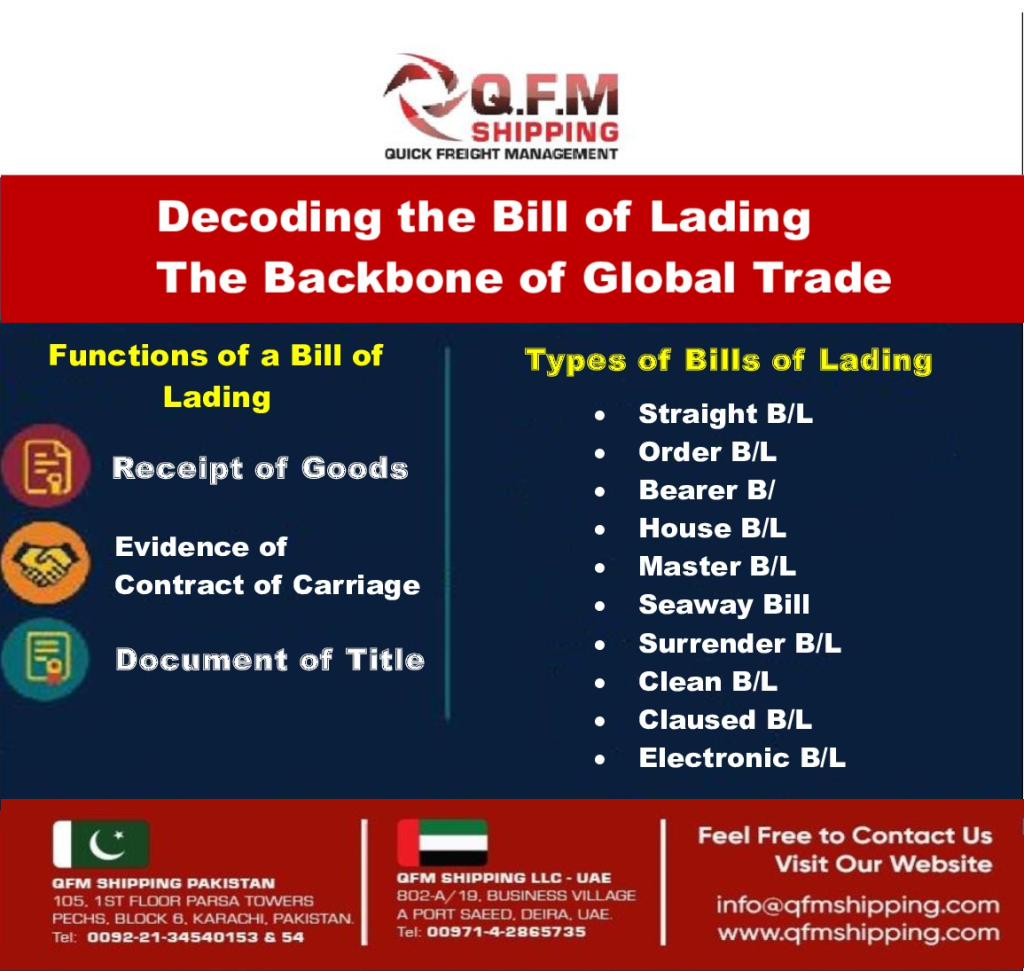
A Bill of Lading is a legally binding document issued by a carrier (shipping line, airline, or freight forwarder) to acknowledge receipt of cargo for shipment. It serves three main purposes:
- Receipt of Goods – Proof that the carrier has received the cargo in good condition.
- Evidence of Contract of Carriage – Outlines the terms and conditions agreed between shipper and carrier.
- Document of Title – Acts as proof of ownership, allowing the consignee or holder to claim the goods at the destination.
In simpler terms, it is the passport of your cargo—without it, your goods cannot travel across borders or reach their rightful owner.
Functions of a Bill of Lading
The importance of a B/L lies in its multi-functional role:
- Facilitates International Trade: By providing legal proof of shipment, it ensures smooth customs clearance and delivery.
- Protects Parties Involved: Both shippers and carriers are safeguarded against disputes over goods, conditions, and ownership.
- Supports Banking & Finance: In many trade finance arrangements, banks require the B/L to process Letters of Credit (LCs).
Types of Bills of Lading
The versatility of this document is evident in its different types, each designed to serve a specific purpose:
- Straight B/L – Non-negotiable; consigned to a specific person or company.
- Order B/L – Negotiable; can be endorsed and transferred to another party.
- Bearer B/L – Whoever holds the document can claim the cargo.
- House B/L vs. Master B/L – Issued by freight forwarders (House) and carriers (Master) respectively.
- Seaway Bill / Surrender B/L / Telex Release – Simplified versions used for speedier release of goods.
- Clean B/L vs. Claused B/L – Clean indicates goods received in good order, Claused indicates damage or discrepancy.
- Electronic B/L (eB/L) – Digital evolution of traditional B/Ls, reducing paperwork and fraud risks.
Bill of Lading in Action: A Real Example
Imagine a company in Pakistan exporting textiles to a buyer in Germany. The exporter delivers the goods to the shipping line, which issues a Bill of Lading. This document is then sent to the buyer’s bank as part of the Letter of Credit process. Once payment is confirmed, the buyer receives the original B/L and presents it to the carrier at the port of Hamburg to claim the goods.
Without the B/L, the buyer cannot legally take delivery of the textiles, even if they physically arrive at the port. This underscores its power and significance in global trade.
Common Challenges with Bills of Lading
Despite its importance, mishandling or misusing a B/L can lead to costly delays and disputes. Some common issues include:
- Incorrect consignee details leading to delivery problems.
- Lost or stolen original B/Ls causing delays in cargo release.
- Fraudulent B/Ls used to cheat traders and financiers.
- Delays in issuing electronic or telex releases.
The Future of Bills of Lading
With the rise of digitalization in shipping, the Bill of Lading is also evolving. Blockchain-based eB/Ls are gaining traction, promising faster transactions, reduced fraud, and seamless tracking. Industry leaders such as Maersk and MSC are investing in paperless B/L systems, signaling a future where traditional paper documents may become obsolete.
Conclusion
The Bill of Lading is much more than a piece of paper—it is the lifeline of international trade. Acting as a contract, a receipt, and a title deed, it ensures that billions of dollars’ worth of cargo moves safely and legally across borders.
As trade becomes more complex and digital transformation accelerates, understanding and correctly using the Bill of Lading is essential for businesses engaged in global commerce. Simply put: without the Bill of Lading, global trade would not exist as we know it.
Getting Started is Easy
Ready to simplify your shipping? Contact us today for a free consultation and a custom quote. Our team is ready to design a logistics plan that will save you time, reduce costs, and give you peace of mind.
Contact Us:
-
Email: info@qfmshipping.com
-
Website: www.qfmshipping.com
