
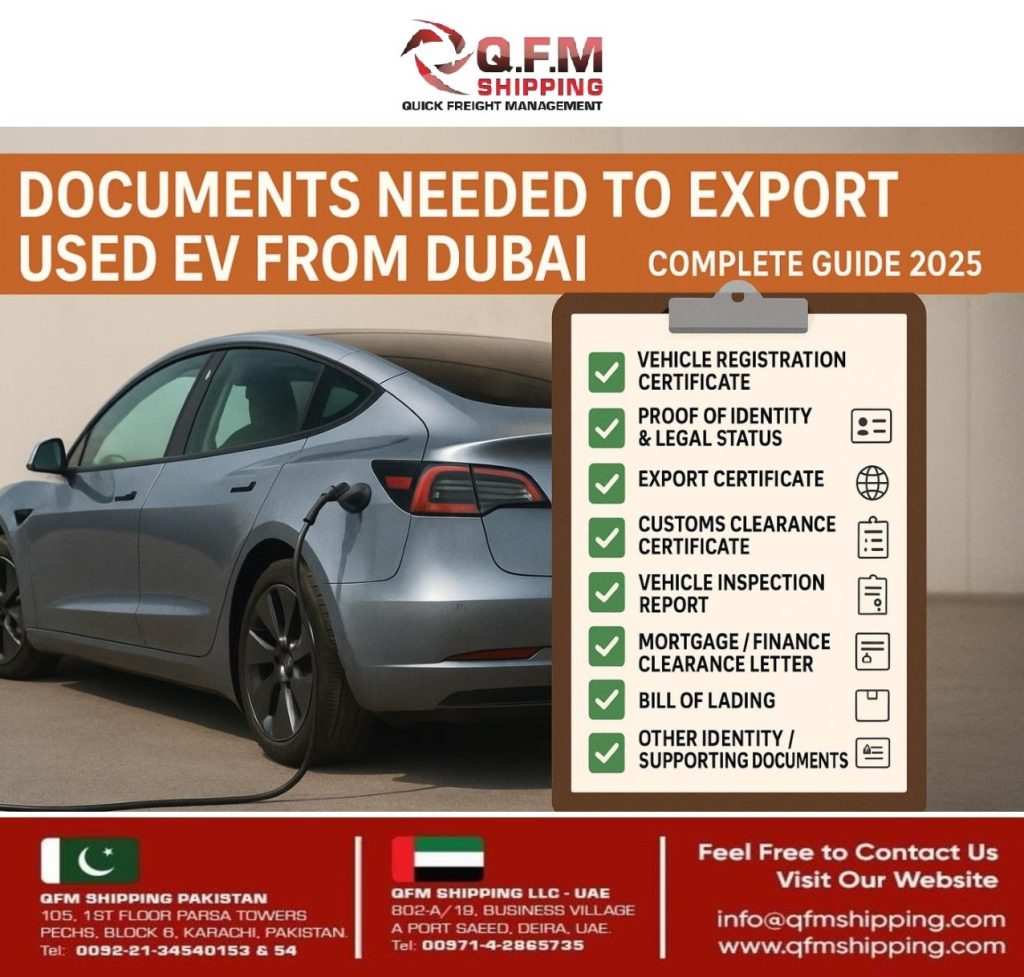
Exporting Used EV from Dubai | Complete Documents Guide 2025
Here’s a complete guide (2025) to the documents & requirements for exporting a used electric vehicle (EV) from Dubai / UAE. Depending on your vehicle, destination country, and whether it’s commercial or personal export, some extra docs may be needed — but this covers what’s almost always required.
Key Steps Before Document Preparation
-
Check destination country import rules
-
Emissions & safety standards
-
Age restrictions
-
If EVs have extra battery / hazardous‐material rules
-
Whether left-hand drive vs right-hand drive is allowed
-
-
Ensure ownership / clear title
-
No ongoing finance (or a clearance letter if there was financing)
-
No liens, mortgages or unpaid fines on the vehicle
-
-
Vehicle condition inspection
-
Mechanical safety inspection
-
Emissions test (if required)
-
Cleanliness, especially for shipping (sometimes quarantine or biosecurity rules)
-
-
Choose shipping / forwarding agent
They often guide and help collect many of these documents.
Documents Needed to Export a Used EV from Dubai
Here’s a checklist of the documents you’ll almost certainly need. Some are UAE formalities, others are for international/customs/shipping.
| Document | Purpose / Who Issues It | Notes / Additional Requirements |
|---|---|---|
| Vehicle Registration Certificate (Mulkiya / Title / Original Registration) | Proves ownership, registration in UAE. Issued by RTA or relevant emirate authority. | |
| Proof of Identity & Legal Status | Passport copy, visa copy, Emirates ID. | |
| Export Certificate | From Roads and Transport Authority (RTA) or equivalent. Confirms the vehicle is to be exported, de-registered in UAE. | |
| Customs Clearance Certificate (Export Declaration) | From Dubai Customs. Confirms duties/fees are paid, vehicle cleared for export. | |
| Vehicle Inspection Report | Safety / mechanical check, emissions (if applicable). Must meet UAE export & destination country standards. | |
| Mortgage / Finance Clearance Letter | If the vehicle was financed, a letter stating all dues have been cleared. | |
| Bill of Sale / Commercial Invoice | To show value, date of purchase, seller & buyer details. Needed for customs & shipping | |
| Bill of Lading | Issued by the shipping company. The key shipping document for transit. | |
| Certificate of Origin | Some countries require proof of where the car was manufactured. Helps with import duties | |
| Insurance Documents | At least transit/shipping insurance; some destination countries require insurance proof before import. | |
| Export Vehicle Plates / Deregistration Proof | Sometimes you surrender UAE license plates once export certificate is issued; proof that the vehicle is off UAE register. | |
| Other Identity / Supporting Documents | Passport & visa (of shipper/buyer), Emirates ID; sometimes local utility bills, proof of residency. |
EV-Specific / Additional Considerations
Because it’s an electric vehicle, there are a few extra points:
-
Battery certification / safety documents (especially if the battery chemistry or manufacture is subject to hazardous materials rules).
-
Whether the battery must meet transport regulations for shipping (air freight is particularly strict).
-
Charging system compatibility (though not a document, but useful if destination country requires certain standards).
-
Export / import rules for used EVs might be stricter in some countries because of environmental / battery disposal laws.
How to Get the Main Documents in Dubai / UAE
-
RTA (Roads & Transport Authority): For registration, de-registration, export certificate.
-
Dubai Customs: For export customs clearance, export declaration.
-
Bank / Financier: For mortgage / finance clearance letter (if applicable).
-
Authorized inspection / testing centres: For mechanical / safety / emissions inspection.
Timeline & Practical Tips
-
Allow several days to 1-2 weeks for all paperwork, depending on whether the car has finance, needs inspections, etc.
-
Double check that every document has correct names (owner, address) matching identity docs. Any mismatch can cause delays.
-
Some documents may need translation (into English or country’s official language) & attestation/notarization depending on destination country.
-
Make multiple certified copies of the key documents (export certificate, registration, bill of sale).
Checklist for Exporting A Used EV from Dubai (UAE)
Country Specific:
From Dubai/UAE (applies to all destinations)
Core UAE paperwork
-
RTA Export Certificate + de-registration (you’ll surrender plates). Bring the original registration card (Mulkiya) and ID.
-
Dubai Customs export declaration/clearance (export GD)
-
Owner ID set: Passport, visa/Emirates ID (seller + exporter as applicable).
-
Bill of Sale / Commercial invoice (VIN, price, seller/buyer). Typically requested by forwarder & destination customs.
-
Bill of Lading from the carrier once the car sails.
-
(If financed) Bank mortgage/loan release letter.
EV shipping note (important)
-
Carriers increasingly treat EVs as dangerous goods: for sea, usually UN 3171 “Battery-powered vehicle” (Class 9) (IATA/IMDG are updating to UN 3556 for lithium-ion vehicles; 2025 has a transition period in air rules). Your forwarder will prepare DG declarations when required.
If You’re Exporting to Pakistan
Destination paperwork commonly requested by Pakistan Customs
-
Goods Declaration (GD) for import (filed in Pakistan’s system by your broker).
-
Original Export Certificate (from UAE RTA).
-
Original Bill of Lading / AWB.
-
Commercial Invoice/Purchase invoice (with VIN, model year).
-
Identity: CNIC (or POC for overseas Pakistanis), plus passport.
-
Bank duty/tax payment proof (remittance/PRC) after assessment.
Policy pointers
-
FBR confirms vehicles can be imported on payment of duty/taxes; your broker will map the HS code (EVs are typically 8703.80 in many regimes) and compute dues.
-
Some guides note Euro-II or local standards checks may apply—confirm current provincial registration requirements before shipping.
Practical add-ons
-
Translation (Arabic→English) for the UAE Export Certificate if your broker asks.
-
Marine insurance for the voyage (recommended).
If You’re Exporting to United Kingdom
On arrival (UK)
-
NOVA: Notify HMRC via NOVA within 14 days of arrival (mandatory; penalties if late).
-
Customs entry + pay VAT/duty, then proceed to approval/registration.
-
Vehicle approval evidence: EU/UK CoC or IVA (individual approval) if needed.
Docs UK border/registration typically asks for
-
Bill of Lading, commercial invoice, proof of ownership/registration (UAE Mulkiya + Export Certificate), ID, and insurance.
Tip
-
Keep the UAE Export Certificate and a clean VIN-matching invoice handy—DVLA/HMRC will reference them against NOVA details.
If You’re Exporting to United States
Regulators & forms
-
EPA: File EPA Form 3520-1 at entry (emissions compliance or qualifying exemption).
-
DOT/NHTSA: File HS-7 declaration with U.S. Customs; vehicles under 25 years must comply with FMVSS or use a registered importer path.
Typical document set at U.S. port
-
Bill of Lading, commercial invoice, foreign registration/title (UAE Export Certificate + Mulkiya), ID, EPA 3520-1, DOT HS-7.
EV shipping caution (air vs sea)
-
Air carriage has tightened: airlines may require declared low state-of-charge and special containment; confirm UN 3171/UN 3556 handling with your carrier.
Quick, Printable Packing-List (what to hand your forwarder)
-
Passport + (if applicable) Emirates ID
-
Original Mulkiya (registration)
-
RTA Export Certificate
-
Dubai Customs export declaration
-
Bill of Sale / Invoice (VIN, model year, value, seller/buyer)
-
Loan release (if any)
-
Destination consignee ID (e.g., CNIC for Pakistan)
-
Destination-specific forms (e.g., NOVA ref for UK; EPA 3520-1 + HS-7 for USA)
Getting Started is Easy
Ready to simplify your shipping? Contact us today for a free consultation and a custom quote. Our team is ready to design a logistics plan that will save you time, reduce costs, and give you peace of mind.
Contact Us:
-
Email: info@qfmshipping.com
-
Website: www.qfmshipping.com
