
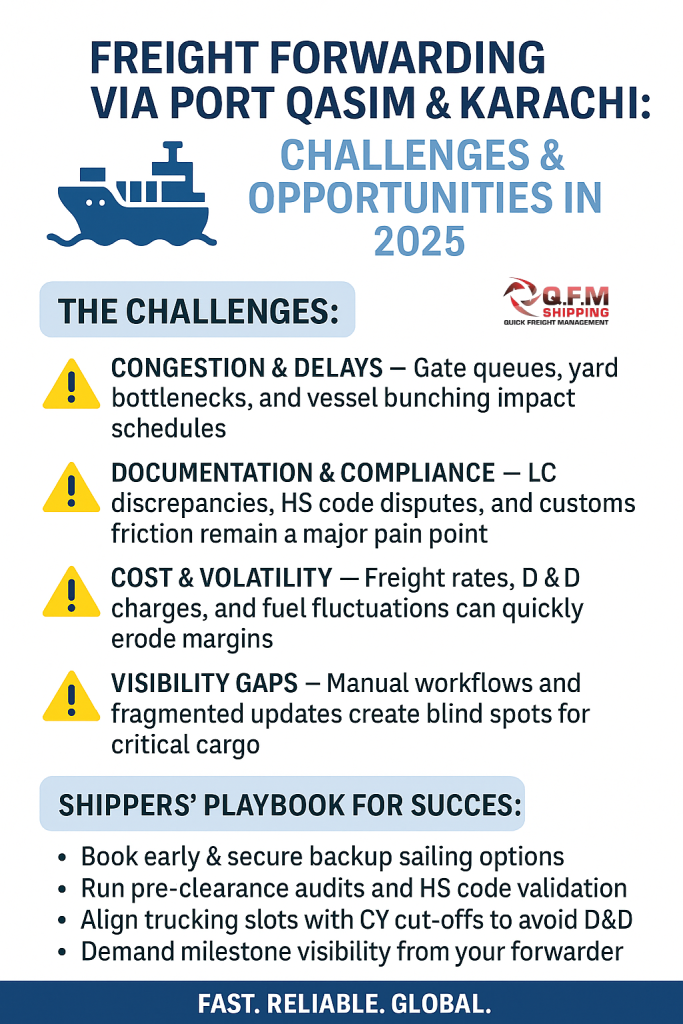
Freight Forwarding via Port Qasim & Karachi | Challenges, Opportunities, and How to Win in 2025
Karachi is the beating heart of Pakistan’s trade—home to Karachi Port (KPT) on the Keamari channel and Port Qasim Authority (PQA) on the Phitti Creek. Together, they handle the lion’s share of the country’s containerized, bulk, and liquid cargo. For exporters and importers, this corridor offers scale, connectivity, and resilience—but it also presents real-world hurdles across documentation, capacity, costs, and compliance. This guide breaks down the key challenges, the emerging opportunities, and a practical playbook to ship smarter via Port Qasim / Karachi.
Why Karachi & Port Qasim Matter
-
Dual-port advantage: KPT’s proximity to the city’s industrial clusters and PQA’s expansive industrial zones (e.g., steel, power, chemicals) give shippers routing flexibility.
-
Gateway to regions: Direct blue-water access to the Middle East, Africa, and Europe; transshipment to the Americas and Far East; and overland links to Pakistan’s industrial belt.
-
End-to-end ecosystem: Customs, terminals, ICDs/dry ports, CFS, bonded warehousing, reefer infrastructure, and a mature network of transporters and 3PLs.
The Freight Forwarding Challenges You’ll Actually Face
1) Capacity, Scheduling & Rate Volatility
-
Blank sailings & space crunch: Global rotations shift quickly; space gets tight in peak seasons or when carriers re-balance networks.
-
Box imbalances: Shortages of empties for exports—or pileups of imports—can trigger unexpected surcharges or delays.
-
Rate swings: Oil prices, geopolitical tensions, and carrier alliances can move ocean freight rates sharply in a matter of weeks.
What to do:
Book early for peak windows; combine FAK + named account rates; hold optionality with two carriers/loops; pre-position empties where possible.
2) Port & Yard Congestion
-
Gate queues & berth windows: Weather, swell, dredging cycles, equipment outages, or bunching of calls can slow down gate-in/gate-out and vessel ops.
-
CFS/ICD bottlenecks: High yard occupancy and documentation mismatches create additional dwell.
What to do:
Use appointment systems when available; pick terminals/depots with better truck-turn times; synchronize trucking slots with CY cut-offs; escalate via your forwarder for priority moves on time-critical cargo (e.g., reefer, pharma).
3) Documentation & Compliance Friction
-
LC discrepancies and HS-code pitfalls: Minor errors cost days.
-
Sanctions & dual-use scrutiny: Heightened checks increase document demands.
-
Customs classification & valuation disputes: Adds unpredictability to clearance timelines and duty impact.
What to do:
Run pre-clearance documentation audits, align the commercial invoice, packing list, BL/AWB, COO, and insurance docs precisely; use a compliance checklist (see below) and pre-consult on HS codes and valuation notes.
4) Inland Logistics Constraints
-
First/last-mile variability: Seasonal demand, regional holidays, and fuel price changes impact trucking cost and availability.
-
Weight & axle limits: Overweight penalties or enforced re-stuffing can blow up schedules.
-
Security & risk: Certain corridors and nighttime moves need vetted carriers and GPS-enabled fleets.
What to do:
Secure standing trucking capacity, implement GPS tracking, and build buffer time around weekends/public holidays. Use sealed, tamper-evident protocols and vetted yards.
5) Operational Costs & FX Headwinds
-
Local charges inflation: THC, storage, demurrage/detention (D&D), and port fees escalate during congestion.
-
Currency & payment cycles: FX availability and banking timelines can complicate freight payments or duty settlement.
What to do:
Request all-in landed cost models with sensitivity ranges; negotiate tiered D&D relief tied to gate-in performance; explore multi-currency settlements with your forwarder.
6) Visibility & Data Gaps
-
Manual workflow gaps: Paper-heavy steps create status blind spots.
-
Fragmented updates: Truckers, depots, terminals, and lines use different data standards; EDI/API is not universal.
What to do:
Adopt a forwarder that offers live milestone tracking, EDI/API ties to carriers/terminals where available, and automated exception alerts.
The Opportunities You Can Capture Now
A) Multimodal & Cross-Border Expansion
-
Sea–air via the Gulf: Pair cost-effective ocean leg to a GCC hub with fast regional air uplift to Africa/Europe.
-
Central Asia corridors: TIR, bonded trucking, and rail are expanding—opening new markets for Pakistani exporters.
B) Value-Added Logistics (VAL) Near Port
-
Bonded warehousing & postponement: Labeling, kitting, and light assembly near Port Qasim/Karachi reduce lead times and duty exposure.
-
E-commerce enablement: Faster order-to-ship via urban micro-fulfilment and duty optimization for returns.
C) Cold Chain & High-Value Verticals
-
Reefer exports & imports: Seafood, meat, pharma, and perishables benefit from growing reefer plugs and priority handling.
-
HSSE-compliant hazardous moves: Better documentation and specialist partners open higher-margin categories.
D) Compliance as a Competitive Edge
-
Preferential market access: Optimize under GSP+/FTAs where applicable; airtight origin documentation can unlock duty savings.
-
AEO & authorized facilities: Trusted-trader programs and secure yards accelerate customs cycles.
E) Digital Transformation
-
Paperless corridors: eBL/eDocs pilots, port community systems, and appointment platforms keep shaving time off dwell.
-
Predictive ETA & exception handling: AI-driven alerts help you re-book, re-route, and inform customers before a delay becomes a crisis.
Port Qasim vs. Karachi Port: How to Choose
-
Cargo profile: Industrial and project cargo often favors Port Qasim; time-sensitive, urban-proximate moves may benefit from KPT depending on vessel window and yard conditions.
-
Terminal performance: Compare current berth waiting times, crane productivity, reefer availability, and yard occupancy.
-
Inland lane: Match port choice with your factory/DC location to cut first/last-mile legs and avoid city congestion.
Tip: Ask your forwarder for a live weekly scorecard of both ports (vessel bunching, average dwell, truck turn-time) and choose per shipment rather than “always-on” loyalty.
A Practical Shipper Playbook (You Can Use Tomorrow)
1) Planning & Booking
-
Forecast 8–12 weeks for peak; place rolling weekly POs so carriers can allocate space.
-
Secure two sailing options (primary + backup loop).
-
Pre-position empty containers (export) or book early gate-out (import) to minimize D&D.
2) Documentation & Customs
-
Lock HS codes with your broker before issuing POs.
-
Use a 4-eyes check on commercial invoice, packing list, BL/AWB instructions.
-
Prepare certificates of origin, PSQCA/plant/health certs, MSDS (haz) in advance; digitize where accepted.
3) Packaging & Compliance
-
Match CTU packing code best practices; avoid overweight/imbalanced stuffing.
-
For reefer: pre-cool, temperature-log, and add real-time data loggers where possible.
-
For hazmat: UN-approved packaging, correct placards, and emergency response info.
4) Inland & Port Ops
-
Book truck slots aligned to CY cut-offs; confirm VGM timeline.
-
Choose CFS/ICD with better lift-on/off SLAs; consider night gates if safer/faster.
-
Monitor terminal advisories for any gate or berth restrictions.
5) Visibility & Escalation
-
Insist on milestone tracking: booking confirmed → empty pickup → gate-in → loaded on board (ROB) → departure → transshipment → arrival → gate-out.
-
Set escalation trees (forwarder ops lead, carrier desk, terminal shift manager) for time-critical cargo.
-
Review weekly exceptions dashboard (rolled shipments, short-shipped, customs holds, missed cut-off).
Cost Control: Where Savings Hide
-
Unitize & standardize: Fewer SKUs per load and consistent carton sizes improve stowage—cutting per-unit freight.
-
Flexible INCOTERMS: Consider FCA/FOB variants depending on who has leverage on ocean rates.
-
D&D strategy: Negotiate free-time extensions in exchange for predictable pickup/return patterns.
-
Audit local charges: Scrutinize THC, scanning, documentation, and handling fees; benchmark across terminals/depots.
-
Insurance optimization: Match coverage to real risk; leverage annual open policies for rate efficiency.
Risk & Resilience
-
Weather & seasonal: Build monsoon and holiday buffers; protect cargo with appropriate packaging and tarping.
-
Security: Vet carriers; prefer sealed yards; track high-value loads; consider escorts on sensitive lanes.
-
Regulatory change: Maintain a watchlist of customs notices, port circulars, and carrier advisories.
-
Route diversification: Keep a second loop or alternate port option on file for critical lanes.
Quick Compliance Checklist
-
✅ HS codes pre-validated and documented
-
✅ LC terms aligned with commercial invoice & BL data elements
-
✅ Certificates (COO/health/plant/PSQCA/MSDS) ready and digitized
-
✅ VGM, packing declaration, and insurance confirmed
-
✅ Pre-alert customs broker; ensure duty/taxes funding is arranged
-
✅ Reefer/hazmat protocols, data loggers, temperature set-points
-
✅ Truck slots & CY cut-offs aligned; GPS-tracked vehicles
-
✅ Milestone tracking & exception alerts active
KPIs to Track with Your Forwarder
-
On-time gate-in % / missed cut-off %
-
Average port dwell (export/import)
-
Truck turn-time and yard moves per box
-
Roll-over rate and space utilization
-
D&D cost per container
-
Damage/shortage incidence
-
Milestone latency (hours from event to visibility update)
How QFM Shipping Helps (Karachi & Port Qasim)
Fast. Reliable. Global. That’s our operating model.
-
Space & routing options: Multiple carrier partners and loops for better schedule assurance.
-
Documentation muscle: Pre-clearance reviews, LC/HS support, and error-free BL instructions.
-
Live visibility: Event-driven tracking, predictive ETAs, and escalation when seconds matter.
-
Special cargo: Reefer, hazmat, OOG/project—handled with compliant packaging, temp control, and HSSE rigor.
-
Cost discipline: Transparent quotations, D&D mitigation strategies, and all-in landed-cost models.
Ready to go global from Karachi or Port Qasim?
Let’s map your lane, solve your bottlenecks, and lock in reliable capacity.
Getting Started is Easy
Ready to simplify your shipping? Contact us today for a free consultation and a custom quote. Our team is ready to design a logistics plan that will save you time, reduce costs, and give you peace of mind.
Contact Us:
-
Email: info@qfmshipping.com
-
Website: www.qfmshipping.com
Tags:
Port Qasim freight forwarding, Karachi port logistics, shipping from Karachi, Pakistan export import, Karachi customs clearance, Karachi ICD, bonded warehouse Karachi, reefer shipping Pakistan, hazmat shipping Pakistan, D&D charges Karachi, ocean freight Pakistan
