
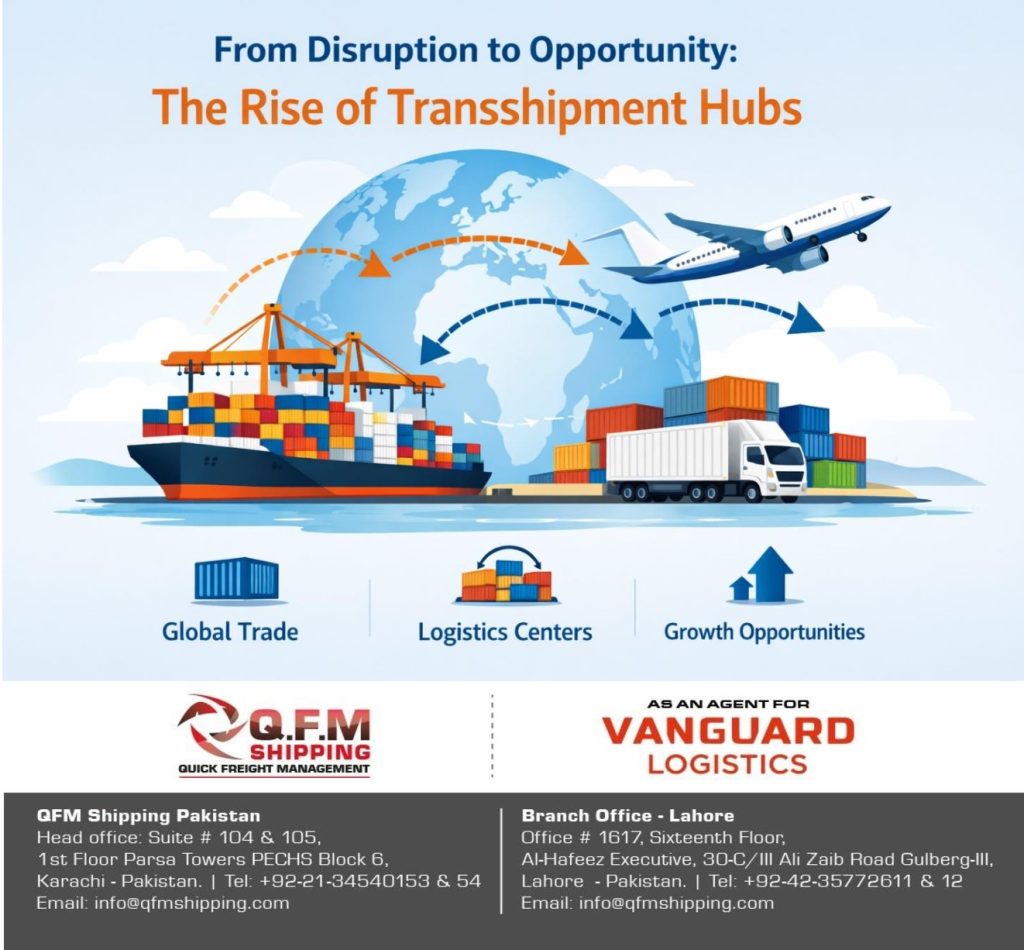
Turning Global Disruption into Strategic Advantage
Global logistics is no longer operating in a predictable environment. Over the past few years, supply chains have been tested by geopolitical conflicts, port congestion, rising freight costs, and shifting trade routes.
What once appeared as disruption has now become an opportunity—especially for countries and logistics providers that can adapt quickly.
At the center of this transformation is the rise of transshipment hubs. These hubs are not just facilitating cargo movement; they are reshaping how global trade flows.
Forward-thinking logistics players like QFM Shipping Pakistan are leveraging this shift to provide exporters with faster, more flexible, and cost-effective solutions.
Understanding Transshipment Hubs in Modern Logistics
A transshipment hub is an intermediate port where cargo is transferred from one vessel to another before reaching its final destination.
Unlike traditional direct shipping, transshipment introduces flexibility into logistics networks by allowing cargo to be rerouted, consolidated, and optimized.
How It Works:
- Cargo originates from one country
- Arrives at a transshipment hub
- Is consolidated or redirected
- Moves onward to final destination
This system plays a critical role in transshipment in global logistics, especially for:
- LCL (Less-than-Container Load) shipments
- Multi-country consolidation (MCC)
- Complex global trade routes
The Disruption Driving Change
1. Geopolitical Instability
Conflicts in key regions, particularly the Middle East, have forced shipping lines to rethink traditional routes. War risk surcharges, insurance premiums, and vessel delays have significantly increased.
👉 Result: Businesses are actively seeking safer and more reliable alternatives.
2. Port Congestion & Delays
Major global ports are experiencing congestion, leading to:
- Extended transit times
- Increased operational costs
- Supply chain bottlenecks
👉 Transshipment hubs help distribute cargo more efficiently.
3. Rising Freight Costs
Fuel price volatility and capacity constraints have driven freight rates upward.
👉 Companies are turning to transshipment to optimize costs through consolidation and route efficiency.
4. Demand for Flexibility
Modern supply chains require agility. Static, direct routes no longer meet the needs of dynamic global trade.
👉 Transshipment enables real-time routing adjustments.
The Rise of Transshipment Hubs: A Global Shift
The rise of transshipment hubs is not accidental—it is a direct response to the evolving logistics landscape.
Key Drivers:
✅ Strategic Location Advantage
Hubs positioned near major trade lanes provide faster access to multiple regions.
✅ Cost Efficiency
Consolidation reduces per-unit shipping costs, especially for SMEs.
✅ Network Connectivity
Hubs act as central nodes connecting multiple global routes.
✅ Risk Diversification
Cargo can be rerouted away from high-risk areas.
Pakistan: A New Powerhouse in Transshipment
Pakistan is emerging as a key player in the global transshipment ecosystem.
Strategic Advantages:
- Proximity to GCC, Asia, and Africa
- Access to major shipping routes
- Cost-effective port operations
- Supportive government policies
Recent regulatory developments have positioned Pakistan as a transshipment gateway, especially for cargo moving toward:
- UAE (Dubai)
- Saudi Arabia
- Oman
- Qatar
- Kuwait
QFM Shipping Pakistan: Enabling the Shift
QFM Shipping Pakistan is at the forefront of the rise of transshipment hubs, offering innovative logistics solutions tailored for modern trade challenges.
🔹 Core Capabilities:
1. Neutral LCL Consolidation
Ensures confidentiality and trust for international freight forwarders.
2. Flexible Routing Solutions
Adapts quickly to disruptions, ensuring uninterrupted cargo flow.
3. Strong Global Network
Seamless connectivity across major trade lanes.
4. Cost Optimization
Efficient consolidation reduces logistics expenses.
5. Reliability in Uncertain Times
Stable operations even during global disruptions.
Why Transshipment Is Now Essential for LCL Shipping
The growth of small and medium exporters has fueled demand for LCL shipping.
Transshipment is the backbone of LCL because it enables:
- Cargo consolidation from multiple shippers
- Efficient container utilization
- Reduced shipping costs
👉 Without transshipment, LCL logistics would struggle to scale.
Transshipment vs Direct Shipping: A Strategic Comparison
| Factor | Transshipment | Direct Shipping |
|---|---|---|
| Cost | Lower | Higher |
| Flexibility | High | Low |
| Risk Management | Strong | Limited |
| Connectivity | Extensive | Restricted |
| LCL Efficiency | Excellent | Weak |
👉 In today’s environment, transshipment provides a competitive edge.
Key Benefits of the Rise of Transshipment Hubs
✅ 1. Enhanced Supply Chain Resilience
Ability to adapt quickly to disruptions.
✅ 2. Reduced Costs
Lower freight expenses through consolidation.
✅ 3. Improved Transit Efficiency
Optimized routing reduces delays.
✅ 4. Greater Market Access
Businesses can reach new regions more easily.
✅ 5. Scalability
Supports businesses of all sizes.
Challenges and How to Overcome Them
❌ Handling Risks
👉 Solution: Partner with experienced providers like QFM Shipping
❌ Documentation Complexity
👉 Solution: Professional freight forwarders ensure compliance
❌ Port Delays
👉 Solution: Use efficient, well-connected hubs
Future Outlook: The Next Phase of Transshipment
The rise of transshipment hubs is set to accelerate further due to:
Digital Transformation
AI-driven route optimization and predictive logistics.
Smart Ports
Automation improving efficiency and reducing turnaround times.
E-commerce Expansion
Demand for faster, flexible shipping solutions.
Integrated Logistics Networks
Hubs becoming central nodes in global trade ecosystems.
Strategic Insight: From Disruption to Opportunity
What once disrupted global logistics has now created new opportunities.
Businesses that embrace transshipment can:
- Reduce operational costs
- Improve delivery timelines
- Expand into new markets
- Strengthen supply chain resilience
👉 The shift is clear: transshipment is no longer optional—it is essential.
Conclusion: The Future Is Hub-Centric
The rise of transshipment hubs marks a fundamental shift in global logistics.
From enabling cost efficiency to ensuring resilience in uncertain times, these hubs are redefining how goods move across the world.
With strategic positioning, growing infrastructure, and industry expertise, QFM Shipping Pakistan is helping businesses turn disruption into opportunity.
Call to Action
Ready to optimize your logistics strategy?
Partner with QFM Shipping Pakistan and leverage the power of transshipment hubs.
Contact us today to move smarter, faster, and more efficiently.
 Book your next LCL shipment with a trusted neutral partner
QFM Shipping Pakistan
Your Trusted Neutral LCL Consolidation Partner
 Contact us |
  Global Reach |
  Reliable Partnerships
It’s time to move with QFM Shipping Pakistan.
Move Smarter. Ship with Confidence.
QFM Shipping Pakistan
Karachi : Suite # 104 & 105, 1st Floor Parsa Towers PECHS Block 6 Karachi
Tel: 0092-21-34540153 & 54
Lahore: Suite # 1617, 16th Floor, Al Hafeez Executive Gulberg III, Lahore
Tel: 0092-42-35772611 & 12
Email: pricing.pkkhi@qfmshipping.com
Mobile: 0092-321-8280327
Tags:
rise of transshipment hubs, transshipment in global logistics, Pakistan transshipment hub, LCL transshipment, global shipping disruption, freight forwarding Pakistan, neutral consolidation Pakistan, supply chain resilience, logistics trends 2026
Read More:
- Pakistan LCL Trade Routes
- Neutral Freight Forwarder Pakistan
- Direct vs MCC LCL Pakistan
- Rising Freight Rates Guide
