
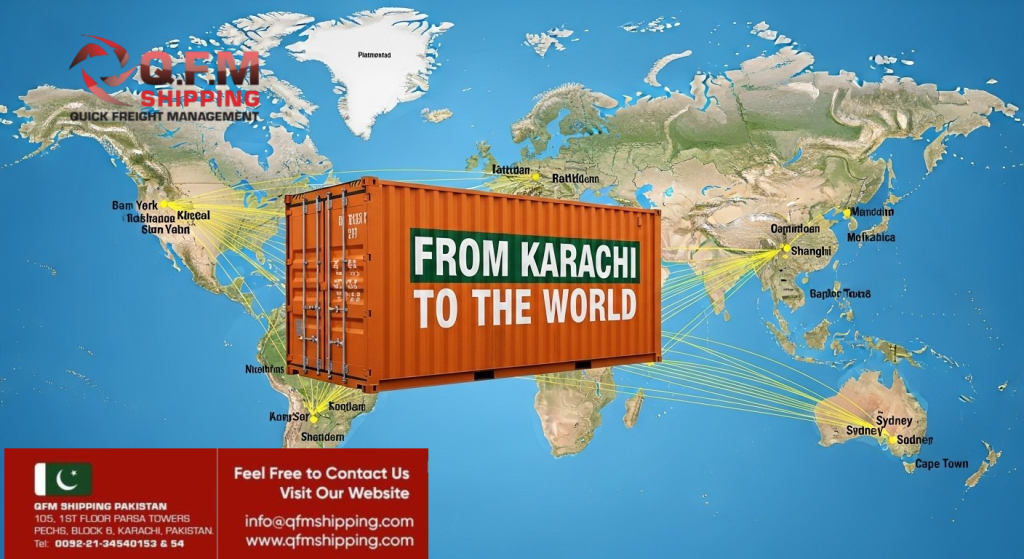
From Karachi to the World | How One Container Connects 5 Continents
When you look at a shipping container stacked on a vessel at Karachi Port, it may appear ordinary—just steel walls and a unique tracking code. But behind that container lies an extraordinary journey that stitches together economies, industries, and lives across the globe. In fact, one container loaded in Karachi can connect five continents, fueling international trade in ways most people never imagine.
The First Step: Karachi as a Gateway
Karachi, home to Pakistan’s busiest ports—Karachi Port Trust (KPT) and Port Qasim—has long served as a hub for South Asia’s trade. From textiles and surgical instruments to seafood and leather goods, the city exports products that make their way into supply chains across the world.
A container might start its journey with cotton apparel destined for New York, electronics parts heading to Rotterdam, or even frozen seafood bound for Tokyo. Karachi is not just a point of departure—it’s a global launchpad.
Stop One: Asia’s Growing Markets
Before leaving Asia, the container might call at hubs like Singapore, Hong Kong, or Shanghai. Here, it may be transshipped, consolidated with goods from other regions, or loaded onto mega-ships.
Why does this matter? Because Asia accounts for more than half of the world’s containerized trade. This means that Karachi’s container is immediately plugged into the heartbeat of the world’s busiest trade routes, linking Pakistan’s exports to booming economies in East Asia, Southeast Asia, and beyond.
Stop Two: Europe’s Ports of Power
From Asia, the container might cross the Indian Ocean and pass through the Suez Canal—a maritime highway that links the East to Europe. Rotterdam in the Netherlands, Hamburg in Germany, or Antwerp in Belgium could be its next home.
Europe relies heavily on imports from South Asia, particularly textiles, sports goods, and surgical instruments from Pakistan. One container could supply retail shelves in London, hospitals in Berlin, and sports stores in Paris. Karachi’s footprint is alive in Europe’s daily life.
Stop Three: The Americas
From Europe, some containers continue their voyage across the Atlantic to the Americas. A shipment of Pakistani denim might end up in New York fashion stores. Rice exports could land in Miami for Latin American markets. Machinery parts might move through Houston for U.S. industries.
The beauty of containerization is its flexibility. That single steel box can easily transfer from ship to rail to truck—seamlessly connecting Karachi’s exporters to Chicago’s warehouses, Brazil’s retailers, or Canada’s supermarkets.
Stop Four: Africa’s Rising Hubs
Africa, once seen as a secondary stop in global shipping, is now an emerging hub of trade. Ports like Mombasa in Kenya, Durban in South Africa, and Lagos in Nigeria increasingly receive goods from Karachi.
Here, Pakistani pharmaceuticals, fertilizers, and textiles support growing African economies. That one container from Karachi could just as easily be feeding households in Nairobi or supplying hospitals in Johannesburg.
Stop Five: Oceania’s Edge
Finally, some containers make the long journey across the Pacific to Oceania—Australia and New Zealand. From Pakistani basmati rice on Melbourne’s grocery shelves to leather goods in Sydney, Karachi’s exports meet demand on the far side of the world.
The Invisible Web of Connectivity
One container may start its voyage in Karachi, but its journey is rarely linear. It can be offloaded, repacked, or reloaded multiple times—touching ports and people in Asia, Europe, Africa, the Americas, and Oceania.
Behind this seamless movement is the global freight forwarding and logistics network. Freight forwarders, shipping lines, and port operators ensure that the container is tracked, secured, and delivered on time.
Why This Matters for Businesses and Consumers
-
For businesses in Pakistan: A container is more than a steel box—it’s access to five continents and billions of customers.
-
For consumers worldwide: That soccer ball in Paris, those jeans in New York, or that rice in Melbourne may have started its journey at Karachi Port.
-
For global trade: The container embodies globalization—reducing costs, increasing efficiency, and connecting producers with consumers at an unprecedented scale.
Conclusion: Karachi’s Global Signature
From Karachi to the world, one container shows how interconnected we truly are. It carries not just goods but also stories, opportunities, and livelihoods across five continents. Next time you see a container ship leaving Karachi, remember—it isn’t just moving steel boxes. It’s moving the world.
Getting Started is Easy
Ready to simplify your shipping? Contact us today for a free consultation and a custom quote. Our team is ready to design a logistics plan that will save you time, reduce costs, and give you peace of mind.
Contact Us:
-
Email: info@qfmshipping.com
-
Website: www.qfmshipping.com
Tags:
Karachi global trade, Karachi shipping routes, container trade across continents, Karachi port exports, Pakistan logistics hub, container journey Karachi, Karachi to Europe shipping, Karachi to Americas trade, Karachi port global connectivity, international shipping from Karachi, QFM Shipping
