
House B/L vs. Master B/L: What’s the Difference in Freight Forwarding?
In the complex world of global logistics, few documents carry as much weight—both literally and legally—as the Bill of Lading (B/L). It’s more than just a receipt for cargo; it’s also a contract of carriage and, in many cases, a document of title. For shippers, importers, and freight forwarders, understanding the different types of Bills of Lading is critical to ensuring smooth international trade.
Two of the most commonly discussed forms are the House Bill of Lading (HBL) and the Master Bill of Lading (MBL). While they serve similar purposes, the parties involved, the level of control, and the legal implications differ significantly.
What is a Master Bill of Lading (MBL)?
The Master Bill of Lading is issued by the carrier or shipping line directly. It’s the primary document that represents the agreement between the actual carrier and the freight forwarder (or Non-Vessel Operating Common Carrier, NVOCC).
Key Points:
-
Issued by: The shipping line (e.g., Maersk, MSC, CMA CGM).
-
Consignor/Shipper: The freight forwarder or NVOCC.
-
Consignee: The overseas office or partner of the forwarder/NVOCC.
-
Legal Role: Serves as the main contract of carriage.
-
Use Case: Recognized by customs and authorities for release of cargo.
In short, the MBL reflects the “macro” level of the shipment—the agreement between the forwarder and the actual carrier who owns the vessel.
What is a House Bill of Lading (HBL)?
The House Bill of Lading is issued by a freight forwarder or NVOCC to their customer (the actual shipper/exporter). It acts as the “retail” version of the Bill of Lading, representing the agreement between the shipper and the freight forwarder.
Key Points:
-
Issued by: Freight forwarder/NVOCC.
-
Consignor/Shipper: The exporter (the actual seller of goods).
-
Consignee: The importer (the actual buyer of goods).
-
Legal Role: Contract of carriage between exporter and forwarder.
-
Use Case: Often used for door-to-door and consolidation shipments.
The HBL essentially mirrors the details of the MBL but with the shipper and consignee being the actual trading parties.
Key Differences Between House B/L and Master B/L
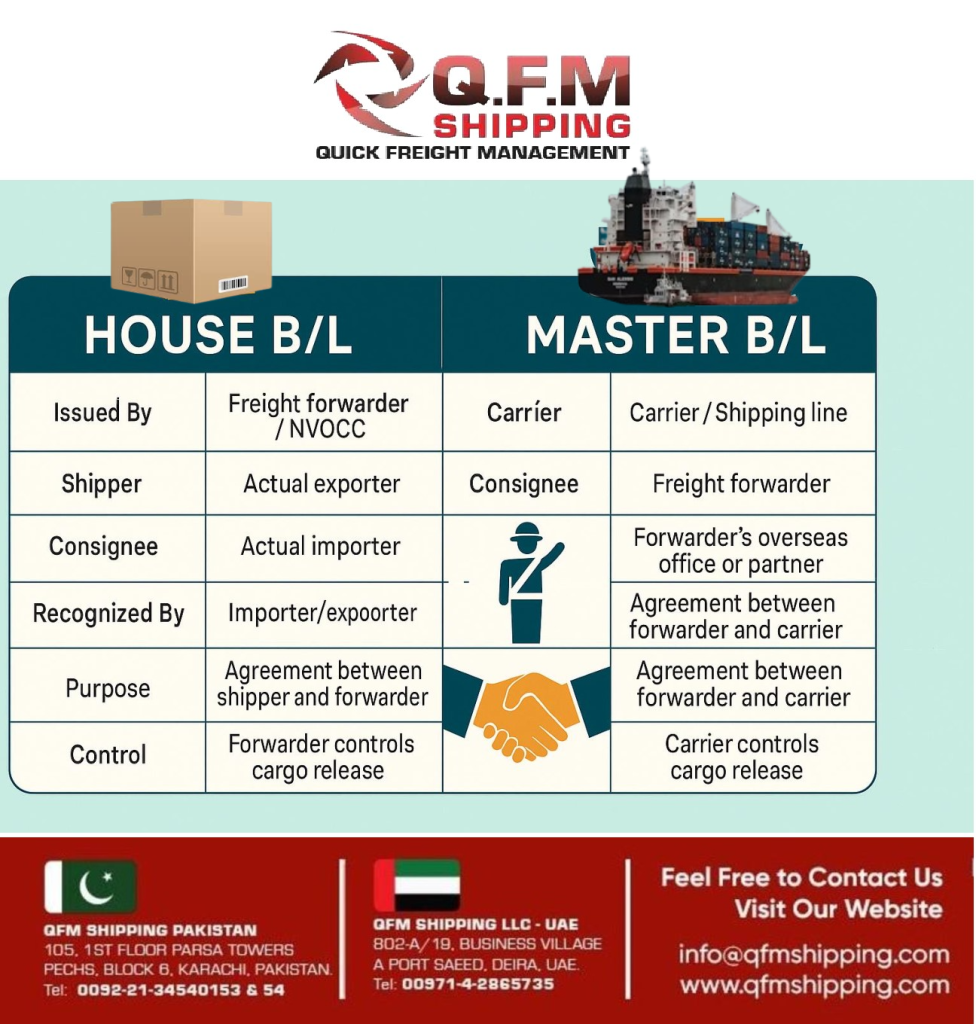
| Aspect | House Bill of Lading (HBL) | Master Bill of Lading (MBL) |
|---|---|---|
| Issued By | Freight forwarder / NVOCC | Carrier / Shipping line |
| Shipper | Actual exporter | Freight forwarder |
| Consignee | Actual importer | Forwarder’s overseas office or partner |
| Recognized By | Importer/exporter | Customs, shipping line, port authorities |
| Purpose | Agreement between shipper and forwarder | Agreement between forwarder and carrier |
| Control | Forwarder controls cargo release | Carrier controls cargo release |
Why Both Documents Exist
You might wonder: why have both? The answer lies in the layered structure of global logistics.
-
The MBL ensures that the carrier and forwarder are bound by contract, and the shipping line is responsible for moving the cargo.
-
The HBL ensures that the shipper and consignee have a binding contract with their freight forwarder, who manages the logistics end-to-end.
This dual structure allows freight forwarders to consolidate shipments, provide flexibility, and offer more competitive rates to shippers.
Risks and Considerations
Understanding the differences between HBL and MBL is not just academic—it has real-world implications:
-
Cargo Release: Customs authorities often require the MBL for release, while the consignee needs the HBL to claim goods from the forwarder.
-
Liability: In case of damage or loss, claims may differ depending on which B/L governs the shipment.
-
Delays: Misalignment between HBL and MBL details (e.g., mismatched consignee names) can cause clearance delays.
-
Banking Transactions: For letter of credit (LC) shipments, banks typically prefer MBLs over HBLs due to their recognition by carriers and customs.
When to Use HBL vs. MBL
-
HBL: Best when working closely with a freight forwarder, especially for consolidated shipments, smaller exporters, or when you need additional services (customs clearance, warehousing, last-mile delivery).
-
MBL: Essential when dealing with large shipments, LC transactions, or direct dealings with carriers.
Final Thoughts
Both the House Bill of Lading and Master Bill of Lading are indispensable in international freight forwarding. The MBL sets the framework between the carrier and forwarder, while the HBL manages the relationship between forwarder and shipper/importer.
For exporters and importers, the critical takeaway is to understand which document governs your shipment, clarify it with your freight forwarder in advance, and ensure details match to avoid costly delays.
In freight forwarding, knowledge is power—and knowing the difference between a House and Master B/L can make the difference between a smooth shipment and a logistical nightmare.
Getting Started is Easy
Ready to simplify your shipping? Contact us today for a free consultation and a custom quote. Our team is ready to design a logistics plan that will save you time, reduce costs, and give you peace of mind.
Contact Us:
-
Email: info@qfmshipping.com
-
Website: www.qfmshipping.com
