
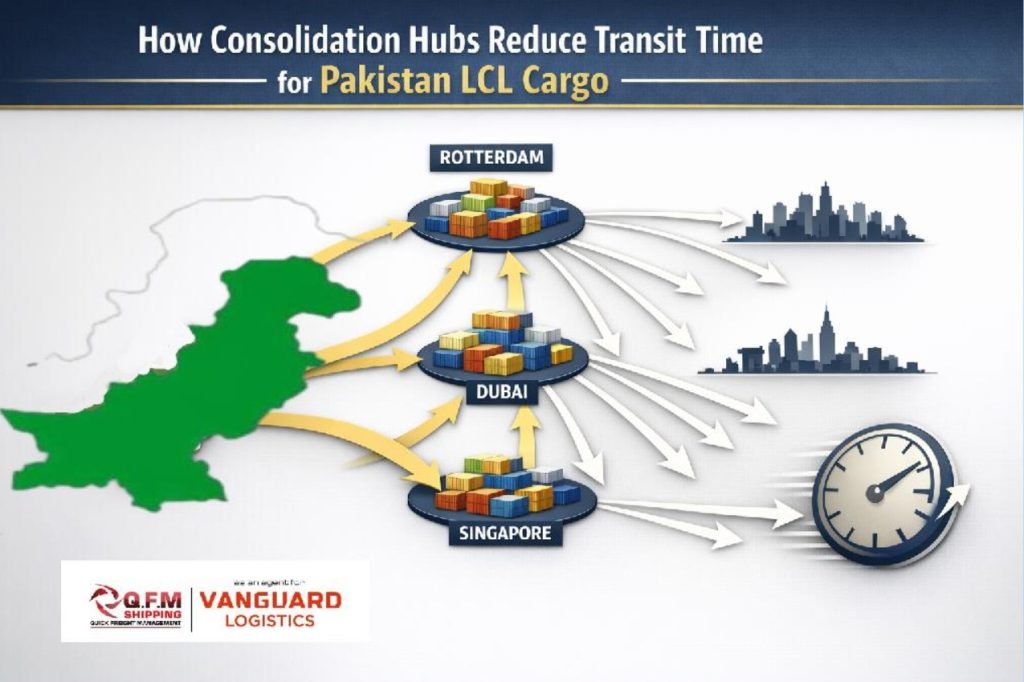
How Consolidation Hubs Reduce Transit Time for Pakistan LCL Cargo
A Network-Centric Perspective by QFM Shipping
In today’s time-sensitive global trade environment, speed and predictability are no longer optional for Less-than-Container Load (LCL) shipments. For Pakistan’s exporters and importers, fragmented routing and ad-hoc transshipments often result in extended transit times, missed connections, and supply-chain uncertainty.
As a Pakistan-based neutral LCL consolidation specialist, QFM Shipping operates on a fundamentally different principle: network-centric consolidation through strategically selected global hubs. This article explains how consolidation hubs reduce transit time for Pakistan LCL cargo—and how QFM Shipping applies this model to deliver faster, more reliable outcomes for Pakistani traders.
The Pakistan LCL Reality: Where Time Is Lost
Most Pakistan LCL cargo originates from Karachi, serving a diverse base of SMEs shipping:
-
Apparel and textiles
-
Sports goods
-
Surgical instruments
-
Leather products
-
Consumer and industrial goods
In traditional LCL models, cargo is often:
-
Routed opportunistically rather than strategically
-
Subject to multiple transshipment ports
-
Held at origin waiting for volume alignment
-
Rolled due to missed vessel connections
These inefficiencies directly translate into longer transit times and higher commercial risk.
QFM Shipping’s Consolidation-Hub Philosophy
QFM Shipping structures its LCL services around purpose-built consolidation hubs rather than random transshipment points. Each hub functions as a controlled aggregation and redistribution center within a global LCL network.
This approach ensures that Pakistan LCL cargo moves through:
-
Fewer vessel touchpoints
-
Fixed weekly consol schedules
-
Optimized onward routing
-
Lower dwell time at ports
The result is a predictable and accelerated transit profile, even for smaller shipment volumes.
How Consolidation Hubs Reduce Transit Time
1. Route Simplification Through Hub-and-Spoke Design
Instead of routing cargo through multiple uncoordinated ports, QFM Shipping applies a hub-and-spoke LCL model:
-
Pakistan (Karachi) acts as the spoke
-
Selected regional and global hubs act as consolidation nodes
Cargo flows:
Pakistan → Consolidation Hub → Final Destination
By eliminating unnecessary transshipments, QFM Shipping reduces idle waiting time and minimizes schedule risk.
2. Fixed Weekly Consols—No Waiting for Volume
A major cause of LCL delays is cargo waiting at origin until enough compatible volume is available.
QFM Shipping solves this through:
-
Guaranteed weekly consol departures
-
Volume aggregation across multiple shippers
-
Pre-planned container builds
This means Pakistan exporters do not wait for “matching cargo”—their shipments move on schedule.
3. Centralized LCL Handling at Hubs
At QFM Shipping’s consolidation hubs:
-
Containers are stripped once
-
Cargo is re-sorted by destination region
-
New containers are built immediately for onward sailing
Because these hubs are LCL-focused facilities, handling is faster, documentation is standardized, and dwell time is tightly controlled.
4. Smarter Vessel Selection From the Hub
From a consolidation hub, QFM Shipping can:
-
Select the fastest or most reliable vessel per trade lane
-
Avoid congested or unreliable sailings
-
Reallocate cargo quickly if schedules change
This flexibility is rarely available when shipping directly from Pakistan to all destinations.
5. Built-In Resilience Against Disruptions
Port congestion, blank sailings, and weather delays are unavoidable—but their impact can be managed.
Consolidation hubs act as buffer points:
-
Cargo already inside the network can be re-routed
-
Alternative sailings are available without returning cargo to origin
This significantly reduces transit volatility for Pakistan LCL cargo.
Transit Time Impact: The QFM Shipping Advantage
| LCL Model | Typical Transit Time | Reliability |
|---|---|---|
| Traditional / Ad-hoc LCL | 45–60 days | Low |
| Basic Hub Routing | 35–45 days | Medium |
| QFM Shipping Hub-Based Network | 25–40 days | High |
Actual transit times vary by destination and season, but QFM Shipping’s network-centric model consistently outperforms fragmented routing.
Why This Matters for Pakistan Exporters and Importers
For exporters:
-
Faster delivery improves buyer confidence
-
Shorter lead times support repeat orders
-
Reduced penalties and claims risk
For importers:
-
Predictable arrivals improve inventory planning
-
Lower demurrage and detention exposure
-
Reduced need for buffer stock
QFM Shipping’s consolidation strategy directly supports commercial competitiveness for Pakistan trade.
Speed Without Cost Inflation
Unlike premium express services, QFM Shipping achieves faster transit through operational efficiency, not surcharge-driven pricing.
By:
-
Maximizing container utilization
-
Reducing duplicate handling
-
Leveraging network scale
QFM Shipping delivers faster LCL transit without sacrificing cost efficiency.
QFM Shipping: Powering Pakistan’s Neutral LCL Ecosystem
QFM Shipping operates as a neutral LCL consolidation partner, enabling freight forwarders, exporters, and importers to access a world-class consolidation network without channel conflict.
Our model is built on:
-
Network discipline
-
Schedule integrity
-
Hub-centric design
-
Pakistan-focused trade enablement
For Pakistan LCL cargo, consolidation hubs are not a convenience—they are the backbone of reliable global trade.
Conclusion
In an era where predictability defines logistics success, consolidation hubs are no longer optional for Pakistan LCL cargo.
Through its network-centric, hub-based consolidation model, QFM Shipping reduces transit time, lowers variability, and delivers dependable LCL solutions for Pakistan’s global traders.
For businesses shipping less than container loads—but demanding full-scale performance—QFM Shipping turns LCL into a structured, strategic advantage.
Ready to explore collaboration opportunities? Reach out to our team to discuss your LCL needs, strategic partnerships, and custom routing options. Let’s build stronger, smarter logistics together.
Email: info@qfmshipping.com
Phone: +92-21-34540153 & 54
+92-21-34540135 & 36
Tags:
Pakistan LCL consolidation, LCL consolidation hubs Pakistan, neutral LCL consolidator Pakistan, Pakistan LCL transit time reduction, hub-based LCL shipping Pakistan, Karachi LCL exports, global LCL consolidation network, multi-origin LCL consolidation, Pakistan freight forwarding LCL, QFM Shipping LCL services
