
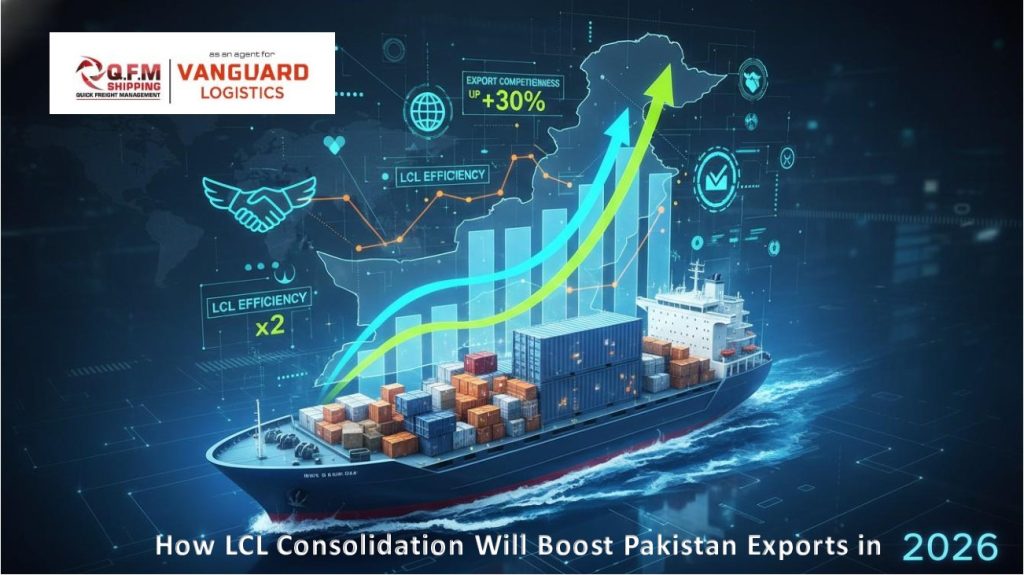
How LCL Consolidation is Transforming Pakistan’s Export Competitiveness in 2026 (and Why QFM Shipping + Vanguard Logistics Matter)
Pakistan’s exporters are under pressure in 2026: buyers want shorter lead times, smaller and more frequent replenishment, tighter compliance documentation, and predictable landed costs. At the same time, many Pakistani exporters—especially SMEs in textiles, apparel, leather, sports goods, instruments, home décor, FMCG ingredients, and engineering components—do not always have enough cargo volume to justify a full container (FCL) on every order.
This is exactly where LCL consolidation is transforming the game. By combining multiple exporters’ shipments into a single container, LCL consolidation reduces cost barriers, improves sailing options, and enables Pakistan’s exporters to compete more effectively in global markets—without waiting to “fill a container.”
In this post, we will break down how LCL consolidation is strengthening Pakistan’s export competitiveness in 2026, and how QFM Shipping—in collaboration with Vanguard Logistics—helps exporters access reliable consolidation networks, scheduling discipline, and end-to-end visibility.
What is LCL Consolidation?
LCL (Less-than-Container Load) means your cargo shares container space with other shipments. LCL consolidation is the operational process of receiving shipments from multiple shippers, verifying packaging and documentation, grouping cargo by destination, then loading into a container at a consolidation hub (CFS) and shipping it to the overseas deconsolidation point for final delivery.
In practical exporter terms:
-
You ship cartons/pallets/crates, not a whole container.
-
You pay for the space you use (usually based on chargeable weight: CBM/ton rules).
-
You gain access to regular sailing schedules that may be difficult to achieve alone.
Why LCL Consolidation is a Competitive Advantage for Pakistan in 2026
1) SMEs can export faster without waiting to build FCL volume
A common problem for Pakistani SMEs is the “volume delay”: production finishes, but shipping is postponed until there is enough volume to justify an FCL booking. That delay increases cash-cycle time, misses buyer cut-off dates, and can weaken the supplier’s performance score.
With LCL consolidation, exporters can ship smaller lots more frequently, keeping international buyers supplied on schedule.
Result: Faster order fulfillment and improved buyer confidence—two critical factors in export competitiveness.
2) LCL supports the global shift to smaller, frequent replenishment orders
In 2026, international procurement patterns are increasingly aligned with lean inventory and frequent restocking. Buyers want:
-
Smaller PO sizes
-
More frequent shipments
-
Less inventory risk
-
Better demand responsiveness
LCL enables Pakistani exporters to meet these patterns without forcing artificial consolidation on the manufacturing side.
Result: Pakistani suppliers can win buyers who value agility, not just price.
3) Better route access through established consolidation networks
Not all LCL is equal. The competitive edge comes from:
-
Strong origin CFS operations
-
Reliable carrier allocations
-
Proven destination CFS partners
-
Consistent cut-off discipline and documentation handling
This is where partnerships matter. QFM Shipping working with Vanguard Logistics helps exporters tap into a mature consolidation ecosystem rather than relying on ad-hoc space and irregular routings.
Result: Predictable shipping options can become a selling point for Pakistani exporters.
4) Lower logistics cost per shipment—especially for smaller orders
For many exporters, the choice is not “LCL vs FCL.” It is “ship now via LCL vs ship late (and risk penalties).” LCL reduces the financial barrier to export execution by avoiding:
-
Paying for empty container space
-
Higher minimum volume commitments
-
Container repositioning and peak surcharges that can disproportionately affect small shippers
When managed correctly, LCL makes export logistics more accessible and financially rational—particularly for small and medium exporters.
Result: More exporters can serve more markets, more often.
5) Improved reliability and accountability through process-driven consolidation
In 2026, exporters compete not only on product quality but also on OTIF performance (On Time, In Full). LCL consolidation can enhance reliability when the consolidator is process-driven:
-
Standard receiving checks
-
Cargo measurement verification
-
Packaging integrity inspections
-
Warehouse scanning and shipment milestones
-
Clear documentation SOPs
QFM Shipping focuses on operational discipline—while Vanguard Logistics brings global consolidation experience and hub connectivity—helping reduce the “uncertainty tax” exporters often face.
Result: Better shipment predictability improves exporter ratings and repeat business.
How LCL Consolidation Improves Pakistan’s Export Competitiveness Across Key Industries
Textiles and Apparel
Buyers increasingly demand smaller assortments shipped frequently. LCL supports:
-
Partial shipments by style/color/size
-
Faster restocking to overseas warehouses
-
Reduced penalty risk from delayed deliveries
Sports Goods and Leather
Often shipped as mixed SKUs in cartons. LCL enables:
-
Regular movement of mixed-product orders
-
Flexibility for seasonal demand spikes
Engineering Parts and Light Manufacturing
Many shipments are dense and compact—ideal for LCL pricing efficiency. LCL supports:
-
Spares and after-sales parts logistics
-
Time-sensitive production support shipments
Home Décor and Handicrafts
Shipments are often varied and order-driven. LCL supports:
-
Frequent small batches
-
Better cash-flow cycles for artisan supply chains
The QFM Shipping + Vanguard Logistics Advantage for Exporters
Exporters do not just need LCL; they need dependable LCL—with global reach, consistent process, and strong exception handling. This is where QFM Shipping and Vanguard Logistics become strategically relevant in 2026.
1) Global consolidation infrastructure and hub strategy
Vanguard Logistics is known for operating and partnering across international consolidation hubs. For Pakistani exporters, this means improved access to:
-
Structured LCL routing options
-
Destination deconsolidation capabilities
-
Standardized milestone visibility
When QFM Shipping leverages this network, exporters benefit from a stronger global operating backbone—especially for repeat lanes and long-term programs.
2) Better planning through fixed cut-offs and sailing discipline
Competitive exporters plan production around shipping cut-offs. A reliable consolidator helps:
-
Align factory dispatch with CFS receiving windows
-
Reduce rollovers caused by missed consolidation cut-offs
-
Maintain stable ETD/ETA expectations
3) Export documentation and compliance support
Documentation errors can erase all the advantages of faster transit. A professional LCL operator helps reduce risk around:
-
Packing list / invoice alignment
-
HS code consistency and shipping bill support (as applicable)
-
Buyer-required labeling, carton marks, and cargo readiness
4) Consolidation quality: cargo handling, measurement accuracy, and claims risk control
LCL involves more handling points than FCL. Exporters need:
-
Proper cargo segregation
-
Secure palletizing/crating guidance
-
Measurement transparency (CBM accuracy)
-
Reduced damage and short-landing risk
QFM Shipping’s operational coordination—supported by Vanguard’s structured processes—helps exporters protect cargo integrity and commercial outcomes.
What Exporters Should Do in 2026 to Maximize LCL Benefits
-
Design export packaging for LCL movement
Use stronger outer cartons, edge protection, stretch wrap, and moisture control where needed. -
Standardize carton labeling and SKU mapping
This reduces errors at CFS receiving and destination deconsolidation. -
Plan shipments around weekly cut-offs
Treat LCL cut-offs as part of your production calendar, not an afterthought. -
Use LCL strategically—not only tactically
If your buyer accepts frequent smaller shipments, LCL can become a permanent advantage. -
Choose a consolidation partner with network strength
The network behind your forwarder determines route options, stability, and problem-resolution speed.
Common Myths About LCL (That Hurt Export Decisions)
Myth 1: “LCL is always slower than FCL.”
Not necessarily. If you are waiting to fill an FCL, LCL can be faster overall door-to-door.
Myth 2: “LCL is only for small companies.”
Many large exporters use LCL for samples, spares, replenishment, and mixed-SKU programs.
Myth 3: “All LCL services are the same.”
Service quality depends on consolidation discipline, destination partners, scheduling reliability, and documentation accuracy.
FAQs: LCL Consolidation for Pakistan Exporters
Q1) Is LCL suitable for high-value cargo?
Yes, if packaged correctly and handled through reliable consolidation networks with clear milestone tracking and claims procedures.
Q2) How is LCL freight calculated?
Typically by chargeable weight—based on volume (CBM) versus actual weight, depending on tariff rules.
Q3) When should I prefer FCL over LCL?
If you have enough volume regularly, want minimal handling points, or have cargo that is highly sensitive to consolidation environments, FCL may be better.
Q4) Can LCL help me enter new markets?
Yes. It reduces the cost and volume barrier of “testing” new destinations, buyer relationships, and distribution channels.
Final Takeaway: LCL Consolidation is Now a Growth Lever for Pakistan’s Exports
In 2026, export competitiveness is defined by speed, reliability, flexibility, and cash-flow efficiency—not only by manufacturing cost. LCL consolidation is enabling Pakistani exporters to ship smaller volumes more frequently, reach more destinations, and meet modern buyer expectations.
With QFM Shipping and the global consolidation strengths of Vanguard Logistics, exporters gain access to structured lanes, operational discipline, and network reliability—turning LCL from a “backup option” into a strategic export advantage.
Call to Action (Conversion-Focused)
If you are exporting from Pakistan and want to reduce shipping delays, improve delivery reliability, and scale exports without waiting to fill containers, QFM Shipping can guide you on the right LCL consolidation strategy using the Vanguard Logistics network.
Tags:
LCL shipping Pakistan, LCL consolidation services Pakistan, Pakistan export logistics 2026, LCL freight forwarding Pakistan, QFM Shipping Vanguard Logistics, consolidation hub CFS Pakistan, SME exports Pakistan shipping, cost-effective export shipping Pakistan
