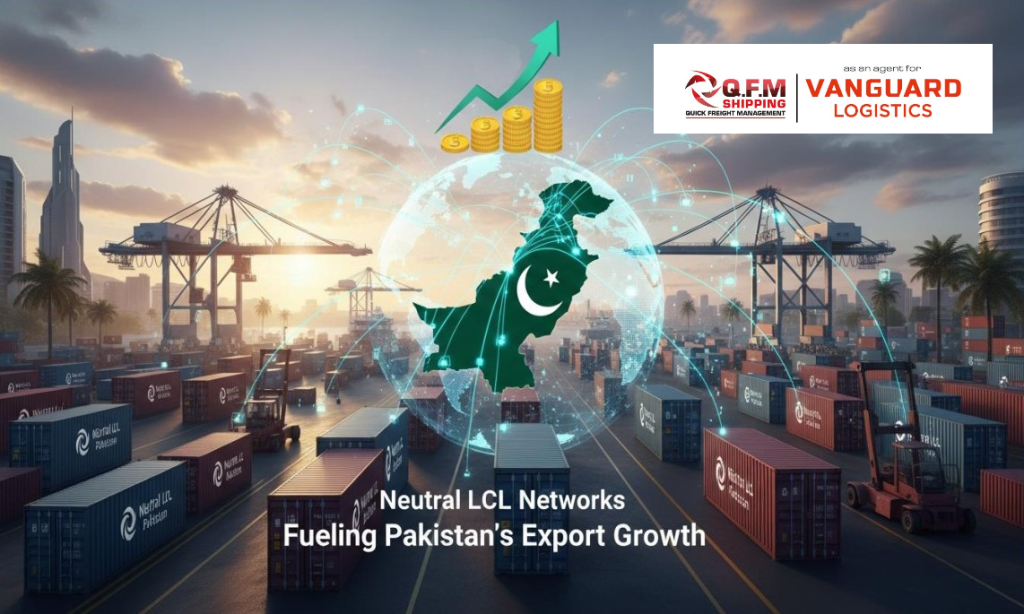
How Neutral LCL Networks Will Shape Pakistan’s Export Growth
The role of QFM Shipping (Vanguard Logistics Agent in Pakistan)
Pakistan’s export growth is no longer constrained by demand alone. In many sectors—textiles, sports goods, leather, surgical instruments, FMCG, engineering parts—the real constraint is logistics: consolidation reliability, sailing frequency, documentation discipline, and predictable door-to-door lead times.
For exporters and freight forwarders, one model is emerging as a practical, scalable solution: neutral LCL networks.
Neutral LCL networks are not a trend. They are becoming a structural advantage for export economies—because they make global market access possible even when shippers don’t have FCL volume, and even when markets require faster replenishment cycles and tighter inventory management.
What is a Neutral LCL Network (and why it matters)?
A neutral LCL (Less-than-Container Load) network is a consolidation ecosystem designed to support the forwarding community without competing against it.
In a truly neutral setup:
-
Consolidation capacity is built to serve multiple forwarders fairly.
-
Processes are standardized for consistent cut-offs, documentation, labeling, and cargo handling.
-
Export cargo from many shippers is combined into scheduled departures to global destinations.
-
The network prioritizes transparency and operational discipline, not rate games and last-minute rollovers.
-
Forwarders retain the customer relationship while gaining access to a stronger consolidation backbone.
This neutrality is crucial in Pakistan because export cargo is typically fragmented across industries, cities, and shipper sizes. Neutral LCL helps Pakistan “act larger” in global supply chains—by aggregating volume into predictable, bookable capacity.
Why Neutral LCL Networks accelerate export growth
1) More SMEs can export without waiting to build FCL volume
A large portion of Pakistan’s exporter base consists of SMEs. Many have excellent products but insufficient volume for FCL. Neutral LCL networks allow:
-
Smaller shipment sizes
-
More frequent export cycles
-
Reduced working-capital pressure (less inventory waiting to accumulate)
Result: more exporters can ship consistently, which supports sustainable export growth.
2) Better sailing frequency improves lead time competitiveness
Export growth increasingly depends on speed and reliability—not just price. Neutral LCL networks create routine departures that improve:
-
ETD predictability
-
Inventory planning
-
Buyer confidence
-
Repeat purchase cycles
This matters for high-mix, mid-volume exports where buyers reorder frequently and penalize delays.
3) Lower landed cost through consolidation efficiency (not shortcuts)
Neutral consolidation reduces cost by improving the system:
-
Better container utilization
-
Fewer handling exceptions
-
Reduced rework and documentation errors
-
Lower incidence of delays and demurrage caused by operational non-compliance
It’s not about cutting corners. It’s about running consolidation like an airline—scheduled, standardized, measurable.
4) Stronger compliance and documentation discipline reduces shipment risk
Global buyers, customs authorities, and carriers expect accuracy and consistency. Neutral networks typically bring stronger:
-
SOPs for labeling, packing lists, HS support, VGM coordination where applicable
-
Cut-off governance and document checklists
-
Auditability for cargo milestones
This reduces holds, disputes, and missed connections—directly supporting exporter reliability in overseas markets.
The role of QFM Shipping as Vanguard Logistics agent in Pakistan
For neutral LCL networks to drive export growth, Pakistan needs partners that can combine local execution excellence with global network reach. This is where QFM Shipping, as a Vanguard Logistics agent in Pakistan, plays a strategic enabling role.
1) Bridging Pakistan exporters and forwarders to a global neutral consolidation system
As Vanguard’s agent, QFM Shipping helps connect Pakistan’s export cargo into a wider neutral LCL framework—supporting forwarders with access to:
-
Structured consolidation routings
-
Regular schedules aligned with international network planning
-
Destination coverage that supports multi-market growth strategies
2) Enabling forwarders with a neutral platform (not competing for their customers)
The strongest neutral models protect the forwarder’s business. QFM Shipping’s position is to support the freight community with:
-
Fair access to consolidation capacity
-
Consistent operational processes
-
Transparent shipment milestones and coordination
-
A growth-focused approach that strengthens the forwarding ecosystem
This is how neutrality becomes trust—and trust becomes volume.
3) Raising execution standards at origin: the “export reliability layer”
Export performance depends heavily on origin discipline. QFM Shipping supports the reliability layer by focusing on:
-
Cargo readiness governance (receiving, checking, segregation)
-
Documentation coordination and pre-alert accuracy
-
Consolidation planning to reduce last-minute surprises
-
Stakeholder alignment across shipper, forwarder, carrier, and destination teams
When origin execution improves, exporters become more dependable, which attracts repeat buyers and long-term contracts.
4) Helping Pakistan compete in a world moving toward networked logistics
Global supply chains are increasingly “networked”: buyers source from multiple countries, distribute inventory across regions, and demand predictable replenishment. Neutral LCL networks fit that reality—and QFM Shipping’s role is to ensure Pakistan is not excluded from that logistics evolution.
What this means for Pakistan’s export future
Neutral LCL networks can create a multiplier effect for Pakistan:
-
More SMEs exporting consistently
-
Better lead times and schedule reliability
-
Lower hidden logistics costs (delays, disputes, rework)
-
Stronger buyer confidence and repeat cycles
-
A more professional, scalable forwarding ecosystem
This is how logistics becomes an export-growth engine—not just a cost line.
Practical next step for forwarders and exporters
If you are a freight forwarder supporting multiple exporter accounts—or an exporter aiming to grow internationally without FCL volumes—your next advantage will come from aligning with a neutral LCL consolidation partner that can deliver:
-
Process discipline at origin
-
Predictable schedules
-
Transparent coordination
-
Network connectivity through a recognized global consolidator
QFM Shipping, as Vanguard Logistics’ agent in Pakistan, is positioned to support forwarders and exporters who want to scale with reliability, neutrality, and a network-first strategy.
CTA (lead-generation style)
If you want to explore neutral LCL routings, consolidation planning, and forwarder-friendly support for your export shipments from Pakistan, message QFM Shipping to discuss your lanes, volumes, and target markets.
Partner with QFM Shipping & Vanguard Logistics Services — and take your global forwarding business to the next level.
Connect with Us
Ready to explore collaboration opportunities?
Reach out to our team to discuss your LCL needs, strategic partnerships, and custom routing options.
Let’s build stronger, smarter logistics together.
Email: info@qfmshipping.com
Phone: +92-21-34540153 & 54
+92-21-34540135 & 36
Website: www.qfmshipping.com
Tags:
neutral LCL networks, neutral LCL consolidation Pakistan, Pakistan export logistics, LCL consolidation Pakistan, freight forwarders Pakistan, neutral freight consolidation, Pakistan SME exports, export supply chain Pakistan, global LCL network, Vanguard Logistics Pakistan agent, QFM Shipping Pakistan, LCL export solutions Pakistan, consolidated shipping Pakistan, international freight forwarding Pakistan, export growth logistics Pakistan
