How SMEs Can Scale Exports Using LCL Services
A Practical Guide for Growth-Focused Exporters
For many small and medium-sized enterprises (SMEs), export expansion is not limited by demand — it is constrained by logistics. Traditional full container load (FCL) shipping often requires higher volumes, larger capital commitment, and longer inventory cycles.
This is where How SMEs Can Scale Exports Using LCL Services becomes a practical and strategic discussion.
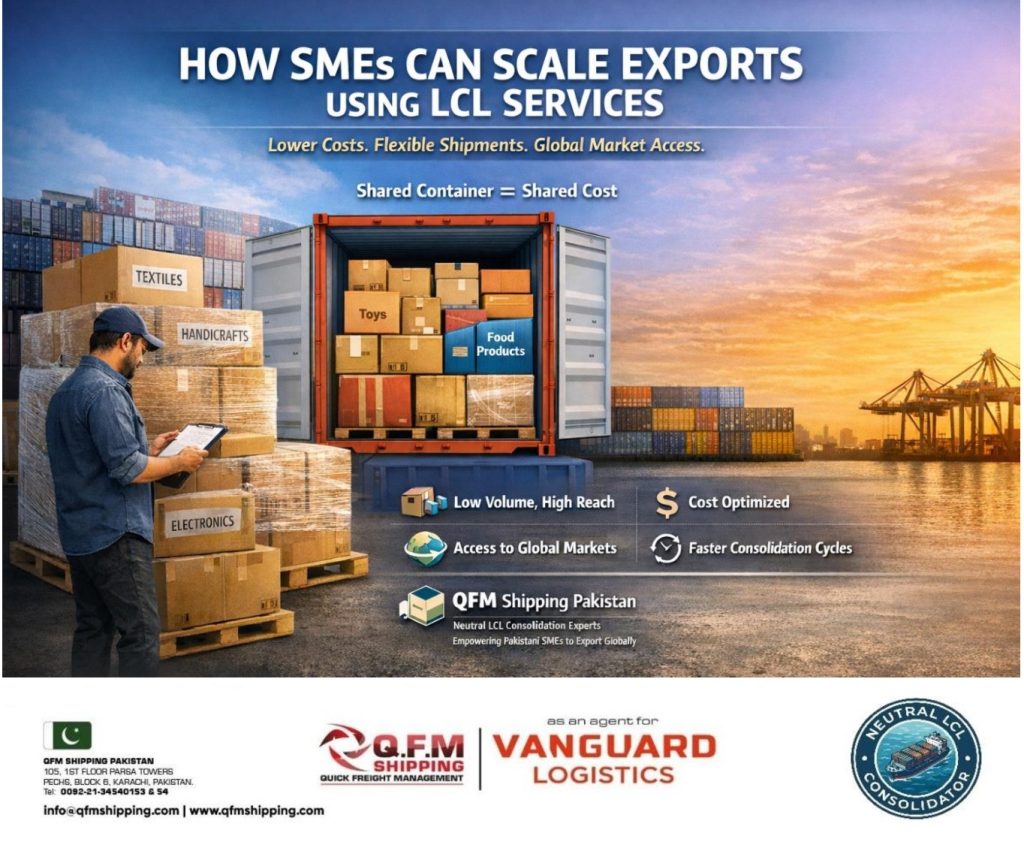
Less than Container Load (LCL) services allow SMEs to ship smaller volumes while sharing container space and costs with other exporters. The result is improved cash flow, lower risk exposure, and faster entry into new markets.
What Is LCL and Why It Matters for SMEs?
LCL (Less than Container Load) shipping means your cargo shares container space with shipments from other exporters. Instead of paying for an entire 20ft or 40ft container, you pay only for the space you use.
Why this is critical for SMEs:
-
No need to wait for full container volumes
-
Lower upfront freight costs
-
Reduced warehousing burden
-
Faster product-to-market cycles
-
Ability to test new export markets safely
For SMEs operating in textiles, handicrafts, surgical goods, light engineering, cosmetics, or consumer products, LCL provides a scalable export model.
The Core Challenge SMEs Face in Export Growth
Before understanding How SMEs Can Scale Exports Using LCL Services, it is important to identify the core barriers:
-
Limited working capital
-
Irregular order sizes
-
Market testing uncertainty
-
High container freight rates
-
Storage and inventory management costs
FCL shipping often forces SMEs to overproduce or delay shipments — both of which create financial pressure.
LCL removes that structural limitation.
How SMEs Can Scale Exports Using LCL Services – Step-by-Step Strategy
1. Start with Market Testing
Instead of committing to a full container, SMEs can:
-
Ship smaller volumes to Europe, GCC, or USA
-
Test product acceptance
-
Measure distributor response
-
Evaluate seasonal demand
This minimizes financial risk while maintaining market presence.
2. Improve Cash Flow Through Shared Container Costs
In FCL shipping:
-
You pay for unused container space.
In LCL shipping:
-
You pay only for cubic meters (CBM) used.
This cost-sharing mechanism allows SMEs to:
-
Rotate inventory faster
-
Reduce capital lock-in
-
Increase shipment frequency
Over time, this directly supports export scale-up.
3. Ship More Frequently Instead of Shipping Bigger
Scaling exports does not always mean shipping larger volumes. It often means:
-
Shipping more consistently
-
Improving supply chain reliability
-
Building buyer trust
LCL enables weekly or bi-weekly consolidation cycles from Karachi, allowing SMEs to maintain consistent delivery schedules.
4. Expand Into Multiple Markets Simultaneously
Using LCL services, SMEs can:
-
Send 5 CBM to Hamburg
-
3 CBM to Jebel Ali
-
2 CBM to Istanbul
All without needing full container commitments.
This diversification strategy reduces dependency on one market and accelerates global reach.
The Strategic Role of QFM Shipping Pakistan
When discussing How SMEs Can Scale Exports Using LCL Services, execution matters as much as strategy.
This is where QFM Shipping Pakistan plays a pivotal role.
As a neutral LCL consolidation expert and exclusive agent of Vanguard Logistics, QFM Shipping Pakistan provides structured export support for SMEs through:
1. Neutral Consolidation Services
-
Protection of forwarder relationships
-
Confidential cargo handling
-
Competitive freight structures
-
Transparent consolidation processes
Neutrality ensures that SMEs working with freight intermediaries maintain trust across the supply chain.
2. Karachi as a Consolidation Hub
Operating from Karachi, QFM Shipping Pakistan enables:
-
Scheduled LCL departures
-
Global routing connectivity
-
Efficient cargo handling
-
Reduced dwell time
Karachi’s strategic location strengthens access to:
-
Europe
-
GCC
-
USA & Canada
-
Mediterranean
-
Far East
3. Cost Optimization for SMEs
QFM Shipping Pakistan helps SMEs:
-
Calculate accurate CBM usage
-
Optimize packaging efficiency
-
Avoid unnecessary freight surcharges
-
Plan export schedules strategically
This advisory approach transforms LCL from a freight option into a growth mechanism.
4. Documentation & Compliance Support
Many SMEs struggle with export documentation. QFM Shipping Pakistan supports with:
-
Bill of Lading processing
-
Export documentation guidance
-
Customs coordination
-
Proper cargo classification
Reducing compliance errors ensures smooth export operations.
Real Growth Model: From Small Exporter to Global Player
Many exporters start with:
-
2–3 CBM per month
-
Single-market shipments
With structured LCL planning, they gradually:
-
Increase shipment frequency
-
Expand to new regions
-
Move to hybrid LCL + FCL models
This is how SMEs scale sustainably — not through sudden volume jumps, but through controlled, predictable expansion.
Risk Mitigation Through LCL
Another major advantage in How SMEs Can Scale Exports Using LCL Services is risk management:
-
Lower financial exposure per shipment
-
Reduced inventory stagnation
-
Market flexibility
-
Controlled freight budgeting
For SMEs, controlled risk equals controlled growth.
When Should an SME Consider Moving to FCL?
Scaling does not mean remaining on LCL permanently.
SMEs should consider FCL when:
-
Shipment volume consistently exceeds 12–15 CBM
-
Market demand stabilizes
-
Cash flow supports full container cycles
Until then, LCL remains the most efficient growth bridge.
Competitive Advantage Through Strategic Logistics
Export growth is no longer just about product quality. It is about:
-
Logistics agility
-
Cost efficiency
-
Route reliability
-
Market responsiveness
SMEs that understand How SMEs Can Scale Exports Using LCL Services gain a structural advantage over competitors who wait to accumulate full container volumes.
Conclusion
Scaling exports does not require immediate large-volume shipping. It requires structured, disciplined logistics planning.
How SMEs Can Scale Exports Using LCL Services is fundamentally about:
-
Lower cost entry
-
Flexible shipment models
-
Market testing capability
-
Consistent global presence
With expert consolidation support from QFM Shipping Pakistan, SMEs can transition from local suppliers to global exporters — methodically, efficiently, and competitively.
Call to Action
If your SME is ready to expand internationally without committing to full container loads, consult with QFM Shipping Pakistan to design a structured LCL export strategy.
Export smarter. Scale steadily. Grow globally.
Ready to explore collaboration opportunities? Reach out to our team to discuss your LCL needs, strategic partnerships, and custom routing options. Let’s build stronger, smarter logistics together.
Email: info@qfmshipping.com
Phone: +92-21-34540153 & 54
+92-21-34540135 & 36
Tags:
How SMEs Can Scale Exports Using LCL Services, LCL shipping Pakistan, SME export strategy, neutral LCL consolidation, shared container shipping, QFM Shipping Pakistan, low volume export solutions, Karachi LCL services
