
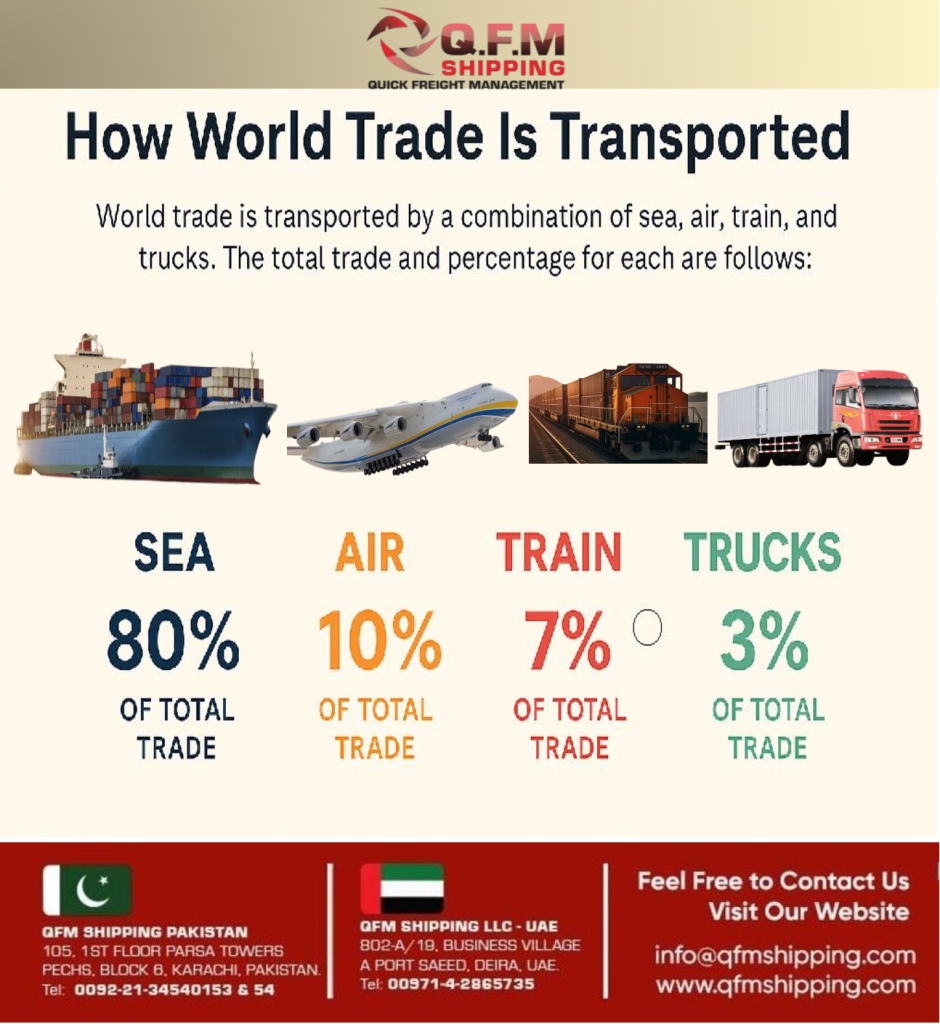
World trade, the lifeblood of our globalized economy, relies on a complex and interconnected network to move goods across continents and countries. This intricate system utilizes various modes of transportation, each with its unique advantages and disadvantages. Understanding how goods are moved by sea, air, rail, and road provides crucial insight into the dynamics of international commerce.
The Mighty Oceans: Sea Freight (80%)
Sea freight remains the dominant mode for international trade, handling an overwhelming majority of global cargo volume. This is primarily due to its cost-effectiveness for large shipments over long distances. Massive container ships can carry thousands of TEUs (Twenty-foot Equivalent Units), making it the most economical option for bulk goods, raw materials, and finished products.
Advantages of Sea Freight:
- High Capacity: Ships can transport enormous quantities of goods.
- Low Cost: Generally, the most affordable option for large volumes and long distances.
- Versatility: Can handle a wide variety of cargo, including oversized and heavy items.
Disadvantages of Sea Freight:
- Slow Transit Times: Shipping can take weeks or even months depending on the origin and destination.
- Less Flexible Routing: Sea routes are fixed and subject to geographical constraints.
- Potential for Delays: Weather conditions, port congestion, and customs procedures can cause delays.
Speed and Urgency: Air Freight (10%)
When speed is paramount, air freight becomes the preferred choice. While significantly more expensive than sea freight, air transport offers unparalleled transit times, making it ideal for time-sensitive goods, high-value items, and perishable products.
Advantages of Air Freight:
- Fastest Transit Times: Goods can be transported across the globe within days.
- High Security: Airports and air cargo operations typically have stringent security measures.
- Reduced Warehousing Costs: Faster transit can minimize the need for extensive warehousing.
Disadvantages of Air Freight:
- High Cost: Considerably more expensive than sea, rail, or road transport.
- Limited Capacity: Aircraft cargo holds have size and weight limitations.
- Weather Dependence: Flights can be significantly impacted by adverse weather conditions.
Connecting Continents and Countries: Rail Freight (7%)
Rail freight plays a crucial role in inland transportation, particularly for connecting ports to inland hubs and for cross-country trade. It offers a balance between cost and speed, often proving more economical than road transport for long distances and large volumes.
Advantages of Rail Freight:
- Cost-Effective for Inland Transport: Generally cheaper than road for long distances and heavy loads.
- Higher Capacity than Road: Trains can carry significantly more cargo than trucks.
- More Environmentally Friendly than Road and Air: Lower carbon footprint per ton-mile compared to trucks and airplanes.
- Reduced Congestion on Roads: Shifts freight movement away from already congested highways.
Disadvantages of Rail Freight:
- Limited Infrastructure: Rail networks may not be as extensive or accessible as road networks.
- Less Flexible Routing: Rail transport is confined to existing railway lines.
- Requires Intermodal Transfers: Often requires transferring goods to and from other modes of transport (e.g., trucks).
The Last Mile and Beyond: Road Freight (3%)
Road freight, primarily utilizing trucks, is indispensable for last-mile delivery and for connecting businesses within and between countries. Its flexibility and extensive network allow for door-to-door service, making it a vital component of the supply chain.
Advantages of Road Freight:
- High Flexibility and Accessibility: Trucks can reach almost any location via extensive road networks.
- Door-to-Door Service: Offers convenient and direct delivery.
- Relatively Fast for Shorter Distances: Can be quicker than other modes for regional transport.
Disadvantages of Road Freight:
- Higher Cost for Long Distances and Large Volumes: More expensive per unit volume and distance compared to sea and rail.
- Capacity Limitations: Individual trucks have limited cargo capacity.
- Significant Environmental Impact: Contributes to air pollution and greenhouse gas emissions.
- Traffic Congestion: Road transport is susceptible to traffic delays, especially in urban areas.
Intermodality: The Key to Efficiency
In modern world trade, intermodal transportation, which involves the seamless movement of goods using two or more modes of transport, is increasingly crucial. This approach leverages the strengths of each mode to create efficient and cost-effective supply chains. For example, goods might be shipped by sea, then transferred to rail for inland transport, and finally delivered by truck to their final destination.
Conclusion
The movement of world trade is a dynamic and evolving process. Sea freight remains the backbone for its cost-effectiveness in long-distance, high-volume transport. Air freight caters to the need for speed and urgency. Rail freight offers an efficient and more sustainable option for inland connections. Road freight provides the crucial flexibility and reaches for last-mile delivery. The integration of these modes through intermodal transportation is key to ensuring the efficient and reliable flow of goods that underpins our global economy. As trade patterns continue to shift and technological advancements emerge, the field of world trade transportation will undoubtedly continue to adapt and evolve.
Getting Started is Easy
Ready to simplify your shipping? Contact us today for a free consultation and a custom quote. Our team is ready to design a logistics plan that will save you time, reduce costs, and give you peace of mind.
Contact Us:
- Email: info@qfmshipping.com
- Website: www.qfmshipping.com
