Import & Export from Europe to Pakistan: What Businesses Need to Know — and Where QFM Shipping Fits In
Trade between Europe and Pakistan is expanding steadily. Yet many importers and exporters still face avoidable delays, cost overruns, and coordination failures—not because shipping is impossible, but because it is poorly structured.
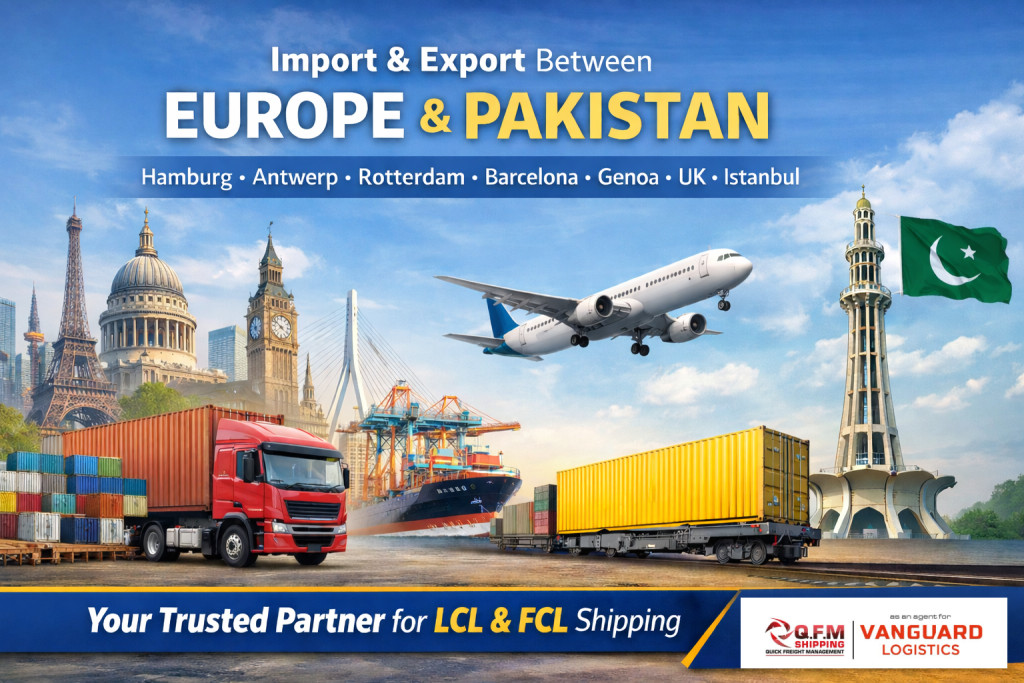
Moving cargo from Hamburg, Antwerp, Rotterdam, Barcelona, Genoa, UK ports, or Istanbul to Pakistan is not simply about booking freight. It is about controlling the process end-to-end.
This is where the role of a neutral, consolidation-focused logistics partner becomes critical—and where QFM Shipping operates in the value chain.
Europe Is Not One Shipping Market
Each European gateway functions differently:
-
Hamburg – industrial goods, machinery, components
-
Antwerp – LCL consolidation and multi-supplier cargo
-
Rotterdam – broad carrier coverage and routing flexibility
-
Barcelona – Southern Europe retail and consumer goods
-
Genoa – machinery, fittings, industrial exports
-
UK ports – strict post-Brexit documentation requirements
-
Istanbul – textiles, garments, and general cargo
A common failure point is treating Europe as a single origin. QFM Shipping’s role begins here—helping shippers align origin selection, consolidation strategy, and routing logic before cargo moves.
LCL vs FCL: Where QFM Shipping Adds Control
Choosing between LCL (Less-than-Container Load) and FCL (Full Container Load) is not only about volume—it is about operational risk.
LCL Shipments
LCL works best when:
-
Volumes are smaller
-
Multiple suppliers are involved
-
Regular shipment cycles are required
However, LCL only succeeds with disciplined consolidation.
QFM Shipping’s role in LCL:
-
Coordinating origin consolidation flows
-
Enforcing cargo labeling and documentation standards
-
Managing container build integrity
-
Ensuring clean handover at destination CFS
FCL Shipments
FCL is preferred when:
-
Cargo fills a full container
-
Reduced handling is critical
-
Cost predictability per container matters
QFM Shipping’s role in FCL:
-
Advising on container selection and routing
-
Monitoring documentation accuracy
-
Coordinating destination handling and release readiness
Documentation: The Biggest Risk QFM Shipping Helps Eliminate
Most Europe–Pakistan delays are documentation-driven, not vessel-driven.
Required documents typically include:
-
Commercial invoice
-
Packing list
-
Bill of lading
-
Certificate of origin (if applicable)
QFM Shipping’s role in documentation control:
-
Pre-shipment document checks
-
Alignment of invoice, packing list, and B/L data
-
Early identification of HS code or consignee mismatches
-
Reducing post-sailing amendments and penalties
This proactive document governance is where real cost savings occur.
Transshipment Is Normal—When Managed Correctly
Many Europe–Pakistan shipments move via transshipment hubs. This is not a weakness if planned properly.
Issues arise when:
-
Transit buffers are too tight
-
Carrier networks are unstable
-
Documentation triggers holds mid-route
QFM Shipping’s role here is not to promise “direct at any cost,” but to design routings that balance schedule reliability, cost, and operational risk.
Why Neutrality Matters in Multi-Party Supply Chains
Europe–Pakistan trade often involves:
-
Multiple suppliers
-
Buying agents
-
Overseas forwarders
-
Local customs and delivery stakeholders
In such setups, neutrality is essential.
QFM Shipping operates as a neutral Pakistan-based partner, which means:
-
No channel conflict with overseas agents
-
Secure handling of multi-supplier cargo
-
Process transparency for all stakeholders
-
Consolidation-led execution rather than sales-driven booking
This model is particularly effective for LCL and mixed cargo flows.
Common Mistakes QFM Shipping Helps Businesses Avoid
-
Selecting the cheapest quote without understanding inclusions
-
Poor cargo labeling and inaccurate measurements
-
Incoterms misunderstandings
-
Last-minute document corrections
-
Underestimating UK and EU compliance nuances
Each of these mistakes increases delay risk and landed cost.
Final Thought
Successful import and export from Europe to Pakistan is built on process discipline, not price alone.
QFM Shipping’s role is not simply to move cargo—but to structure, control, and de-risk the shipment lifecycle, from European origin through consolidation to final release in Pakistan.
In modern trade, predictability is the real competitive advantage.
Ready to explore collaboration opportunities? Reach out to our team to discuss your LCL needs, strategic partnerships, and custom routing options. Let’s build stronger, smarter logistics together.
Email: info@qfmshipping.com
Phone: +92-21-34540153 & 54
+92-21-34540135 & 36
Tags:
Import export Europe to Pakistan, Europe to Pakistan shipping, Hamburg to Karachi freight, Rotterdam to Pakistan cargo, Antwerp LCL consolidation, Barcelona Pakistan shipping, Genoa to Karachi logistics, UK to Pakistan freight forwarding, Istanbul to Pakistan shipping, LCL Europe Pakistan, FCL Europe Pakistan, neutral freight forwarder Pakistan, Europe Pakistan trade routes
