
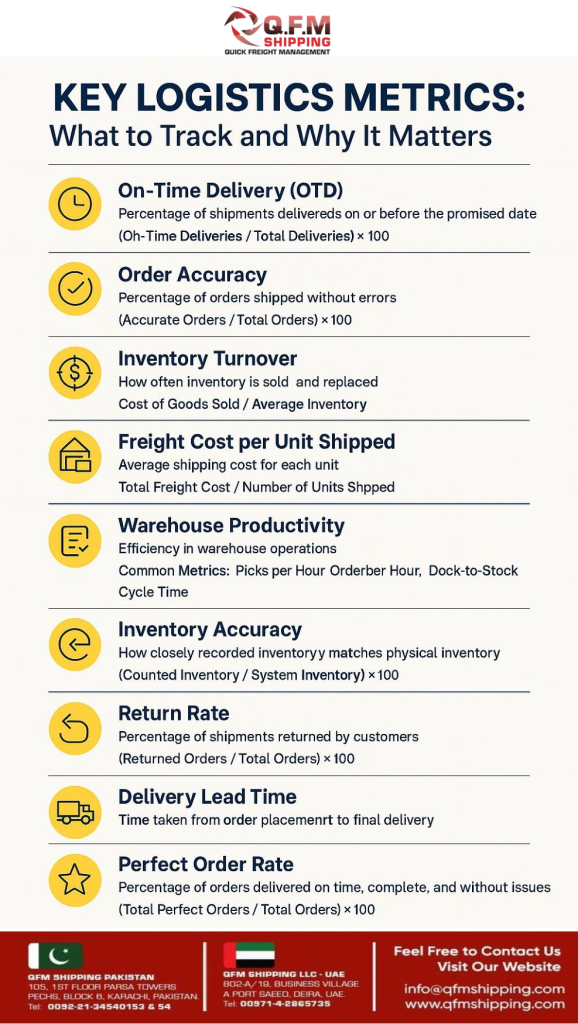
Key Logistics Metrics
In today’s competitive global market, logistics is more than just moving goods from point A to B—it’s a strategic function that directly impacts customer satisfaction, profitability, and operational efficiency. To ensure optimal performance, companies must track the right logistics metrics. But which ones matter most, and why?
This guide breaks down key logistics KPIs, explains their importance, and shows you how to leverage them for success.
1- On-Time Delivery (OTD)
What it measures:
The percentage of shipments delivered to customers on or before the promised date.
Why it matters:
OTD is one of the most critical indicators of customer satisfaction. A high OTD rate reflects reliability and efficiency, while delays can harm customer trust and retention.
Formula:
(On-Time Deliveries / Total Deliveries) x 100
2- Order Accuracy
What it measures:
The percentage of orders shipped without errors in quantity, item type, or documentation.
Why it matters:
Inaccurate orders lead to returns, increased costs, and unhappy customers. High accuracy rates signal a well-functioning warehouse and order management process.
Formula:
(Accurate Orders / Total Orders) x 100
3- Inventory Turnover
What it measures:
How often inventory is sold and replaced within a period (typically annually).
Why it matters:
High turnover means efficient inventory usage and less capital tied up in stock. Low turnover can signal overstocking or slow-moving items.
Formula:
Cost of Goods Sold / Average Inventory
4- Freight Cost per Unit Shipped
What it measures:
The average shipping cost for each unit (e.g., item, pallet, container).
Why it matters:
Monitoring this helps control logistics expenses and highlights opportunities to optimize transportation modes, carriers, and routes.
Formula:
Total Freight Cost / Number of Units Shipped
5- Warehouse Productivity
What it measures:
Efficiency in warehouse operations, such as picks per hour, orders packed per employee, or dock-to-stock time.
Why it matters:
Improved productivity translates into faster order fulfillment and reduced labor costs.
Common Metrics:
- Picks per Hour
- Orders Shipped per Labor Hour
- Dock-to-Stock Cycle Time
6- Inventory Accuracy
What it measures:
How closely recorded inventory matches physical inventory.
Why it matters:
Discrepancies can lead to stockouts, overstocking, and missed sales opportunities. High accuracy reduces write-offs and boosts customer service.
Formula:
(Counted Inventory / System Inventory) x 100
7- Return Rate
What it measures:
The percentage of shipments returned due to errors, defects, or dissatisfaction.
Why it matters:
A high return rate can indicate quality control issues, poor packaging, or incorrect picking. Reducing returns saves costs and improves customer satisfaction.
Formula:
(Returned Orders / Total Orders) x 100
8- Delivery Lead Time
What it measures:
The time taken from order placement to final delivery.
Why it matters:
Shorter lead times improve responsiveness and customer satisfaction. Tracking this metric helps identify delays in sourcing, processing, or shipping.
9- Perfect Order Rate
What it measures:
The percentage of orders delivered on time, complete, and without damage or errors.
Why it matters:
It combines multiple metrics into a single view of logistics performance and customer experience.
Formula:
(Total Perfect Orders / Total Orders) x 100
10- Transportation Utilization
What it measures:
The efficiency of transport space—whether you’re fully utilizing trucks, containers, or pallets.
Why it matters:
Better utilization reduces the number of trips and shipping costs, lowering your carbon footprint and improving margins.
Why Tracking These Metrics Matters
- Informed Decision-Making: Metrics give data-driven insights for continuous improvement.
- Cost Control: Tracking expenses like freight costs helps find savings opportunities.
- Customer Satisfaction: Delivering the right product on time builds trust and loyalty.
- Agility and Responsiveness: Metrics highlight bottlenecks, enabling faster fixes.
- Scalability: Robust logistics KPIs support sustainable growth as business expands.
Final Thoughts
Tracking logistics metrics isn’t just for large corporations. Whether you’re a small eCommerce startup or a multinational distributor, monitoring the right KPIs can dramatically improve your efficiency, costs, and customer service. Focus on the metrics that align with your goals, and use them to drive smart, strategic decisions across your supply chain.
Getting Started is Easy
Ready to simplify your shipping? Contact us today for a free consultation and a custom quote. Our team is ready to design a logistics plan that will save you time, reduce costs, and give you peace of mind.
Contact Us:
- Email: info@qfmshipping.com
- Website: www.qfmshipping.com
