
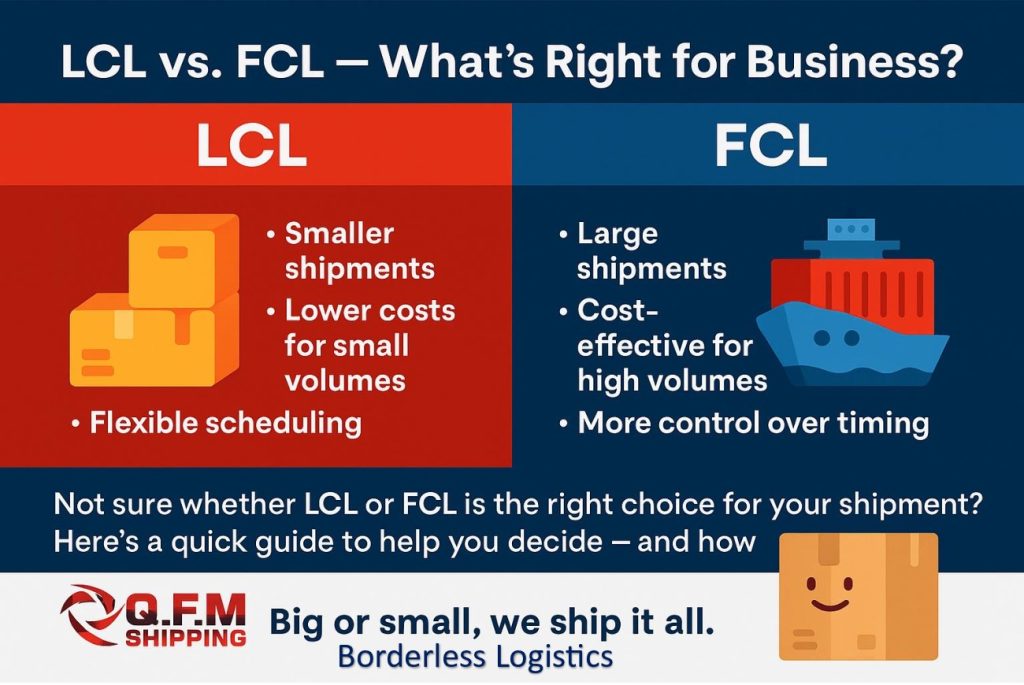
Shipping is an important aspect of any business that deals with the movement of goods, whether domestically or internationally. Understanding the different shipping options available is crucial for cost-effectiveness, efficiency, and timely delivery. Two common terms you’ll encounter in the world of freight are LCL (Less than Container Load) and FCL (Full Container Load). Choosing between these two can significantly impact your logistics operations. Let’s delve into a detailed comparison to help you determine what’s right for your business.
What is LCL (Less than Container Load)?
LCL shipping involves consolidating multiple smaller shipments from different shippers into one container. This means your goods will share container space with other businesses’ cargo. Once the container reaches its destination, the shipments are deconsolidated, and each business receives its respective goods. Think of it like a shared taxi service for your freight.
When to Choose LCL:
- Small Shipment Volumes: LCL is ideal when your shipment isn’t large enough to fill an entire container. If you’re shipping a few pallets, boxes, or smaller quantities, LCL allows you to pay only for the space your goods occupy.
- Cost-Effective for Smaller Quantities: For smaller volumes, LCL is generally more cost-effective than paying for a full container that you won’t utilize completely. You’re essentially sharing the cost of the container.
- Flexibility: LCL offers greater flexibility in terms of shipment frequency. You can ship smaller quantities more often without having to wait until you have enough cargo to fill a container.
- Trial Shipments and New Markets: If you’re testing a new market or making smaller, trial shipments, LCL provides a less risky and more affordable option.
Advantages of LCL:
- Lower Cost for Small Volumes: You only pay for the space used.
- Flexibility in Shipment Size and Frequency: Ship what you need, when you need it.
- Access to Global Trade: Makes international shipping feasible for small to medium-sized businesses.
Disadvantages of LCL:
- Longer Transit Times: LCL shipments typically take longer due to the consolidation and deconsolidation processes at origin and destination ports.
- Higher Risk of Damage: With multiple handling stages involved, there’s a slightly higher risk of damage or loss compared to FCL.
- More Complex Documentation: While you’re shipping less cargo, the overall documentation process can still be somewhat intricate due to the consolidated nature of the shipment.
- Potential for Delays: The consolidation and deconsolidation processes can introduce potential delays.
What is FCL (Full Container Load)?
FCL shipping means you’re paying for the exclusive use of an entire shipping container. Your goods will be the only cargo inside the container, regardless of whether you fill it to capacity or not. This is like hiring a private car for your freight.
When to Choose FCL:
- Large Shipment Volumes: If you have enough cargo to fill a significant portion or the entirety of a container (typically 10-12 pallets or more, depending on size), FCL is usually the more economical option.
- Time-Sensitive Shipments: FCL generally offers faster transit times because your container goes directly from the origin to the destination without the need for consolidation or deconsolidation.
- High-Value or Fragile Goods: With less handling involved, FCL reduces the risk of damage or loss, making it a preferred choice for valuable or delicate items.
- Greater Control and Security: You have more control over the loading and unloading process, and the sealed container offers enhanced security for your goods.
Advantages of FCL:
- Faster Transit Times: Direct shipment reduces delays associated with consolidation and deconsolidation.
- Lower Risk of Damage: Less handling minimizes the potential for damage or loss.
- Simplified Documentation: Compared to managing multiple LCL shipments, a single FCL shipment can have simpler documentation.
- Enhanced Security: The container is sealed at the origin and opened at the destination.
- Potentially Lower Cost per Unit: For large volumes, the cost per unit shipped can be lower with FCL.
Disadvantages of FCL:
- Higher Cost for Smaller Volumes: If you don’t have enough cargo to fill a container, FCL can be significantly more expensive than LCL. You’re paying for unused space.
- Less Flexibility: You need to have enough cargo to justify filling a container. Smaller, more frequent shipments might not be cost-effective with FCL.
- Potential for Empty Space Costs: If your cargo doesn’t completely fill the container, you’re still paying for the empty space.
LCL vs. FCL: A Side-by-Side Comparison
| Feature | LCL (Less than Container Load) | FCL (Full Container Load) |
| Shipment Size | Smaller volumes | Larger volumes |
| Cost | Lower for small quantities | Potentially lower per unit for large quantities, higher overall for small |
| Transit Time | Longer | Shorter |
| Risk of Damage | Higher | Lower |
| Handling | More handling stages | Less handling stages |
| Documentation | Can be complex | Generally simpler |
| Flexibility | Higher | Lower |
| Security | Generally lower | Higher |
Export to Sheets
Choosing What’s Right for Your Business
The decision between LCL and FCL ultimately depends on several factors specific to your business and the shipment in question:
- Volume and Weight of Goods: This is the primary determining factor.
- Budget: Compare the costs of both options, including freight charges, handling fees, and other associated expenses.
- Time Sensitivity: How quickly do your goods need to reach their destination?
- Nature of Goods: Are your goods fragile, high-value, or require special handling?
- Supply Chain Needs: Consider your overall inventory management and order fulfillment processes.
QFM Shipping: Your Reliable Partner, Big or Small
At QFM Shipping, we understand that every business has unique shipping needs. Whether you’re shipping a few boxes or multiple full container loads, we offer reliable and efficient solutions tailored to your requirements. Our expert team can help you analyze your shipment details and determine the most cost-effective and suitable option, be it LCL or FCL. We ensure smooth handling, transparent communication, and timely delivery, no matter the volume.
Conclusion
Understanding the differences between LCL and FCL shipping is essential for making informed decisions that impact your bottom line and supply chain efficiency. By carefully evaluating your shipment characteristics and business needs, you can choose the option that best aligns with your goals. And with a trusted partner like QFM Shipping, you can be confident that your goods, big or small, will reach their destination safely and on time.
