
What Is MCC (Multi-Country Consolidation) in Logistics and How QFM Shipping Connects Pakistan to the World
Why MCC in Logistics Is Gaining Global Importance
Global supply chains have shifted dramatically over the last decade. Manufacturers, traders, and SMEs increasingly source, produce, and ship goods from multiple countries at once, yet still expect predictable transit times, controlled costs, and transparent operations. This shift has accelerated the adoption of MCC in logistics, a model designed to consolidate cargo from multiple origins into a single, optimized shipment.
For exporters in emerging markets—particularly in South Asia—MCC in logistics offers a way to compete globally without committing to full-container volumes. Pakistan, with its growing textile, surgical, leather, and industrial export base, is uniquely positioned to benefit from this model. This is where QFM Shipping plays a strategic role, enabling exporters and freight forwarders to connect Pakistan to global markets through structured, neutral MCC services.
What Is MCC in Logistics?
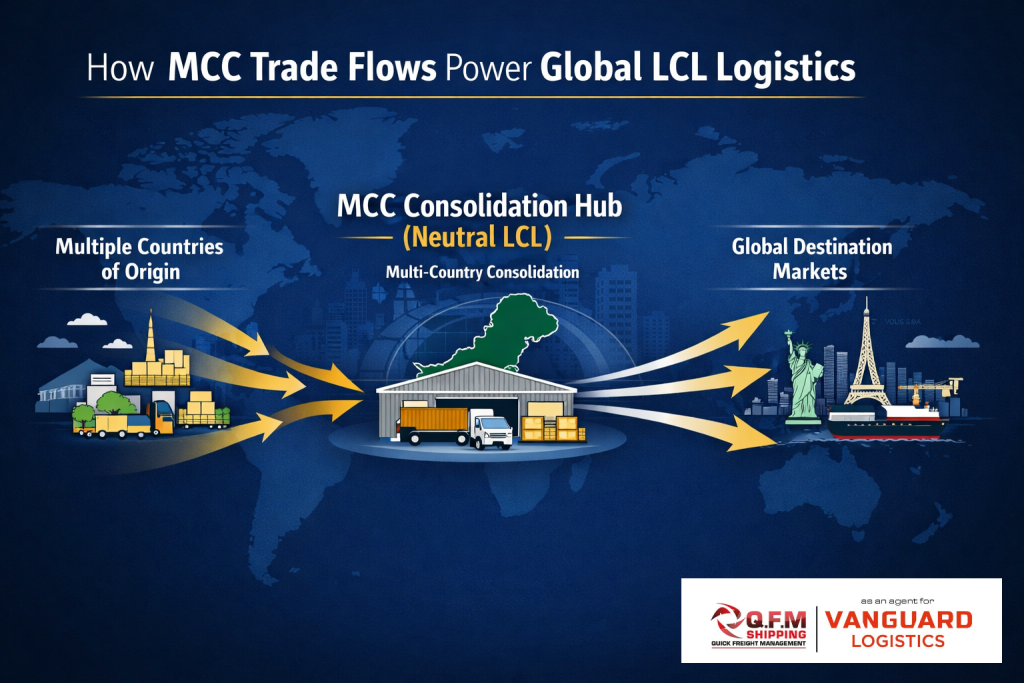
MCC in logistics (Multi-Country Consolidation) is a freight strategy in which less-than-container-load (LCL) cargo from multiple origin countries is consolidated into a single container at a designated hub and shipped to the destination as one coordinated movement.
Unlike traditional LCL, which usually consolidates cargo from a single country, MCC in logistics combines shipments across regions—Asia, South Asia, the Middle East, or Europe—before onward transportation.
Core Elements of MCC in Logistics
-
Multiple countries of origin
-
Centralized consolidation hubs (CFS)
-
Neutral cargo handling
-
Optimized container utilization
-
Single destination or distribution market
This approach reduces fragmentation, lowers per-unit costs, and improves reliability across complex trade lanes.
How MCC in Logistics Differs from Traditional LCL
While MCC in logistics builds on the LCL concept, the operational design is significantly more advanced.
| Feature | Traditional LCL | MCC in Logistics |
|---|---|---|
| Origins | One country | Multiple countries |
| Consolidation | Local CFS | Regional / global hubs |
| Cost efficiency | Moderate | High |
| Frequency | Limited | Higher |
| Best use case | Simple exports | Global sourcing & SMEs |
MCC in logistics is especially valuable for importers and distributors who source from several countries but want a single arrival schedule and unified cost structure.
Why MCC in Logistics Matters in Today’s Supply Chains
1. Cost Optimization
MCC in logistics maximizes container utilization, reducing the cost per cubic meter compared to fragmented LCL shipments.
2. Increased Sailing Frequency
By pooling cargo from multiple origins, MCC shipments achieve more frequent departures, even on secondary trade lanes.
3. Reduced Supply Chain Complexity
Instead of managing multiple shipments from different countries, importers receive one consolidated delivery.
4. Greater Market Access for SMEs
Small and mid-sized exporters gain access to global markets without the burden of FCL volumes.
Pakistan’s Strategic Role in MCC in Logistics
Pakistan has emerged as a competitive export hub for:
-
Textiles and apparel
-
Surgical instruments
-
Sports goods
-
Leather products
-
Industrial components
However, many exporters ship small but frequent volumes, making MCC in logistics an ideal solution. By aggregating Pakistan-origin cargo with shipments from other countries, MCC programs ensure:
-
Predictable schedules
-
Lower landed costs
-
Reliable access to Europe, North America, and Asia-Pacific
How QFM Shipping Delivers MCC in Logistics from Pakistan
Neutral LCL Consolidation Model
QFM Shipping operates as a neutral LCL consolidator, meaning it does not compete with freight forwarders or exporters. Neutrality is essential in MCC in logistics, where cargo from competing parties is consolidated into the same container.
This model ensures:
-
Data confidentiality
-
Transparent pricing
-
Long-term partner trust
Strategic Global Hub Integration
Through an extensive international partner network, QFM Shipping connects Pakistan-origin cargo into global MCC hubs, where shipments from multiple countries are consolidated before onward movement.
These hubs enable:
-
Multi-origin intake
-
Professional cargo segregation
-
Efficient deconsolidation at destination
End-to-End MCC Execution
QFM Shipping manages the full MCC in logistics lifecycle:
-
Cargo intake at origin CFS
-
Documentation and compliance checks
-
Multi-country consolidation at hub
-
Ocean freight coordination
-
Destination deconsolidation and distribution
This integrated approach minimizes delays and reduces handling risks.
Key MCC Trade Corridors Supported
QFM Shipping supports MCC in logistics across major global corridors, including:
-
South Asia → Europe
-
South Asia → USA (East & West Coast)
-
South Asia → Asia-Pacific
-
Multi-Origin Asia → Single Destination Markets
These corridors are designed to support exporters, importers, and freight forwarders seeking stable, repeatable MCC solutions.
Operational Advantages of MCC with QFM Shipping
Weekly and Fixed Sailings
Regular MCC departures ensure supply chain predictability, even during peak seasons.
Controlled Cut-Off Management
Standardized cut-offs across origins reduce missed sailings and documentation errors.
Reduced Transit Variability
Centralized hub consolidation minimizes delays caused by fragmented routing.
End-to-End Visibility
Consistent tracking and reporting provide transparency across all MCC movements.
MCC in Logistics and the Role of Neutrality
Neutrality is a defining success factor in MCC in logistics. Without a neutral consolidator, freight forwarders risk losing clients or sensitive commercial data. QFM Shipping’s neutral positioning ensures:
-
Fair cargo allocation
-
No preferential treatment
-
Long-term collaboration across markets
This makes MCC programs scalable and sustainable.
MCC vs FCL: When Does MCC Make More Sense?
MCC in logistics is particularly advantageous when:
-
Shipments originate from multiple countries
-
Volumes are below FCL thresholds
-
Importers require synchronized arrivals
-
Cost efficiency outweighs speed-only considerations
For many global buyers, MCC bridges the gap between fragmented LCL and rigid FCL structures.
The Future of MCC in Logistics
As global sourcing continues to diversify, MCC in logistics will become a standard operating model rather than a niche solution. Digital visibility tools, advanced CFS operations, and neutral global networks will define the next phase of consolidation.
Pakistan’s exporters are well-positioned to benefit from this shift—especially when supported by experienced neutral consolidators like QFM Shipping.
Conclusion: MCC in Logistics as a Competitive Advantage
MCC in logistics is no longer optional for businesses operating across multiple sourcing markets. It is a strategic enabler that delivers cost efficiency, operational reliability, and global reach.
By positioning Pakistan as a key MCC origin and integrating it into global consolidation hubs, QFM Shipping enables exporters and freight forwarders to access world markets with confidence, transparency, and scalability.
For businesses seeking a future-ready logistics strategy, MCC in logistics—executed through a neutral partner—offers a clear competitive advantage.
Tags:
MCC in logistics, Multi-country consolidation, MCC shipping, LCL consolidation, neutral LCL consolidator, global LCL services, Pakistan LCL exports, freight consolidation hubs
