
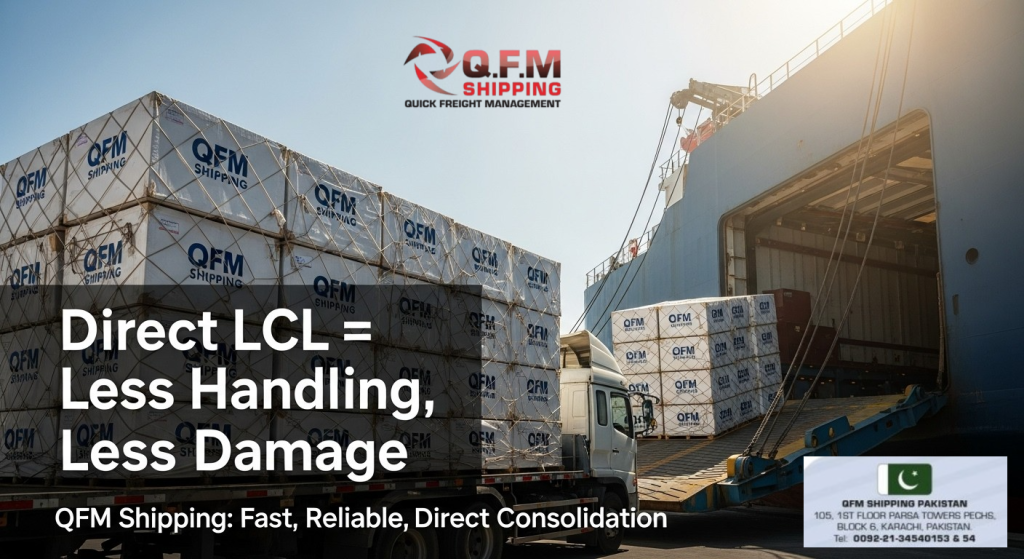
Minimizing Cargo Damage | Why Direct LCL Means Less Handling
QFM Shipping Direct Consolidation Network
The Problem No One Likes to Admit: Damage Loves “Extra Touches”
Every extra lift, restack, or transfer in logistics increases the risk of freight damage. Traditional LCL (Less-than-Container Load) services often route shipments through multiple hubs, leading to repetitive CFS loading, transshipment, and deconsolidation. Each stage means forklifts, spreaders, and human handling—amplifying the chance of crushed cartons, dented drums, or lost labels.
QFM Shipping’s Direct LCL network changes that equation. By offering non-stop lanes—such as Karachi–Jebel Ali (bi-weekly), Shanghai–Karachi, and Antwerp–Karachi—QFM Shipping minimizes the handling cycle to just two main events: consolidation at origin and deconsolidation at destination.
Less touches = Less risks = Lower claims.
Why Less Touchpoints Matter
In freight logistics, damage probability multiplies with handling frequency. A typical hub-based LCL route involves 5–8 handlings, while QFM Shipping direct LCL routes require only 2–4.
| Risk Factor | Traditional LCL | QFM Direct LCL |
|---|---|---|
| Handling events | 5–8 | 2–4 |
| Cargo exposure | High | Minimal |
| Transit time | Delayed at hubs | Fast and direct |
| Misrouting chances | Common | Nearly eliminated |
| Claim ratio | High | Significantly reduced |
With QFM Shipping direct LCL network, there’s no intermediate re-stacking or re-labeling between ports—cargo stays sealed and secured throughout the voyage.
QFM Shipping Advantages | Engineered for Cargo Safety
1. Direct Lane Infrastructure
QFM Shipping growing portfolio of direct LCL routes (Karachi ↔ Jebel Ali, Shanghai → Karachi, Antwerp → Karachi, Singapore → Karachi, etc.) eliminates middle-hub delays and unnecessary cargo exposure. Each container moves on a single Bill of Lading, ensuring smooth customs flow and predictable ETAs.
2. Bi-Weekly and Weekly Schedules
Frequent departures mean less warehouse dwell time. Faster consolidation and shorter waiting windows reduce packaging fatigue and moisture risk—especially important in tropical and coastal climates.
3. Optimized CFS Operations
QFM Shipping operates dedicated CFS yards in Karachi and Jebel Ali with strict pallet integrity checks, cargo photos on receipt, and layered stacking plans to ensure every cubic meter is secure before sealing.
4. Damage-Prevention Protocols
QFM Shipping enforces ISPM-15 pallet compliance, corner-guard policies, and void-fill requirements for fragile goods. Each container load is digitally mapped, minimizing cargo movement during voyage vibration.
5. End-to-End Tracking
QFM Shipping digital tracking suite offers milestone updates—CFS-in, loaded, sailed, arrived, devanned—so shippers can monitor cargo safety at every stage, without needing to chase multiple agents.
6. Customer-Centric Claims Management
In the rare case of a claim, QFM Shipping’s centralized documentation system links photographic evidence, condition reports, and tally sheets—streamlining verification and reducing dispute cycles.
Case Example: Karachi–Jebel Ali (Bi-Weekly Miracle)
-
Transit Time: 2–3 days at sea
-
Touchpoints: 2 (load and unload only)
-
Average claim reduction: up to 45% versus hub-based routing
-
Reliability: >95% on-time departure record
This short-sea route exemplifies QFM Shipping’s “Fast. Reliable. Global.” mission—delivering direct sailings that rival air freight in predictability while maintaining sea freight cost efficiency.
Packaging Still Matters — Partnering with QFM Shipping Enhances It
Even the safest routing benefits from good preparation. QFM encourages shippers to follow these practices:
-
Use strong corrugated cartons (ECT-44+) for stack stability.
-
Shrink-wrap pallets tightly with corner boards and top sheets.
-
Add tilt indicators, shock labels, and humidity cards for high-value or moisture-sensitive goods.
-
Label clearly on all sides with SKU, PO, and carton numbers.
At QFM Shipping CFS, each pallet undergoes visual inspection and condition photography before loading, giving you proof-of-care documentation right from the origin.
Comparative Example: Shanghai–Karachi Direct LCL vs. Multi-Hub Route
| Aspect | Multi-Hub Route | QFM Direct Route |
|---|---|---|
| Handling Points | 7 | 3 |
| Average Transit | 28–35 days | 18–21 days |
| Damage Probability | Moderate to High | Very Low |
| Claim Ratio | 4.2% | 1.1% |
| Visibility | Fragmented | Continuous milestone tracking |
The difference isn’t just in transit time—it’s in the condition of arrival, which directly impacts resale value, claim costs, and customer satisfaction.
When You Ship with QFM Shipping, You Ship with Confidence
Every QFM Shipping lane is designed around minimized handling, maximized reliability, and transparent tracking. Whether you’re moving industrial machinery, FMCG, electronics, or retail inventory, direct LCL consolidation delivers both operational peace of mind and financial savings through:
-
Reduced rework, repacking, and returns
-
Fewer insurance claims
-
Quicker customs clearance
-
Lower detention/demurrage exposure
-
Stronger reputation with end customers
The Bottom Line: QFM Shipping Direct LCL = Less Touches, Less Losses
In logistics, control equals care. QFM Shipping Direct LCL services eliminate unnecessary handovers, safeguard your cargo through shorter transit and optimized stowage, and give you digital visibility at every stage.
That’s how QFM Shipping turns freight management into damage prevention.
Key Takeaways
-
Each extra handling increases damage risk—QFM Shipping cuts them by half or more.
-
QFM Shipping direct, scheduled LCL lanes (Karachi–Jebel Ali, Shanghai–Karachi, Antwerp–Karachi) ensure faster, cleaner deliveries.
-
CFS quality control + real-time tracking = verifiable cargo safety.
-
The result: lower claims, higher reliability, and happier customers.
Book Your Space Today
Contact Us:
Email: info@qfmshipping.com
Phone: +92-21-34540153 & 54
+92-21-34540135 & 36
Website: www.qfmshipping.com
Tags:
QFMShipping, DirectLCL, CargoDamagePrevention, LessHandling, LCLConsolidation, ShippingPakistan, LogisticsDubai, GlobalTrade, FastReliableGlobal,
