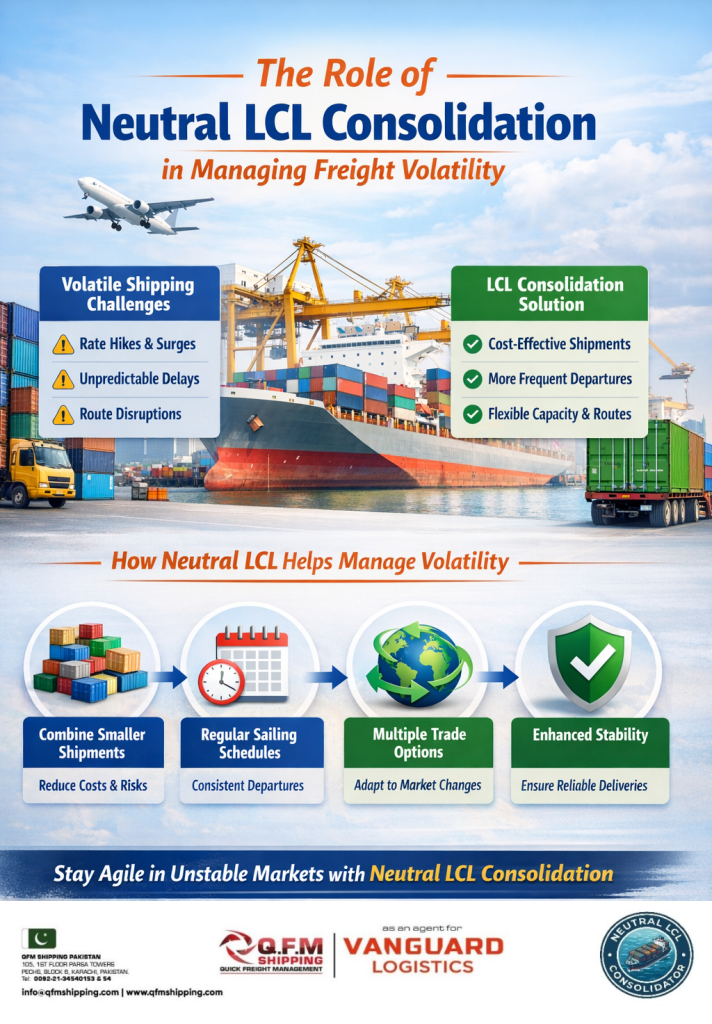
The Role of Neutral LCL Consolidation in Managing Freight Volatility
Global shipping has entered a new era—one defined by disruption, unpredictability, and constant change. From geopolitical tensions and war risk surcharges to port congestion and fluctuating freight rates, exporters are navigating one of the most volatile logistics environments in decades.
In this challenging landscape, neutral LCL consolidation has emerged as one of the most effective strategies for managing uncertainty. Exporters who understand and adopt neutral LCL consolidation are gaining a competitive edge by improving flexibility, reducing costs, and strengthening supply chain resilience.
For businesses working with QFM Shipping Pakistan, neutral LCL consolidation is not just a shipping method—it is a strategic advantage.
Understanding Freight Volatility in Today’s Market
Before diving into the role of neutral LCL consolidation, it is essential to understand the forces driving freight volatility.
🔹 Key Drivers of Freight Volatility
-
Freight Rate Fluctuations
Rates can surge dramatically due to demand spikes, fuel costs, or capacity shortages. -
Geopolitical Instability
Conflicts in key regions impact shipping routes, insurance costs, and transit times. -
Port Congestion
Major ports frequently experience delays due to increased global trade volumes. -
Blank Sailings & Capacity Cuts
Shipping lines reduce sailings to manage supply, causing unpredictability. -
Regulatory Changes
New compliance requirements can affect shipping timelines and costs.
In such conditions, traditional logistics strategies often fail. Exporters relying on full container loads (FCL) or fixed routes struggle to adapt quickly.
This is where neutral LCL consolidation becomes critical.
What Is Neutral LCL Consolidation?
Neutral LCL consolidation refers to the process of combining multiple smaller shipments from different exporters into a single container—managed by a neutral consolidator who does not compete with freight forwarders.
This neutrality ensures:
-
Confidentiality of shipments
-
Equal access for multiple forwarders
-
Professional consolidation handling
-
Optimized container utilization
With neutral LCL consolidation, exporters can ship smaller volumes without waiting to fill an entire container, making logistics more agile and efficient.
Why Neutral LCL Consolidation Matters More Than Ever
In volatile markets, flexibility and control are essential. Neutral LCL consolidation provides both.
🔹 1. Flexibility in Shipment Planning
One of the biggest advantages of neutral LCL consolidation is flexibility.
Exporters can:
-
Ship smaller quantities more frequently
-
Adjust shipment schedules based on demand
-
Avoid delays caused by waiting for full container loads
This flexibility allows businesses to respond quickly to market changes—an essential capability in today’s environment.
🔹 2. Cost Efficiency Without Compromise
Freight volatility often leads to rising costs. However, neutral LCL consolidation helps exporters control expenses by:
-
Sharing container space with other shipments
-
Reducing unused capacity costs
-
Minimizing inventory holding expenses
Instead of paying for an entire container, exporters pay only for the space they use—making neutral LCL consolidation a highly cost-effective solution.
🔹 3. Improved Supply Chain Resilience
Resilience is the defining factor of successful exporters today.
Neutral LCL consolidation enhances resilience by:
-
Offering multiple routing options
-
Reducing dependency on a single shipping mode
-
Ensuring consistent shipment flow
By working with QFM Shipping Pakistan, exporters gain access to reliable consolidation schedules that keep goods moving even during disruptions.
🔹 4. Consistent and Reliable Shipping Schedules
Unpredictability is one of the biggest challenges in global logistics.
With neutral LCL consolidation, exporters benefit from:
-
Regular sailing schedules
-
Structured consolidation planning
-
Reduced risk of shipment delays
Consistency allows businesses to plan better, meet customer expectations, and maintain operational efficiency.
🔹 5. Risk Mitigation in Uncertain Markets
Freight volatility introduces multiple risks:
-
Delays
-
Cost overruns
-
Route disruptions
Neutral LCL consolidation mitigates these risks by:
-
Diversifying shipment options
-
Providing flexible routing
-
Ensuring better cargo management
This makes it a key component of any exporter logistics strategy.
The Strategic Role of QFM Shipping Pakistan
When it comes to implementing neutral LCL consolidation, the choice of logistics partner is critical.
QFM Shipping Pakistan, as an exclusive agent of Vanguard Logistics, offers industry-leading expertise in neutral LCL consolidation.
🔹 1. Strong Global Network
QFM Shipping Pakistan connects exporters to key global trade routes, including:
-
Karachi to China
-
Karachi to Europe (Hamburg)
-
Karachi to Turkey (Istanbul)
-
GCC to Pakistan (Jebel Ali, Oman)
-
Southeast Asia to Pakistan (Singapore)
This extensive network enhances the effectiveness of neutral LCL consolidation, allowing exporters to maintain continuity even during disruptions.
🔹 2. Expertise in Consolidation Management
QFM Shipping Pakistan specializes in:
-
Efficient cargo consolidation
-
Professional handling of multiple shipments
-
Optimized container utilization
Their expertise ensures that neutral LCL consolidation delivers maximum value to exporters.
🔹 3. Neutral and Transparent Operations
Neutrality is a key advantage of QFM Shipping Pakistan.
This ensures:
-
Confidential handling of shipments
-
Equal service access for all partners
-
Transparent logistics processes
Such neutrality builds trust and strengthens long-term partnerships.
🔹 4. Reliable Scheduling and Execution
QFM Shipping Pakistan provides:
-
Consistent consolidation schedules
-
Reliable transit timelines
-
Efficient cargo handling
This reliability is essential for businesses relying on neutral LCL consolidation to maintain supply chain stability.
Real-World Benefits of Neutral LCL Consolidation
Let’s look at how exporters benefit in practical terms:
✔ Faster Market Response
Ship smaller quantities more frequently to meet changing demand.
✔ Reduced Inventory Pressure
Avoid overstocking by shipping only what is needed.
✔ Better Cash Flow
Lower upfront logistics costs improve financial flexibility.
✔ Improved Customer Satisfaction
Consistent delivery timelines enhance reliability.
✔ Competitive Advantage
Adapt quickly to market changes while competitors struggle.
Neutral LCL vs Traditional Shipping Models
| Factor | Neutral LCL Consolidation | Traditional FCL |
|---|---|---|
| Flexibility | High | Low |
| Cost Efficiency | Optimized | Higher for small volumes |
| Risk Exposure | Lower | Higher |
| Shipment Frequency | Frequent | Limited |
| Adaptability | Strong | Weak |
This comparison clearly shows why neutral LCL consolidation is becoming the preferred choice for modern exporters.
The Future of Freight: Why LCL Is Becoming Strategic
The global logistics landscape is evolving rapidly.
Key trends include:
-
Increased demand for flexible shipping
-
Growth in e-commerce exports
-
Rising focus on supply chain resilience
-
Shift toward smaller, frequent shipments
In this context, neutral LCL consolidation is no longer just an option—it is a strategic necessity.
How Exporters Can Leverage Neutral LCL Consolidation
To maximize the benefits of neutral LCL consolidation, exporters should:
🔹 Partner with a Reliable Consolidator
Choose experienced providers like QFM Shipping Pakistan.
🔹 Diversify Shipping Routes
Avoid dependency on a single trade lane.
🔹 Optimize Shipment Planning
Use data-driven strategies for better logistics decisions.
🔹 Focus on Long-Term Efficiency
Prioritize reliability and flexibility over short-term cost savings.
Final Thoughts: Turning Volatility into Opportunity
Freight volatility is not going away—it is becoming the new normal.
Exporters who continue using outdated logistics models will struggle to keep up. Those who adopt neutral LCL consolidation will gain flexibility, control, and resilience.
By partnering with QFM Shipping Pakistan, businesses can transform logistics challenges into strategic advantages.
🔷 Call to Action
Ready to take control of your logistics in a volatile market?
Partner with QFM Shipping Pakistan and leverage the power of neutral LCL consolidation to:
✔ Reduce risk
✔ Improve flexibility
✔ Optimize costs
✔ Strengthen your supply chain
Contact QFM Shipping Pakistan today
Move smarter. Ship with confidence.
Tags:
neutral LCL consolidation, freight volatility solutions, LCL shipping Pakistan, supply chain risk management, exporter logistics strategy, QFM Shipping Pakistan, flexible freight solutions
