Neutral LCL Consolidation in Pakistan What & Why
What Is Neutral LCL Consolidation—and Why It Matters in Pakistan
In the freight forwarding ecosystem, LCL (Less-than-Container Load) is often the most practical choice for small and mid-sized shippers who do not have enough cargo to fill a full container. But LCL also introduces complexity: cargo must be collected from multiple shippers, consolidated into a single container, moved across borders, then deconsolidated and delivered to multiple consignees.
This is where the concept of neutral LCL consolidation becomes important—especially in Pakistan, where exporters and importers rely heavily on dependable, cost-effective freight options, and where forwarders need trusted partners that do not compete for their customers.
This article explains what neutral LCL consolidation is, how it works, and why it matters in Pakistan for freight forwarders, exporters, importers, and international network partners.
Understanding LCL Consolidation in Simple Terms
An LCL shipment is cargo that shares space in a container with other shippers’ cargo. Instead of booking one full container (FCL), the shipper pays for space (usually measured by volume or weight). Because LCL involves multiple parties inside one container, it requires a specialist workflow:
-
Cargo is received at a CFS (Container Freight Station) or warehouse
-
Multiple shipments are stuffed (consolidated) into one container
-
The container moves via ocean freight (often with transshipment)
-
At destination, the container is stripped (deconsolidated)
-
Each shipment is released and delivered to its consignee
This process is coordination-heavy. The quality of consolidation has a direct impact on:
-
transit reliability
-
documentation accuracy
-
cargo integrity and claims risk
-
customer satisfaction
-
overall forwarding profitability
What “Neutral” Means in Neutral LCL Consolidation
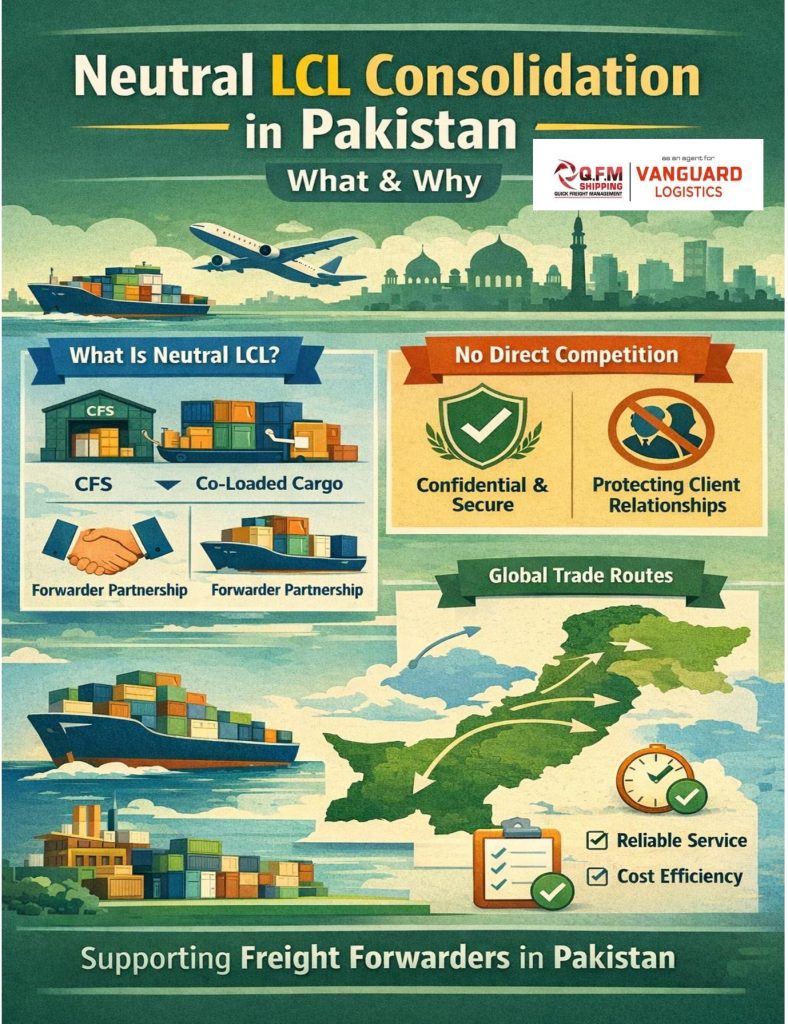
A neutral LCL consolidator is a consolidation provider that works with freight forwarders and does not compete with them by approaching their customers directly.
Neutrality typically means:
-
No customer poaching (the consolidator does not solicit the forwarder’s shipper/consignee)
-
Forwarder-first operating model (service structure designed for forwarding partners)
-
Brand protection (shipments and communications can be handled in a way that preserves the forwarder’s customer relationship)
-
Confidential handling (rates, customer names, routing, and commercial details are treated carefully)
In short: a neutral consolidator is an enabling partner—not a competitor.
How Neutral LCL Consolidation Works Operationally
A mature neutral LCL model usually includes the following operational components:
1) Origin Receiving & CFS Operations
Shipments arrive at an origin warehouse/CFS under controlled processes:
-
cargo receiving checks (packing condition, marks, dimensions)
-
measurement and weighing
-
segregation by destination and cut-off
-
labeling and staging for consolidation
2) Consolidation Planning
Cargo is planned into containers by:
-
destination port (direct or via hub)
-
sailing schedules and carrier allocations
-
compatibility (DG restrictions, commodity rules, special handling)
-
space optimization and load security
3) Documentation & Compliance
LCL’s documentation demands are higher than many realize. Quality consolidation relies on:
-
correct HBL/MBL structure
-
cargo descriptions aligned with commodity and customs requirements
-
cut-off discipline for VGM and SI
-
tight coordination with forwarders to avoid amendments and delays
4) Destination Deconsolidation & Last-Mile Release
At destination:
-
container is stripped at destination CFS
-
shipments are separated and manifested
-
customs release and CFS handling follow local rules
-
forwarder (or nominated agent) manages delivery and consignee coordination
Why Neutral LCL Consolidation Matters in Pakistan
Pakistan’s trade environment makes neutrality especially valuable. Here are the core reasons.
1) Pakistan’s Export Base Often Ships in Smaller Lots
Many Pakistani exporters—particularly in:
-
textiles and apparel
-
leather goods
-
sports goods
-
surgical instruments
-
home textiles and towels
-
small industrial parts
…ship in frequent, smaller volumes, especially when fulfilling diverse purchase orders and seasonal demand. LCL becomes a natural fit, but only if it is consistent and professionally managed.
Neutral LCL consolidation provides forwarders with a stable way to serve SME exporters without forcing them into FCL economics.
2) Forwarders Need Customer Relationship Protection
Pakistan’s forwarding market is relationship-driven. Forwarders build trust over years—often with exporters who depend on them for:
-
booking decisions
-
routing guidance
-
documentation advice
-
cross-border problem-solving
If a consolidator is not neutral, it can create anxiety: forwarders may fear their customer data will be used to compete with them. A neutral consolidator removes that friction and encourages long-term partnership.
3) Service Reliability Is a Competitive Advantage (Not a Luxury)
Pakistan-bound and Pakistan-origin LCL can face challenges such as:
-
volatile cut-offs
-
port congestion cycles
-
feeder/transshipment variability
-
documentation bottlenecks
-
uneven CFS quality standards across markets
A neutral consolidator with disciplined processes helps forwarders deliver reliability—one of the few sustainable differentiators in a price-sensitive market.
4) Better Consolidation Improves Cost Control for Forwarders and Shippers
A strong consolidation program can reduce total landed cost through:
-
better space optimization (lower per-CBM cost)
-
fewer rollovers and rework events
-
reduced documentation corrections and amendment fees
-
fewer claims caused by poor load planning
-
improved predictability (less buffer cost and firefighting)
In Pakistan, where margins are often tight, predictability is a major financial benefit.
5) Multi-Origin and Hub Routing Expands Options
Pakistan’s trade patterns often require routing flexibility:
-
Pakistan–Europe lanes through hubs
-
Pakistan–USA lanes via transshipment points
-
Asia-Pacific inbound lanes with multiple origins
-
multi-country sourcing for importers consolidating purchase orders
Neutral LCL consolidation supports multi-origin planning, enabling forwarders to offer broader coverage without building their own global CFS infrastructure.
Who Benefits Most From Neutral LCL Consolidation?
Freight Forwarders
Forwarders gain:
-
scalable LCL product without owning consolidation infrastructure
-
reliable schedules and operational support
-
protected customer relationships
-
reduced exception management
Exporters (Shippers)
Exporters benefit from:
-
cost-effective shipping for smaller volumes
-
better access to global markets
-
predictable cut-offs and transit planning
-
fewer delays due to documentation issues
Importers (Consignees)
Importers benefit from:
-
smoother inbound supply chains for mixed suppliers
-
manageable inventory replenishment
-
reduced demurrage and storage risks due to delays
Overseas Network Partners
International agents and networks gain:
-
a trusted Pakistan-side consolidation partner
-
consistent SOPs and communication
-
improved end-to-end service quality
Neutral vs Non-Neutral Consolidation: Key Differences
Neutral Consolidator
-
works through forwarders
-
avoids direct commercial engagement with shipper/consignee
-
designs processes for forwarding partners
-
prioritizes confidentiality and repeatability
Non-Neutral / Forwarder-Consolidator
-
may service forwarders but also sells directly
-
can create channel conflict
-
may push its own brand into the customer relationship
-
can reduce forwarder confidence over time
For many forwarders in Pakistan, neutrality is not a preference—it is a requirement to protect their commercial base.
What to Look for in a Neutral LCL Consolidation Partner in Pakistan
If you are evaluating a neutral LCL consolidator, assess the following:
1) SOP Discipline and Documentation Quality
-
clear receiving and cut-off processes
-
consistent HBL/manifest accuracy
-
proactive pre-alerts and milestone updates
2) CFS Handling Standards
-
cargo security and segregation
-
load planning discipline (avoid crush risk, moisture risk, mixed commodity errors)
-
claims-handling maturity
3) Schedule Integrity and Route Coverage
-
frequency on core lanes (Europe, USA, Asia)
-
sensible hub strategy
-
contingency planning for disruptions
4) Partner-Centric Communication
-
fast exception alerts
-
transparent updates
-
escalation paths that actually work
5) True Neutrality
-
contractual and operational neutrality posture
-
non-solicitation mindset
-
respect for forwarder ownership of the client relationship
Why This Topic Is Timely for Pakistan in 2026 and Beyond
Pakistan’s logistics market is under pressure to modernize and become more dependable. The winners will be forwarders and service partners that can deliver:
-
consistent transit performance
-
documentation precision
-
measurable reliability
-
scalable networks across multiple trade lanes
Neutral LCL consolidation sits at the center of that transformation, because it upgrades the forwarding ecosystem without forcing every forwarder to become a consolidator.
Frequently Asked Questions
Is neutral LCL consolidation only for large forwarders?
No. In fact, it is often most valuable for small and mid-sized forwarders who want a strong LCL product without building their own CFS operations.
Does LCL always cost less than FCL?
Not always. LCL is cost-effective for smaller volumes, but once volume rises (often around a practical threshold), FCL can be cheaper per unit. A good forwarder can advise based on CBM, weight, commodity, and urgency.
What is the biggest risk in LCL shipments?
The biggest operational risks typically include:
-
documentation inaccuracies
-
poor consolidation leading to cargo damage
-
delays at transshipment or destination CFS
-
unclear communication during exceptions
Neutral consolidators mitigate these risks through process discipline and coordination.
Closing: Neutrality Builds Confidence in Pakistan’s LCL Ecosystem
Neutral LCL consolidation is not just a service model—it is a trust model. For freight forwarders in Pakistan, neutrality protects customer relationships while delivering the operational capability needed to compete on global trade lanes. For exporters and importers, it increases access to cost-effective shipping and improves reliability.
As Pakistan’s trade continues to diversify, the role of neutral consolidation will only grow—because scalable, partner-first logistics infrastructure is what enables sustainable growth in a relationship-driven market.
Ready to explore collaboration opportunities? Reach out to our team to discuss your LCL needs, strategic partnerships, and custom routing options. Let’s build stronger, smarter logistics together.
Email: info@qfmshipping.com
Phone: +92-21-34540153 & 54
+92-21-34540135 & 36
Tags:
neutral LCL consolidation, neutral consolidator, LCL consolidation Pakistan, freight forwarding Pakistan, co-load LCL, neutral CFS, LCL deconsolidation, buyer’s consolidation, multi-origin LCL, NVOCC consolidation, export consolidation Pakistan, Karachi CFS, documentation accuracy LCL, cargo cut-off management, LCL service reliability
