
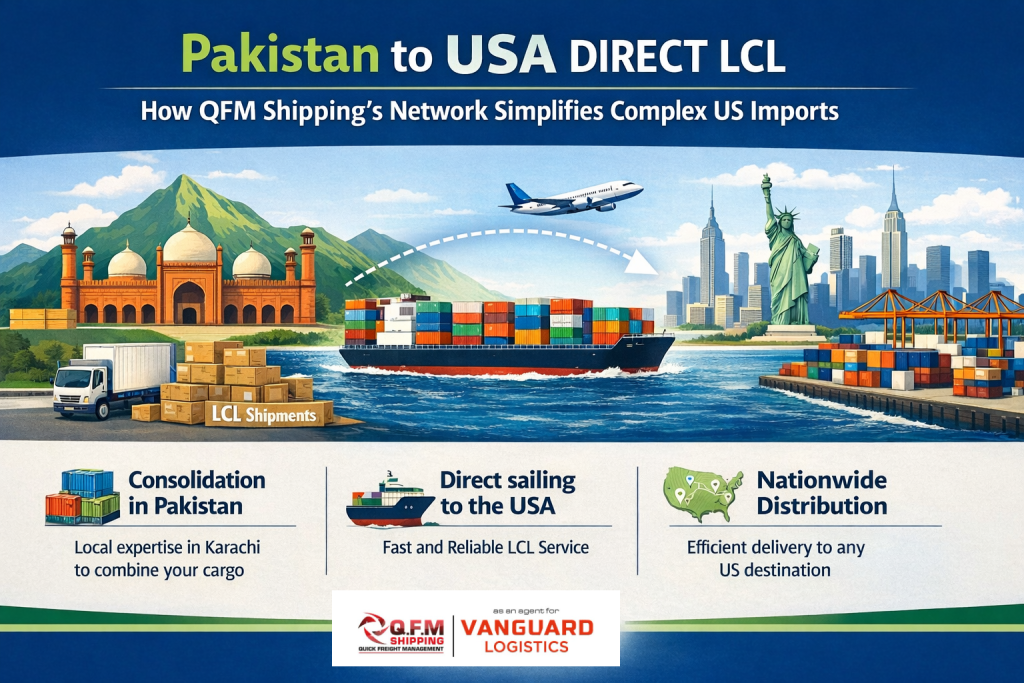
Pakistan to USA Direct LCL | How QFM Shipping as an Agent of Vanguard’s Network Simplifies Complex US Imports
Importing into the United States from Pakistan can be deceptively complex—especially when you are shipping less-than-container load (LCL). You may have reliable suppliers and competitive product pricing, yet still face cost overruns and delays because the shipment is touched too many times, routed through unpredictable transshipment points, or managed by disconnected parties who do not share a single operational standard.
That is exactly where Pakistan to USA Direct LCL becomes a practical advantage. “Direct” in LCL is not just a marketing phrase—it is an operational design goal: fewer handoffs, fewer unknowns, and clearer control over the shipment’s movement from origin consolidation through destination deconsolidation and delivery. When QFM Shipping operates as an agent of Vanguard’s network, it can reduce the typical fragmentation in Pakistan-to-USA LCL by aligning origin operations, documentation discipline, carrier routing, and destination handling under one network playbook.
This article explains what makes Pakistan-to-USA LCL difficult, what “Direct LCL” realistically means in practice, and how a networked operating model—delivered locally via QFM Shipping—can simplify complex US imports.
Why Pakistan-to-USA LCL is Harder Than It Looks
LCL is fundamentally a shared service: multiple shippers’ cargo is consolidated into a single container, moved across the ocean, then unpacked and separated at destination. That shared structure creates three recurring challenges.
1) Too many handoffs create avoidable risk
Traditional LCL often involves multiple intermediaries: a local forwarder, a consolidator, a carrier routing desk, a destination agent, and sometimes a secondary truck broker. Each handoff creates a new risk point for miscommunication, misdocumentation, or missed cutoffs—especially when shipment visibility is limited.
2) Transshipment variability can disrupt US planning
If your cargo routes through multiple transshipment hubs, there can be schedule changes outside your control—rolled sailings, missed connections, or container re-plans. For US importers, that variability hits inventory planning, promotions, and production schedules.
3) US compliance and documentation discipline matters more than ever
The US import environment is documentation-driven. Even small errors—wrong HTS detail, inconsistent shipper/consignee data, missing ISF-related inputs, or vague cargo descriptions—can trigger holds, examinations, or storage/demurrage exposure. For LCL, the risk is amplified because cargo is co-loaded and time windows at destination CFS can be unforgiving.
What “Pakistan to USA Direct LCL” Typically Means (Operationally)
“Direct” can mean different things depending on the lane. In LCL, a realistic and useful definition is:
-
A streamlined origin-to-destination design with fewer non-essential transfer points
-
One network operational standard from consolidation to deconsolidation
-
Predictable CFS handling at origin and destination
-
Clear documentation governance and milestone visibility
Direct LCL does not always mean “no transshipment anywhere”—some lanes still require it depending on carrier strings and port pairings. What matters is whether the service design is controlled and repeatable, with defined processes, accountabilities, and standard handling.
The Network Model: Why It Simplifies Complex US Imports
When your LCL moves inside a structured network rather than stitched together ad hoc, four things become materially easier.
1) Consolidation is treated as a controlled process, not a last-minute activity
A networked LCL model is built around consistent consolidation rules: cargo receiving windows, packaging standards, labeling discipline, measurement verification, and documentation checks at origin CFS. This reduces downstream exceptions (re-weigh, re-measure, relabel, repack) that cause delays and additional charges.
2) Documentation follows a single standard across parties
The practical problem in LCL is that different parties collect different documents in different formats. A network operating model reduces that variability by using a consistent documentation workflow—particularly important when coordinating shipper details, commercial invoices, packing lists, and cargo descriptions that must reconcile across the full shipment lifecycle.
3) Visibility improves because milestones are standardized
Shippers do not just need “ETD/ETA.” They need milestone discipline: cargo received at CFS, consolidated, gated-in, loaded, departed, arrived, devanned, available, out-gated, delivered. A network service tends to define and track these milestones more consistently.
4) Destination handling becomes a planned step, not a scramble
For US imports, the destination CFS and onward delivery are where delays become expensive. A networked approach improves predictability at devanning and availability stages and supports smoother coordination for customs clearance and final delivery.
How QFM Shipping, as a Vanguard Network Agent, Makes the Model Practical in Pakistan
A network is only as effective as its execution at origin. This is where QFM Shipping plays a critical role for Pakistan to USA Direct LCL.
1) Local origin control (Karachi and Pakistan shipper ecosystem)
Pakistan exports often involve a wide range of shipper maturity levels—some have excellent compliance and packaging; others need guidance and structured checks. A local agent can standardize shipper readiness by enforcing practical, repeatable steps:
-
cargo labeling and carton/pallet markings
-
measurement and weight verification before consolidation
-
packing list alignment with physical cargo presentation
-
documentation completeness checks prior to cutoff
This matters because problems introduced at origin are rarely “fixed” later without cost.
2) Single-lane governance: fewer moving parts for the importer
US importers and US-based brokers value one accountable point of coordination. When QFM Shipping manages origin execution in alignment with the Vanguard network, it reduces the common situation where an importer must chase multiple parties for answers.
3) Better alignment between origin documentation and US clearance needs
Even when clearance is handled by a US broker, origin accuracy determines the clearance outcome. A disciplined origin process helps reduce errors that create holds or delays, such as:
-
inconsistent consignee details across documents
-
unclear commodity descriptions
-
mismatched carton counts/weights
-
late document submission windows
In practical terms, this is how the network simplifies “complex US imports”: it prevents avoidable friction rather than reacting to it.
4) Planning for distribution across multiple US destinations
Many Pakistan-to-USA shipments are not destined for a single warehouse. Importers may need cargo delivered to multiple states or different fulfillment nodes. A networked LCL service can support more structured downstream coordination—especially when importers want predictable availability at destination CFS so they can plan drayage and final-mile distribution.
The End-to-End Flow: What a Well-Run Pakistan-to-USA LCL Shipment Looks Like
A simplified, network-aligned process typically follows this structure:
-
Shipper readiness and booking confirmation
Cargo details confirmed early (dimensions, weights, HS/commodity description, shipper/consignee data). -
Cargo receiving at origin consolidation point
Physical checks: packaging condition, labels, piece count, measurement verification. -
Consolidation and container build planning
Cargo stow planning to reduce damage risk and avoid re-handling. -
Ocean movement and milestone visibility
Standardized event updates so the importer can plan customs and delivery timing. -
Destination deconsolidation (devanning at US CFS)
Cargo made available with clear “availability” milestones. -
Customs clearance coordination and release
Broker alignment supported by accurate and timely documents. -
Final delivery / nationwide distribution
Drayage and last-mile planned based on reliable availability windows.
This flow is not theoretical; it is the difference between “LCL as an unpredictable experience” and Pakistan to USA Direct LCL as a controlled supply chain component.
Common Pitfalls—and How a Network Approach Helps Avoid Them
Pitfall 1: Late documentation submission
Networked governance encourages earlier document readiness and reduces last-minute data chasing.
Pitfall 2: Weight/measurement disputes
Origin verification reduces re-measure surprises at destination and helps keep billing aligned with expectations.
Pitfall 3: Weak cargo descriptions
Clear, consistent cargo descriptions reduce customs friction and improve broker readiness.
Pitfall 4: No plan for destination pickup windows
Standardized milestones help importers coordinate drayage and delivery before storage charges accrue.
When Pakistan-to-USA Direct LCL is the Best Fit
Direct LCL is particularly valuable when:
-
your shipment volumes are frequent but not container-load
-
you import SKU-diverse goods requiring tighter inventory planning
-
you distribute across multiple US locations
-
you have high sensitivity to delivery windows (retail campaigns, replenishment, production inputs)
-
you want fewer parties touching the shipment and clearer accountability
Practical Checklist for Importers Using Pakistan to USA Direct LCL
If you want your shipments to run consistently, insist on these operational basics:
-
Accurate cargo dimensions and weights before booking
-
Clean commercial invoice and packing list (aligned with physical cargo)
-
Clear consignee and notify party details (consistent across all documents)
-
Specific commodity descriptions (avoid overly generic wording)
-
Packaging fit for multi-handling (carton strength, pallet integrity, internal protection)
-
Milestone visibility expectations agreed upfront (received, loaded, departed, arrived, available, delivered)
These steps sound basic, but in LCL they are often the difference between predictable lead times and repeated exceptions.
Closing Perspective
US import logistics becomes “complex” not because ocean freight is mysterious, but because too many parties operate without a unified standard. Pakistan to USA Direct LCL works best when it is treated as a network service—one that connects origin consolidation discipline, documentation governance, controlled routing, and reliable destination handling.
That is the core value of QFM Shipping operating as an agent of Vanguard’s network: it brings global network structure into practical, local execution in Pakistan, and it gives US importers a more predictable, controllable path for LCL shipments into the United States.
Ready to explore collaboration opportunities? Reach out to our team to discuss your LCL needs, strategic partnerships, and custom routing options. Let’s build stronger, smarter logistics together.
Email: info@qfmshipping.com
Phone: +92-21-34540153 & 54
+92-21-34540135 & 36
Tags:
Pakistan to USA Direct LCL, LCL shipping Pakistan to USA, direct LCL service, LCL consolidation Karachi, US import logistics, ocean freight LCL, CFS deconsolidation, customs clearance USA, ISF filing, last mile distribution, QFM Shipping, Vanguard network
