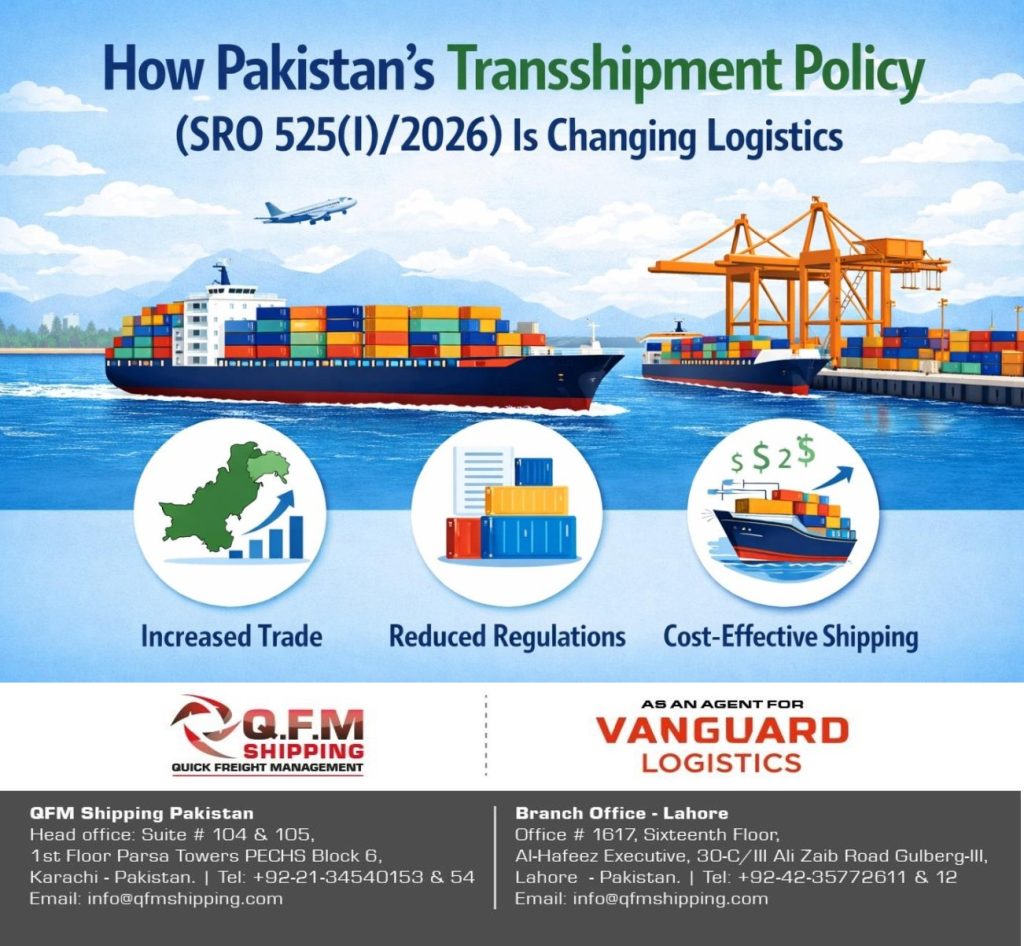
How Pakistan’s Transshipment Policy (SRO 525(I)/2026) Is Changing Logistics
A Turning Point for Pakistan Logistics
The Pakistan transshipment policy 2026 under SRO 525(I)/2026 marks a major transformation in the country’s logistics and freight forwarding ecosystem. Introduced by the Federal Board of Revenue (FBR), this regulatory shift is not just a procedural update—it is a strategic move to position Pakistan as a regional transshipment hub.
Triggered by global shipping disruptions, especially in the Middle East, this policy is enabling Pakistan—particularly Karachi Port and Port Qasim—to capture diverted cargo flows and reshape regional supply chains.
Understanding SRO 525(I)/2026: What Changed?
The Pakistan transshipment policy 2026 introduces a structured, digitized, and highly monitored framework for handling international transshipment cargo.
Key Regulatory Changes
1. 100% Scanning and Enhanced Security
- All transshipment cargo must undergo mandatory scanning
- Any discrepancy triggers full physical inspection
- Ensures transparency and reduces smuggling risks
2. Strict Liability Framework
- Shipping lines, airlines, and terminal operators are fully accountable
- Duties and taxes apply in cases of:
- Misdeclaration
- Pilferage
- Cargo discrepancies
3. Controlled Inter-Port Movement
- Cargo movement is governed under the Customs Computerized System
- Only authorized bonded carriers are allowed
- Full digital tracking of cargo movement
4. Monthly Reporting Compliance
- Operators must submit monthly reconciliation reports
- Ensures accountability across the logistics chain
5. Customs Authority Empowerment
- Authorities can suspend non-compliant operators
- Ensures operational discipline across terminals
Why This Policy Was Introduced
The introduction of SRO 525(I)/2026 is directly linked to global maritime disruptions, particularly:
- The Middle East conflict is affecting shipping lanes
- Vessel delays and rerouting via the Cape of Good Hope
- Congestion at traditional transshipment hubs (Dubai, Jebel Ali)
Pakistan responded proactively by:
- Revising transshipment rules
- Expanding port capacity
- Enabling temporary storage facilities
For example, a 16.9-acre storage facility at Port Qasim was authorized to handle overflow cargo and ease congestion.
How Pakistan’s Transshipment Policy Is Changing Logistics
1. Pakistan Emerging as a Regional Transshipment Hub
The Pakistan transshipment policy 2026 is transforming the country into a strategic alternative to Gulf hubs.
Key Impact:
- Cargo rerouting through Pakistan
- Increased LCL consolidation volumes
- Attraction of international freight forwarders
This shift opens massive opportunities for companies like QFM Shipping Pakistan to lead neutral consolidation services.
2. Boost in LCL (Less-than-Container Load) Business
With more cargo flowing through Pakistan:
- LCL consolidation demand is rising
- Neutral freight forwarders are gaining importance
- Multi-country consolidation is becoming feasible
This aligns perfectly with QFM Shipping Pakistan’s core strength in LCL logistics.
3. Improved Supply Chain Resilience
The new policy enables:
- Alternative routing options
- Reduced dependency on Middle East hubs
- Faster recovery from disruptions
This creates a multi-hub logistics ecosystem, reducing global bottlenecks.
4. Increased Compliance and Transparency
The strict monitoring framework ensures:
- Reduced fraud and misdeclaration
- Higher cargo security
- Digitized tracking systems
For serious logistics players, this means a more predictable and reliable operating environment.
5. Port Infrastructure Optimization
The policy also drives:
- Expansion of off-dock terminals (ODTs)
- Better utilization of Karachi & Port Qasim
- Reduced congestion through overflow facilities
This improves turnaround time and port efficiency.
Opportunities for Exporters and Freight Forwarders
For Exporters
- Faster transit via alternative routes
- Reduced delays due to congestion
- Competitive freight rates
For Freight Forwarders
- Increased demand for consolidation services
- Opportunity to act as neutral partners
- Expansion into new trade lanes
For Pakistan’s Economy
- Foreign exchange earnings
- Job creation in the logistics sector
- Strengthening of maritime trade position
Challenges to Consider
While the Pakistan transshipment policy 2026 offers major benefits, challenges remain:
1. High Compliance Requirements
- 100% scanning increases processing time
- Documentation must be flawless
2. Infrastructure Pressure
- Sudden surge in cargo may strain ports
- Need for continuous investment
3. Operational Learning Curve
- Stakeholders must adapt quickly to new rules
Role of QFM Shipping Pakistan in This Transformation
In this evolving landscape, QFM Shipping Pakistan is uniquely positioned to capitalize on the policy shift.
Why QFM Shipping Pakistan Stands Out:
- Strong expertise in neutral LCL consolidation
- Deep understanding of Pakistan trade routes
- Ability to manage compliance-heavy environments
- Reliable partner for global freight networks
Strategic Advantage
As global logistics shifts toward Pakistan, QFM Shipping Pakistan becomes a key gateway partner for:
- GCC cargo
- Asia-Pacific trade
- Europe-bound shipments
Future Outlook: A New Logistics Era for Pakistan
The Pakistan transshipment policy 2026 is not a temporary measure—it is a long-term strategic repositioning.
Expected Trends:
- Pakistan is competing with Dubai as a transshipment hub
- Growth in regional trade corridors
- Increased investment in port infrastructure
- Rise of digital logistics systems
If implemented effectively, Pakistan could unlock billions in logistics revenue and become a critical node in global supply chains.
Conclusion
The introduction of SRO 525(I)/2026 under the Pakistan transshipment policy 2026 is a game-changing development for the logistics industry.
It is:
- Enhancing transparency
- Strengthening compliance
- Creating new business opportunities
- Positioning Pakistan as a regional logistics powerhouse
For businesses and logistics providers, this is not just a regulatory update—it is a strategic opportunity to scale, expand, and lead.
Call to Action
Ready to leverage Pakistan’s new transshipment advantage?
Partner with QFM Shipping Pakistan to unlock faster, smarter, and more reliable global logistics solutions.
QFM Shipping Pakistan
Karachi : Suite # 104 & 105, 1st Floor Parsa Towers PECHS Block 6 Karachi
Tel: 0092-21-34540153 & 54
Lahore: Suite # 1617, 16th Floor, Al Hafeez Executive Gulberg III, Lahore
Tel: 0092-42-35772611 & 12
Email: pricing.pkkhi@qfmshipping.com
Mobile: 0092-321-8280327
Tags:
Pakistan transshipment policy 2026, SRO 525(I)/2026, Pakistan logistics industry, transshipment Pakistan ports, Port Qasim logistics, Karachi port transshipment, LCL consolidation Pakistan, global shipping disruption,
