
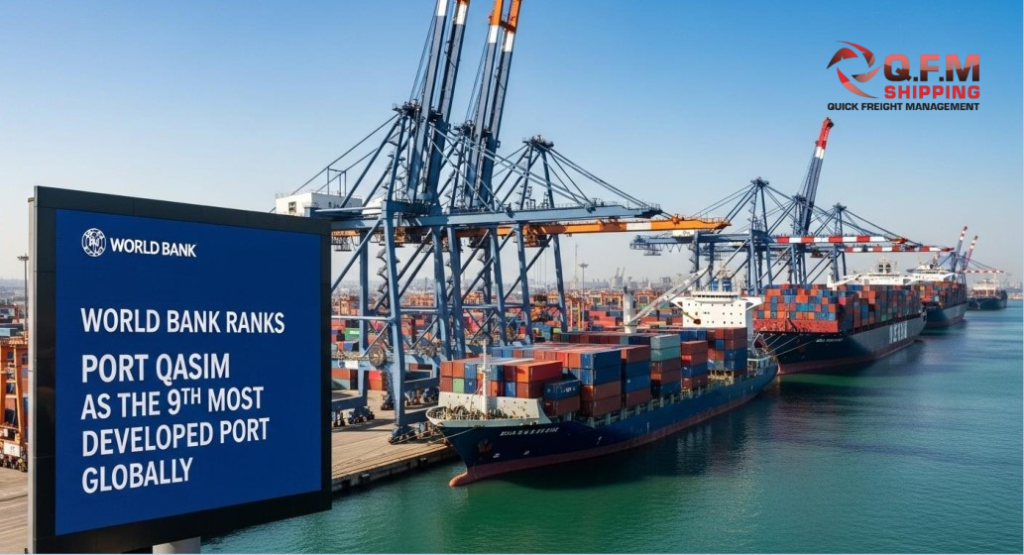
Port Qasim Climbs to 9th Position in World Bank’s Global Port Performance Rankings
A Milestone for Pakistan’s Maritime Ambitions
Introduction
In a significant boost to Pakistan’s maritime credentials, the World Bank has recognized Port Muhammad Bin Qasim (Port Qasim) as the one of the world’s most improved container ports—ranking it 9th globally in improvement over the period 2020–2024. What this ranking reflects is not just numerical gains, but years of reforms, investment, modernization, and an aspiration to transform Pakistan into a regional logistics hub.
This article unpacks what the ranking is about, how Port Qasim achieved it, challenges ahead, and what it means for Pakistan’s trade, industry, and regional ambitions.
What Exactly Was Ranked?
Container Port Performance Index (CPPI) 2024
The World Bank’s Container Port Performance Index (CPPI), prepared in collaboration with S&P Global Market Intelligence, measures and compares how much ports have improved over time, rather than their absolute current size or volume.
Key features:
-
The CPPI looks at modal improvements from 2020 to 2024.
-
It assesses foreland connectivity (how well the port is connected to global shipping routes) and hinterland connectivity (efficiency in moving containers inland, via roads, rails, or inland waterways).
-
It also considers operational metrics like dwell time (how long cargo stays in the port), berth utilization, congestion, and adoption of digital systems.
-
The improvement or “score jump” is what determines the rankings among “most improved” ports.
In the latest index, Port Qasim showed a 35.2-point improvement between 2020 and 2024.
Thus, when media report it as “9th most developed,” a more accurate phrasing is “9th most improved container port globally” over the specified period.
Port Qasim: From Local Gateway to Global Recognition
Overview & Strategic Importance
-
Port Qasim is a deep-water artificial port located in Karachi, Sindh.
-
It handles around 35% of Pakistan’s external trade, with Karachi Port and Qasim together shouldering nearly 90% of the nation’s maritime traffic.
-
The port spans over 12,200 acres of land, with multiple berths handling dry cargo, liquid cargo, containers, bulk shipments, etc.
-
Prior to this ranking, the port has been undergoing modernization, infrastructure upgrades, private sector participation (e.g. QICT, a terminal operator under DP World) and improving logistics connectivity.
Drivers of Improvement
What changed between 2020 and 2024 to generate this upward leap?
-
Operational Efficiency Gains
-
Reduction in dwell time (how long containers wait before being moved in or out).
-
Better berth scheduling, reducing idle times and congestion.
-
More streamlined coordination among port stakeholders (customs, shipping lines, terminal operators).
-
Adoption of digital tools and automation in operations to reduce delays and paperwork.
These changes directly contribute to the “improvement” score in CPPI.
-
-
Improved Connectivity
-
Enhancing hinterland linkages (road and rail) so containers are moved faster to industrial zones, cities, and border areas.
-
Strengthening foreland access (i.e. making Port Qasim more attractive to global shipping lines) through reliable ship calls and line capacity.
-
Approving a dredging project to deepen the navigation channel, thereby enabling larger vessels to access the port.
-
-
Governance & Reform Agenda
-
Policy reforms in port regulation, enabling smoother operations.
-
Encouraging private sector involvement (e.g. terminal operators operating under global standards).
-
Commitment from the federal government and the Ministry of Maritime Affairs to prioritize ports in national trade strategies.
-
Institutional strengthening of Port Qasim Authority and better oversight.
-
-
Benchmarking & International Standards
-
Seeking alignment with international best practices to make the port more globally competitive.
-
Being evaluated under a global index (CPPI) itself nudges internal stakeholders to aim for score-improving reforms.
-
These combined changes yielded a 35.2-point improvement in the CPPI score, which was enough to place Port Qasim 9th among global ports in terms of improvement.
Comparative Context
-
Ports that improved more than Qasim include Posorja (Ecuador), Gothenburg (Sweden), Marseille (France), Philadelphia (USA), Mawan (China), Tin Can Island (Nigeria), Port Said (Egypt), and Lagos (Nigeria).
-
Interestingly, India’s Jawaharlal Nehru Port ranked right after Qasim (10th) in improvement ranking.
-
It is worth noting that Qasim is still behind in absolute throughput compared to many ports, but this improvement ranking is an encouraging sign of momentum.
Why This Matters for Pakistan
This ranking is more than just a symbolic accolade; it has concrete implications across sectors:
-
Trade & Export Competitiveness
-
A more efficient, reliable port cuts cargo handling costs, time delays, and uncertainties—factors that matter to exporters and importers.
-
It makes Pakistani trade more competitive in regional and global markets.
-
-
Investor Confidence & Attracting Capital
-
International recognition signals that the government is serious about reforms, which can draw foreign direct investment into maritime, logistics, warehousing, and allied infrastructure.
-
Global and regional shipping lines may view Pakistan’s ports as more reliable hubs.
-
-
Regional Logistics Hub Vision
-
Pakistan aspires to act as a gateway connecting China, Central Asia, the Middle East, and beyond.
-
Improved ports are a foundational piece in that ambition: stronger port performance helps position Karachi & Qasim as nodes in trade corridors.
-
-
Spillover Effects
-
Industrial growth near port zones, logistics parks, and supply chains may benefit.
-
Employment generation in ancillary services (transport, freight forwarding, warehousing).
-
Enhancing Pakistan’s image and credibility in global trade rankings and indices.
-
-
Momentum & Political Signaling
-
The government uses such rankings to demonstrate progress in sectoral reforms.
-
It is a morale booster for port authorities, workers, and administrative bodies.
-
Federal Minister for Maritime Affairs, Muhammad Junaid Anwar Chaudhry, welcomed the ranking as a national achievement and tied it to an ongoing reform agenda. He also announced that dredging approvals have been cleared to allow larger vessels at Qasim.
Caveats, Challenges & What Must Happen Next
While this ranking is commendable, several caveats and challenges lie ahead:
-
Sustainability of Performance
One-time improvements are easier than continuous gains. Ports globally evolve; to stay competitive, Qasim must not rest on its laurels. -
Absolute Capacity & Scale
Improvement ranking is not the same as being among the largest or highest-throughput ports. Qasim still lags behind major global ports in sheer volume. -
Hinterland Infrastructure Gaps
Efficient ports require strong road, rail, and logistics networks inland. Bottlenecks on these links can negate gains at the port itself. -
Regulatory & Institutional Bottlenecks
Delays in clearances, coordination among agencies, customs procedures, tariffs, and inter-agency bottlenecks could slow progress. -
Environmental & Sustainability Concerns
Expansion and dredging, while useful, have ecological costs (marine ecosystems, pollution, sedimentation). A balance must be struck. -
Geopolitical & Security Risks
Regional instability, trade sanctions, security challenges (piracy, maritime disputes) can impact shipping flows. -
Digital & Technology Adoption Pace
As many ports adopt AI, blockchain, autonomous operations, Qasim must keep up technologically to remain competitive.
To continue the upward path, priorities should include:
-
Further dredging and deepening to take larger vessels
-
Integrating port operations with rail, road, and inland freight corridors
-
Greater digitalization: single window customs, tracking, automation
-
Institutional reforms to reduce red tape and improve inter-agency coordination
-
Sustainable practices in dredging, waste management, emissions
-
Marketing Qasim globally to attract more shipping lines and transshipment traffic
Conclusion
Port Qasim’s 9th place ranking in the World Bank’s Container Port Performance Index (2024) among the world’s most improved ports is more than a cosmetic win. It underscores Pakistan’s capacity to execute meaningful reforms, invest in infrastructure, and compete in the global maritime domain.
However, it should be viewed as a milestone, not an endpoint. The ongoing challenge will be to maintain, expand, and institutionalize these gains. If Pakistan can keep momentum—especially by strengthening hinterland links, technological adoption, and regulatory efficiency—Port Qasim and its sister ports may genuinely become pivotal hubs in regional trade.
QFM Shipping
QFM Shipping maintains a strong operational connection with Port Qasim, one of Pakistan’s most vital maritime hubs. As a gateway for international trade, Port Qasim provides QFM Shipping with direct access to global shipping routes, allowing seamless handling of LCL (Less than Container Load) and FCL (Full Container Load) consolidations. By leveraging the port’s advanced infrastructure and growing global reputation, QFM Shipping ensures efficient routing, reduced transit times, and safe cargo movement for its clients. This partnership strengthens QFM’s ability to combine local expertise with global reach, making Port Qasim an essential anchor in its logistics and consolidation network.
Fast. Reliable. Global. That’s the promise we bring to every LCL shipment and FCL shipment.
Getting Started is Easy
Ready to simplify your shipping? Contact us today for a free consultation and a custom quote. Our team is ready to design a logistics plan that will save you time, reduce costs, and give you peace of mind.
Contact Us:
-
Email: info@qfmshipping.com
-
Website: www.qfmshipping.com
Tags:
Port Qasim ranking, World Bank CPPI 2024, Port Qasim 9th globally, Pakistan port performance, Port Qasim container port, maritime reforms Pakistan, Port Qasim efficiency, global port rankings, Pakistan shipping industry, Port Qasim trade growth #QFM Shipping
