
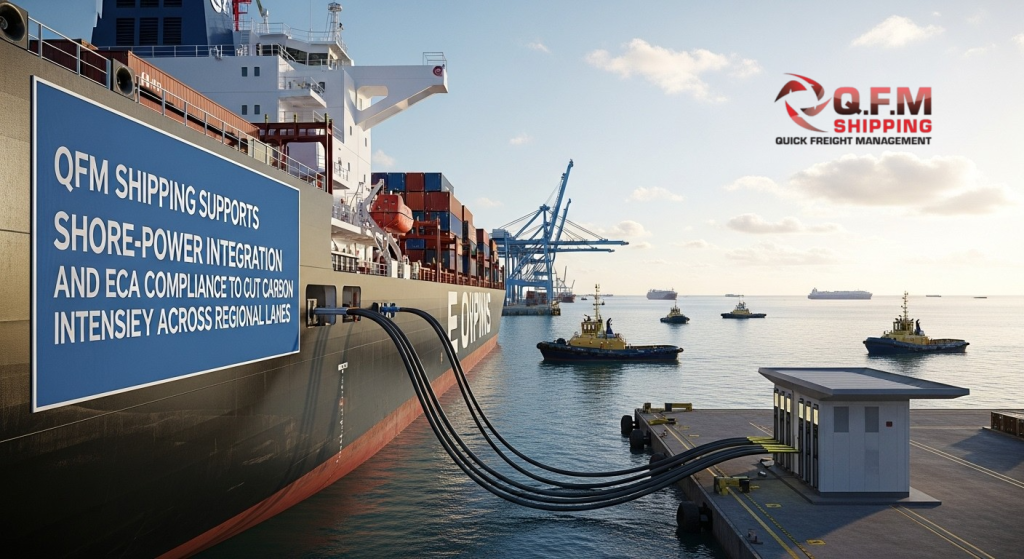
QFM Shipping Supports Shore-Power Integration and ECA Compliance to Cut Carbon Intensity Across Regional Lanes
Executive summary
QFM Shipping is accelerating practical decarbonization for shippers on our regional LCL/FCL lanes by:
-
Prioritizing shore-power (“cold ironing”) calls where available to eliminate at-berth emissions.
-
Routing and operating for Emission Control Area (ECA) compliance (sulfur caps, NOx tiers) with verified fuel switches and documented procedures.
-
Optimizing voyages (speed, stowage, transshipment choices) to reduce gCO₂e/TEU-km without compromising reliability.
-
Providing auditable carbon data so customers can track Scope 3 emissions and evidence greener transport choices.
Whether you move a single pallet or a weekly console, our goal is simple: lower carbon per move while keeping your lead times and costs predictable.
Why shore power and ECAs matter
-
Shore power allows vessels to plug into a port’s electrical grid at berth, shutting down auxiliary engines that burn marine fuel. This slashes local CO₂, NOx, SOx, and PM around port communities and improves overall voyage intensity.
-
Emission Control Areas (ECAs) mandate stricter air-emission limits. Operating inside ECAs requires very low sulfur fuels (e.g., ≤0.10% m/m) or equivalent technologies, as well as compliant procedures for fuel switching before entry and proper recordkeeping.
-
Together, these two levers tackle both at-berth and in-transit emissions—exactly where many shippers’ Scope 3 footprints accumulate.
How QFM Shipping makes it work in practice
1) Shore-power–ready port calls (where available)
-
We prioritize terminals with grid-connect infrastructure on eligible loops and partner carriers whose vessels are fitted—or being retrofitted—for cold ironing.
-
Our operations teams coordinate advance pre-arrival notifications (power spec, berth window, cable/connection standards) to minimize hookup delays and maximize plug-in time.
-
We measure and report % of total berth time on shore power as a key performance indicator (KPI) for each tradelane where infrastructure exists.
2) Robust ECA compliance playbook
-
Fuel strategy: Verified low-sulfur fuel availability for ECA segments; documented fuel switchovers with timestamps and tank logs before ECA entry/after exit.
-
Equivalent controls: Where applicable, collaboration with carriers using exhaust gas cleaning systems (scrubbers) or dual-fuel/LNG capability under accepted rules.
-
NOx management: Preference for fleets meeting Tier II/Tier III engine standards on ECA-heavy routings.
-
Recordkeeping: On-board and shoreside bunker delivery notes (BDNs), switch-over records, noon reports, and ECA passage logs retained and made auditable to customers on request.
3) Voyage optimization that sticks
-
Speed & schedule discipline: We balance eco-speed steaming with service reliability to lower fuel burn without eroding transit commitments.
-
Smart transshipment: We choose hubs with higher shore-power penetration and efficient crane rates to reduce at-berth engine use and waiting time.
-
Stowage planning: Better stow reduces terminal moves and idle time; fewer moves = less yard equipment energy and quicker plug-in windows.
-
Backhaul matching: We work to align export/import flows and reduce ballast legs—cutting grams of CO₂ per TEU-km across the cycle.
4) Data you can trust (for ESG and customer reporting)
-
Lane-level carbon intensity (gCO₂e/TEU-km) estimates derived from operational data and widely referenced factors, reconciled to actual voyage conditions where available.
-
At-berth emission accounting with or without shore power (so you can see the delta when plugged in).
-
Shipment-level statements for tenders, ESG disclosures, or customer audits—so sustainability isn’t just a promise; it’s documented.
Regional focus: how this helps your lanes
-
Middle East–South Asia corridors (e.g., Gulf ↔ Pakistan): High call frequency and short legs mean at-berth emissions are a larger share of total. Shore-power-enabled calls and faster turnarounds yield meaningful reductions in your carbon intensity without touching transit reliability.
-
South Asia–Far East corridors: Busy hub ports increasingly support energy-efficient operations and digital slot management. Our routing choices favor shore-power readiness and high-efficiency terminals, squeezing out idle time and emissions.
-
Transshipment to North America/Europe: For long-haul moves that cross ECAs near Europe and North America, our carrier partners’ documented fuel switches and Tier II/III engines ensure compliance and lower SOx/NOx in sensitive zones—backed by shareable records.
(Note: We select shore-power calls “where available” and continuously update eligible rotations as port infrastructure and carrier retrofits expand.)
What shippers get—concrete benefits
-
Lower carbon intensity per shipment: Real reductions from both at-berth plug-ins and in-transit ECA compliance.
-
Cleaner air around communities: Tangible local benefits near ports and coastal ECAs.
-
Comparable cost, better footprint: We target like-for-like transit times while improving climate and air-quality performance.
-
Audit-ready documentation: Shipment statements and lane summaries to support Scope 3 and product-level LCAs.
-
Brand advantage: Verified greener logistics help with customer RFPs, regulatory pressure, and sustainability commitments.
Our key KPIs (tracked and shareable)
-
Carbon intensity (gCO₂e/TEU-km) per tradelane (rolling average).
-
% of berth time on shore power at eligible terminals.
-
ECA compliance conformance rate (timely fuel switchovers with complete logs).
-
Idle/anchorage time and on-time performance, to ensure decarbonization doesn’t erode reliability.
-
Transshipment efficiency (moves per box, dwell time) as a proxy for yard/berth energy.
How we implement on your shipment
-
Quote & plan: Tell us your lane and sustainability priorities; we propose shore-power-enabled rotations and ECA-optimized routings.
-
Book green: We tag the file to prioritize compliant carriers/ports and align cut-offs to maximize plug-in windows at hubs.
-
Monitor & verify: Operations teams track ECA entry/exit, switchover logs, shore-power hookup status, and dwell.
-
Report back: You receive shipment-level statements and, on request, quarterly lane dashboards summarizing intensity and improvement trends.
FAQs
Q: What if a port on my route doesn’t have shore power yet?
A: We still minimize at-berth emissions by selecting efficient terminals, reducing idle/anchorage time, and optimizing crane windows. As infrastructure comes online, we migrate calls to plug-in berths.
Q: Does ECA compliance add cost or delay?
A: Compliance is built into our planning. We coordinate timely fuel switches and use eco-speed windows that preserve reliability. The objective is equal or better schedule integrity with a cleaner profile.
Q: Can I see the carbon savings for my exact shipment?
A: Yes. We provide shipment statements and can roll up to monthly/quarterly reports by tradelane, including the impact of shore-power time and ECA segments.
Q: Is this available for LCL as well as FCL?
A: Absolutely. Our LCL consoles benefit from the same operational controls, so SMEs can access enterprise-grade decarbonization without full-container commitments.
Call to action
If you’re ready to lower the carbon intensity of your regional moves without sacrificing reliability, talk to QFM Shipping. Ask for a shore-power/ECA-optimized routing on your next quote, and we’ll show you the data-backed difference shipment by shipment.
Optional add-ons we can include on request
-
Lane-specific carbon baselines and target trajectories
-
Green Bill of Lading endorsements for your ESG records
-
Co-branded customer sustainability reports for your end clients
QFM Shipping—making cleaner logistics practical, verifiable, and available to every shipper on our network.
At QFM Shipping, our commitment is not just to move cargo — it’s to move your business forward with dependable global connectivity.
Book Your Space Today
Contact Us:
Email: info@qfmshipping.com
Phone: +92-21-34540153 & 54
+92-21-34540135 & 36
Website: www.qfmshipping.com
Tags:
QFM Shipping, Shore power, ECA compliance, Green logistics, Maritime decarbonization, Cold ironing, Sustainable shipping, Regional shipping, Carbon reduction, Low sulfur fuel, Port electrification, Eco-speed sailing, Scope 3 emissions, Container shipping sustainability, Clean energy ports
