
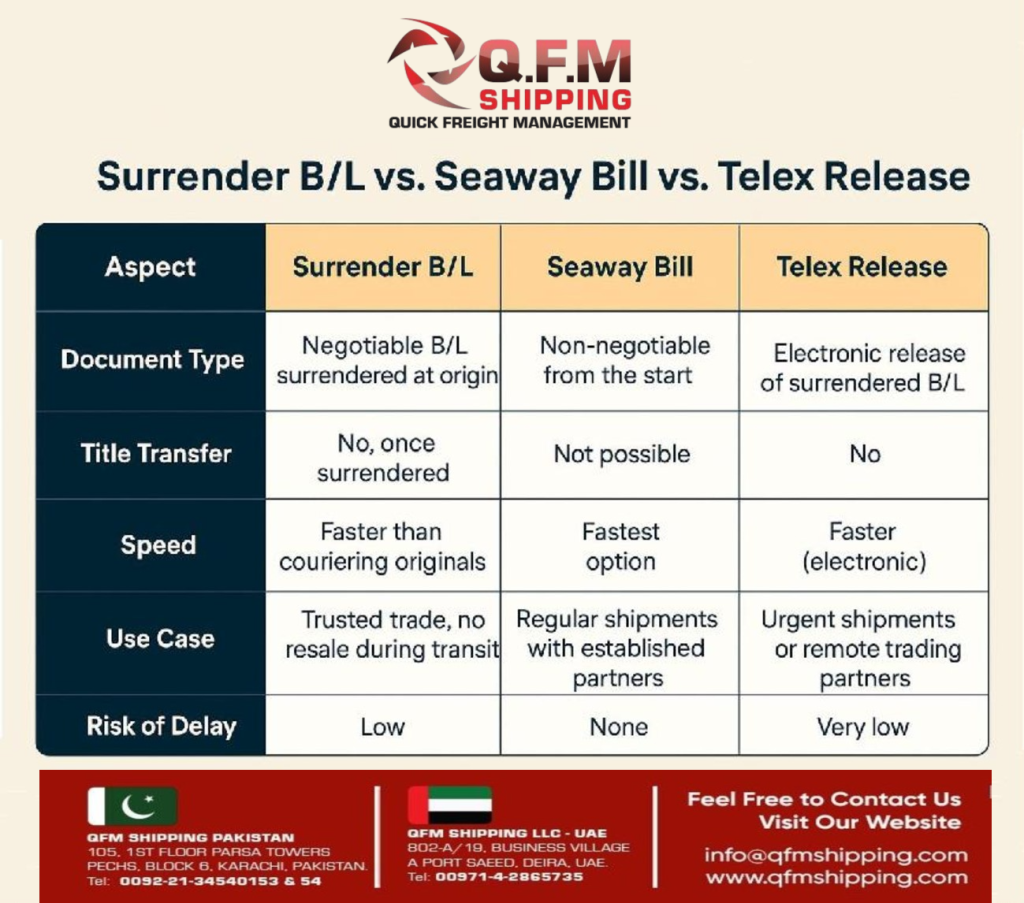
Surrender B/L vs. Seaway Bill vs. Telex Release – Which is Right for You?
In the world of global shipping, smooth documentation is just as critical as the movement of cargo itself. Among the most discussed documents are the Bill of Lading (B/L) variations—specifically the Surrender B/L, Seaway Bill, and Telex Release. Each serves a slightly different purpose, and choosing the right one depends on the nature of your shipment, the trust between trading partners, and how quickly the cargo needs to be released at the destination.
Let’s break down what each of these terms means, their pros and cons, and how to decide which one fits your needs.
Understanding the Basics: Bill of Lading
A Bill of Lading is traditionally a document of title, proof of shipment, and contract of carriage between shipper, consignee, and carrier. However, in modern logistics, speed and digital communication have created alternatives that simplify or even bypass the need for a physical paper bill. That’s where surrender B/L, seaway bills, and telex releases come in.
What is a Surrender B/L?
A Surrendered Bill of Lading is a regular, negotiable bill of lading that has been “surrendered” at the port of origin.
-
The shipper returns the original B/L to the carrier’s office, who then issues instructions for the cargo to be released at the destination without presenting the original document.
-
The word “SURRENDERED” is stamped on the B/L.
Advantages:
-
Eliminates the risk of originals being delayed or lost in courier transit.
-
Speeds up release at the destination.
-
Still provides control—cargo is only released once the shipper authorizes surrender.
Disadvantages:
-
Requires administrative steps at origin.
-
Not suitable if negotiability (transfer of title) is required.
What is a Seaway Bill?
A Seaway Bill (also called an Express Bill of Lading) is a non-negotiable document.
-
It serves purely as a receipt and evidence of contract of carriage, but not as a document of title.
-
The consignee listed in the bill can simply claim the cargo at the destination without presenting any originals.
Advantages:
-
Fastest and simplest method for cargo release.
-
No risk of lost or delayed B/Ls.
-
Ideal when the buyer is known and trusted, and no resale during transit is expected.
Disadvantages:
-
No negotiability—cannot transfer ownership while cargo is in transit.
-
Limited control for the shipper if buyer defaults on payment.
What is a Telex Release?
A Telex Release is an electronic message sent by the origin office of the carrier to its destination counterpart.
-
It authorizes the destination office to release cargo without presentation of the original B/L.
-
Usually applied when the shipper has already surrendered all original bills at origin.
Advantages:
-
Electronic, faster than couriering documents.
-
Convenient for urgent or last-minute shipments.
-
Ensures release instructions are directly communicated between carrier offices.
Disadvantages:
-
Similar to surrender B/L, it removes negotiability.
-
Relies on smooth communication between carrier branches.
Key Differences at a Glance
| Aspect | Surrender B/L | Seaway Bill | Telex Release |
|---|---|---|---|
| Document Type | Negotiable B/L surrendered at origin | Non-negotiable from the start | Electronic release of surrendered B/L |
| Title Transfer | No, once surrendered | Not possible | No |
| Speed | Faster than couriering originals | Fastest option | Faster (electronic) |
| Use Case | Trusted trade, no resale during transit | Regular shipments with established partners | Urgent shipments or remote trading partners |
| Risk of Delay | Low | None | Very low |
Which One is Right for You?
-
Choose Surrender B/L if:
-
You want the benefits of a standard bill of lading but without the courier delay.
-
You may still need negotiability until the shipper decides to surrender.
-
-
Choose Seaway Bill if:
-
You have a long-term, trusted relationship with the buyer.
-
No resale or transfer of ownership during transit is expected.
-
Speed and simplicity are your top priorities.
-
-
Choose Telex Release if:
-
The shipment is urgent and you need an instant electronic release.
-
The shipper has already surrendered the B/L at origin.
-
You want to avoid the cost and time of moving paper documents.
-
Final Thoughts
In today’s fast-paced shipping environment, the choice between Surrender B/L, Seaway Bill, and Telex Release often comes down to a balance between control, speed, and trust.
-
If you need speed and trust is high, opt for a Seaway Bill.
-
If you need speed but still want traditional B/L structure, go with a Surrender B/L or Telex Release.
-
If ownership transfer during transit is necessary, stick to a traditional Bill of Lading.
By understanding the differences, shippers and consignees can avoid costly delays, unnecessary courier charges, and potential disputes—ensuring cargo moves as smoothly as global trade demands.
Getting Started is Easy
Ready to simplify your shipping? Contact us today for a free consultation and a custom quote. Our team is ready to design a logistics plan that will save you time, reduce costs, and give you peace of mind.
Contact Us:
-
Email: info@qfmshipping.com
-
Website: www.qfmshipping.com
