The Evolution of Freight Forwarding in Pakistan: From Traditional to Network-Centric Models (and the Role of QFM Shipping)
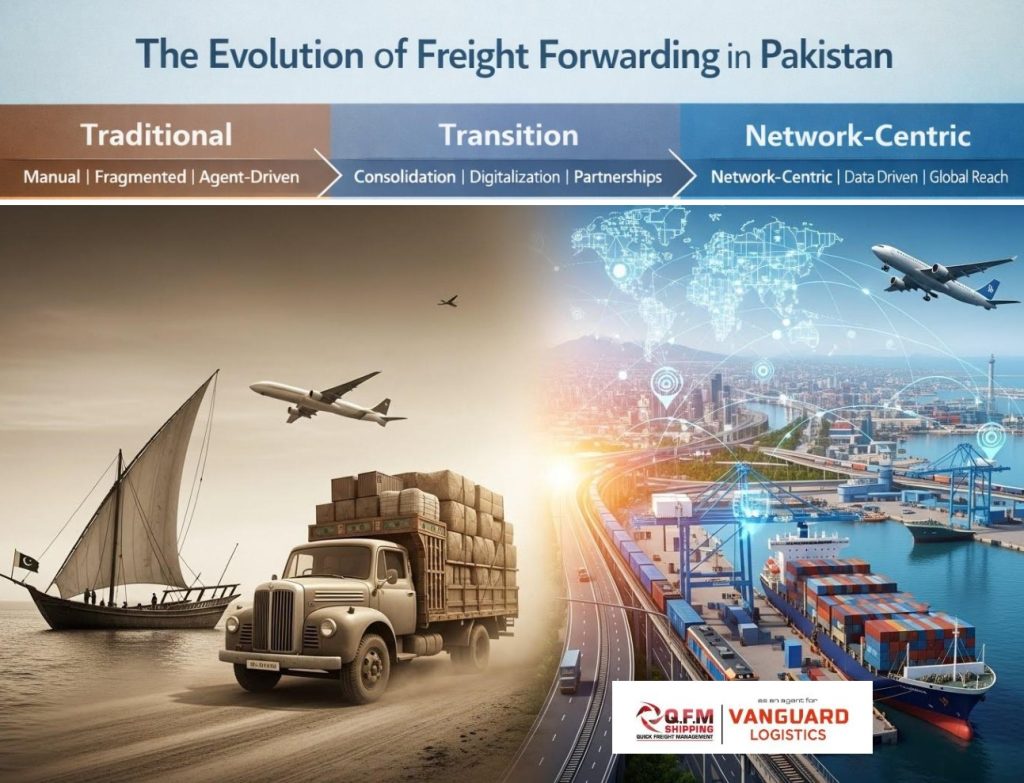
Freight forwarding in Pakistan has moved from relationship-led, paper-heavy operations to a more integrated, technology-enabled, network-centric model. This evolution is being driven by shifts in global trade requirements, customer expectations for visibility and speed, the rise of consolidation hubs, and the need for standardized service quality across multi-country supply chains. In this transition, forwarders that operate with a “network mindset”—coordinating partners, consolidations, and routing options—are shaping what modern freight forwarding looks like.
This article explains how freight forwarding in Pakistan has evolved, what defines a network-centric model, and how QFM Shipping contributes to modernization through neutral LCL consolidation, multi-origin routing, and structured network operations.
1) What Freight Forwarding Looked Like Traditionally in Pakistan
For decades, Pakistan’s forwarding ecosystem was built around manual processes, personal relationships, and fragmented execution across ports, customs brokers, transporters, and overseas agents.
Key characteristics of the traditional model
-
Paper-first operations: Booking notes, BL/HAWB documentation, invoices, and shipment status updates handled largely through email, calls, and physical paperwork.
-
Agent-driven coordination: Service quality often depended on individual agent capability, rather than standardized processes.
-
Limited end-to-end visibility: Customers frequently relied on milestone updates rather than real-time tracking.
-
Route rigidity: Importers and exporters typically used familiar routes, even when they were slower or more expensive.
-
Siloed vendor ecosystem: Trucking, warehousing, and customs processes were often managed as separate transactions, not as a single integrated logistics chain.
This model worked when trade volumes were smaller, compliance expectations were simpler, and customers were less demanding about transparency. However, it becomes inefficient when businesses require reliability, consolidation, and predictable transit outcomes.
2) The Transition Phase: Consolidation, Compliance, and Digital Pressure
As Pakistan’s trade lanes became more complex and customer expectations rose, freight forwarding entered a transition phase. This phase is defined less by a single innovation and more by an accumulation of pressures:
What changed
-
The rise of LCL demand and consolidation needs
-
SMEs increasingly require LCL (Less-than-Container Load) to manage working capital and inventory cycles.
-
Consolidation hubs and CFS networks became critical to improving frequency and transit stability.
-
-
Growing importance of multi-origin sourcing
-
Importers began sourcing from multiple countries/regions, requiring forwarders to coordinate multi-origin consolidation.
-
-
Higher compliance and documentation standards
-
Global shippers expect better documentation discipline, SOP alignment, and process consistency.
-
-
Service expectations shifted
-
Customers want fewer delays, clearer ETAs, faster exception resolution, and proactive communication.
-
This phase created a clear separation between forwarders who “arrange shipments” and those who engineer routing strategies and manage repeatable service quality.
3) The Network-Centric Model: What It Means and Why It Wins
A network-centric freight forwarding model is built on a simple premise: the network is the product.
Rather than operating shipment-by-shipment as isolated transactions, the network-centric forwarder designs outcomes through:
-
Routing options (not just routes)
-
Standardized partner performance
-
Consolidation strategy
-
Reliable frequency and capacity planning
-
Visibility and predictable milestones
-
Exception management across multiple nodes
Core features of network-centric freight forwarding
-
Neutral consolidation capability
-
Especially critical in LCL markets: neutrality enables serving multiple forwarders and shippers without conflict.
-
-
Multi-origin orchestration
-
Combine shipments from different origins into optimized gateways and consolidated flows to Pakistan.
-
-
Hub-and-spoke trade planning
-
Using consolidation hubs to reduce variability, increase sailing frequency, and improve schedule reliability.
-
-
Network governance
-
SLAs, SOPs, measurable milestones, and consistent handling across nodes.
-
-
Data-led operations
-
Even if full real-time tracking is still maturing across the ecosystem, network-centric players work toward structured status reporting, performance monitoring, and repeatable exception workflows.
-
In simple terms: the network-centric forwarder is not only moving cargo—it is designing and controlling a logistics system.
4) Why Pakistan Is a Strong Candidate for Network-Centric Logistics
Pakistan’s trade environment makes the shift toward network-centric models not only desirable, but unavoidable:
-
High LCL relevance in SME-driven import/export segments.
-
Port and inland variability that requires better planning and exception handling.
-
Multi-origin imports growing in categories like retail, electronics, industrial spares, packaging, and FMCG inputs.
-
Time sensitivity increasing due to inventory optimization and competitive market pressures.
-
Need for routing flexibility when disruptions occur.
A network-centric approach helps reduce uncertainty by building redundancy into routing, standardizing handling, and leveraging hubs to maintain schedule continuity.
5) QFM Shipping’s Role in Modernizing Freight Forwarding in Pakistan
QFM Shipping represents a modernization pathway by operating with a consolidation-first, network-centric mindset, particularly in LCL movements and multi-origin routing strategies relevant to Pakistan’s import/export reality.
A) Neutral LCL consolidation as a modernization lever
In many markets, LCL is where forwarding fragmentation becomes most visible—multiple stakeholders, multiple handoffs, and unpredictable timelines. QFM Shipping’s positioning as a neutral LCL consolidator / consolidation partner supports modernization by enabling:
-
Standardized consolidation practices
-
More consistent cargo cut-offs and consolidation discipline
-
Better predictability in sailing schedules through planned network flows
-
Reduced dependency on ad-hoc handling
Neutrality is a major advantage because it allows broader ecosystem participation and makes the consolidation network scalable across multiple customer types.
B) Network-centric thinking: shifting from “shipments” to “systems”
QFM Shipping’s modernization value is strongest when viewed as system-building rather than booking execution. Network-centric forwarders and consolidators modernize Pakistan forwarding by:
-
Designing repeatable routing templates (based on trade lanes, cargo types, and lead times)
-
Building performance consistency via network partners and service governance
-
Improving reliability through multi-gateway options, especially for LCL
This approach helps Pakistani traders move away from “single-route dependency” and toward resilient routing strategies.
C) Multi-origin routing: a practical response to modern sourcing
Pakistan’s importers increasingly buy across multiple origin countries. Without orchestration, this leads to:
-
Separate shipments, separate arrivals, separate clearance timelines
-
Higher demurrage/detention exposure
-
Stockouts and inconsistent replenishment
QFM Shipping’s multi-origin consolidation mindset supports modernization by enabling traders to:
-
Consolidate from multiple origins into planned hubs
-
Reduce fragmented arrivals
-
Improve inventory planning and reduce landed-cost surprises
-
Create more predictable inbound flows
D) A bridge between Pakistani shippers and global networks
Modern freight forwarding is increasingly about network access—CFS coverage, partner reliability, and routing flexibility. QFM Shipping’s role is to function as a Pakistan-based gateway operator and network partner, enabling Pakistani businesses to participate in global LCL ecosystems more efficiently—especially when consistent consolidation and routing coordination is required.
6) What Modern Pakistani Traders Gain from Network-Centric Forwarding
When businesses move from traditional forwarding to network-centric models, the benefits are not abstract—they show up in cost, predictability, and operational stability.
Practical outcomes
-
More reliable transit performance through hub-based consolidation and planned sailings
-
Better route flexibility during disruptions
-
Reduced shipment fragmentation via multi-origin orchestration
-
Improved planning confidence (especially for importers managing inventory cycles)
-
Cleaner execution through standardized consolidation discipline and partner governance
7) Challenges That Still Need Solving (and Where the Market Is Going)
Pakistan’s forwarding modernization is real, but uneven. Some of the structural constraints include:
-
Inconsistent digitization across stakeholders (carriers, terminals, inland transport, customs)
-
Variable milestone data quality
-
Dependence on manual interventions in exception scenarios
-
Skills gaps in network operations planning and analytics
Where the market is heading
Over the next few years, modernization will likely concentrate around:
-
Stronger consolidation hubs and neutral networks
-
Better visibility tooling and structured milestone reporting
-
SLA-driven partner management
-
More multi-origin consolidation strategies
-
Forwarders differentiating through system design, not price-only competition
Network-centric players will pull ahead because they can deliver reliability at scale.
Conclusion: The New Standard Is Network-Centric
Freight forwarding in Pakistan is evolving from a fragmented, agent-driven model to a network-centric approach built on consolidation strategy, routing intelligence, partner governance, and operational repeatability. Traditional forwarding will still exist, but the competitive advantage is shifting toward those who can architect supply chain outcomes rather than simply execute bookings.
QFM Shipping’s role in this modernization is most visible in its consolidation mindset—supporting neutral LCL flows, enabling multi-origin routing, and operating as a network-centric partner that aligns Pakistan’s trade needs with structured, scalable global logistics systems.
Ready to explore collaboration opportunities? Reach out to our team to discuss your LCL needs, strategic partnerships, and custom routing options. Let’s build stronger, smarter logistics together.
Email: info@qfmshipping.com
Phone: +92-21-34540153 & 54
+92-21-34540135 & 36
Tags:
freight forwarding Pakistan, evolution of freight forwarding Pakistan, network centric logistics Pakistan, modern freight forwarding Pakistan, LCL consolidation Pakistan, neutral LCL consolidator Pakistan, multi origin consolidation Pakistan, QFM Shipping Pakistan, logistics modernization Pakistan
