
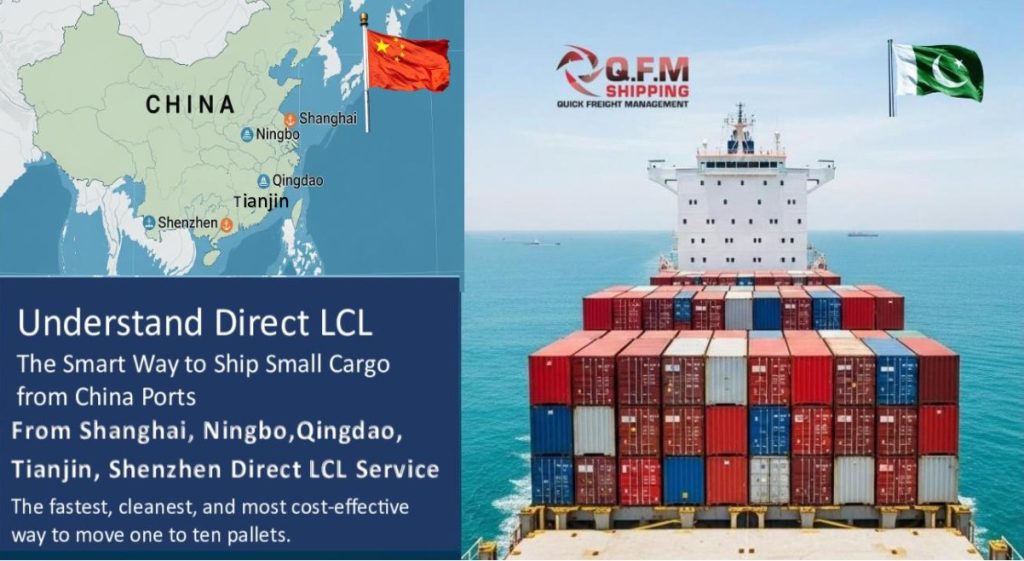
Understanding Direct LCL: The Smart Way to Ship Small Cargo from China Ports
Small and mid-size shipments don’t need to wait for a full container. Direct LCL (Less-than-Container Load) consolidates cargo from multiple shippers into one box, moves it on a fixed schedule, and delivers it with FCL-like reliability—without FCL costs. If you’re sourcing from Shanghai, Ningbo, Qingdao, Tianjin, Shenzhen, Direct LCL is often the fastest, cleanest, and most cost-effective way to move one to ten pallets.
What “Direct LCL” Actually Means
-
LCL: Your cargo shares container space with others.
-
Direct: The container doesn’t get reworked at intermediate hubs. It loads at the China origin CFS (Container Freight Station), sails, and is deconsolidated only at the destination CFS.
-
Result: Fewer handlings, fewer delays, fewer damages, and more predictable transit times than multi-stop (“hub-and-spoke”) LCL.
When Direct LCL Beats FCL (or Parcel/Courier)
Choose Direct LCL when you need:
-
1–12 CBM (roughly 1–8 pallets) or ≤ 8,000–10,000 kg and can’t justify a full 20′ container.
-
Predictable weekly or biweekly sailings from main China ports.
-
Reduced risk vs tranship LCL (less touch-points than hub transfers).
-
Lower landed cost vs air for non-urgent goods.
-
Customs control (formal entries, import compliance) that courier/parcel can’t offer at scale.
How Direct LCL Works (Step-by-Step)
-
Booking & Cut-off
-
Share commodity, CBM/weight, HS code, ready date, pickup address.
-
Get CFS cut-off (docs + cargo) and sailing ETD.
-
-
Origin CFS & Consolidation
-
Cargo receives piece-count & condition check, measuring & weighing (M+W).
-
Palletization or crating (if needed).
-
Your shipment is blocked & braced inside a container built for a single destination CFS.
-
-
Ocean Leg (Direct)
-
Container sails on the nominated vessel; no mid-route de-stuffing.
-
-
Destination CFS & Deconsolidation
-
Container stripped once; cargo made available against arrival notice, duty/taxes, and DO/CFS fees.
-
-
Last-Mile
-
Door delivery, or pick-up with your trucker.
-
Why “Direct” Matters: Risk & Cost
-
Minimum Handlings = Less Damage
Direct LCL eliminates hub reworks (where cartons are often re-palletized). -
Schedule Integrity
No hub queues → higher on-time performance than multi-leg LCL. -
Lower Hidden Costs
Fewer storage surprises, fewer “hub transfer” fees, fewer re-labeling/short-shipment issues. -
Better Visibility
One CFS in, one CFS out, simpler milestone tracking.
Cost Components You Should Expect
-
Origin: Pickup (or factory delivered to CFS), CFS handling, palletization (if needed), documentation.
-
Freight: W/M rate (Weight or Measure—whichever is higher; 1 CBM ≈ 1,000 kg billing rule), bunker & peak season surcharges where applicable.
-
Destination: CFS deconsolidation, DO, customs entry, duties & taxes (based on HS code & value), delivery.
Tip: Always ask for an “all-in LCL quote” that clearly lists W/M ocean rate + origin & destination local charges. For budgeting, request breakpoints (e.g., 2/5/8/10 CBM) to plan consolidation.
Cargo Types That Fit Direct LCL
-
Consumer goods: apparel, shoes, homeware, small appliances.
-
Electronics (non-haz): accessories, peripherals, components.
-
Industrial: fasteners, valves, spares, tools.
-
Printed material/packaging: cartons, labels, POS displays.
(Check special rules for batteries, magnets, liquids, powders, and any DG class.)
Packaging & Compliance Checklist
-
Carton Strength: 5-ply or better; corner protection for fragile goods.
-
Pallets: ISPM-15 compliant if wood; consider fumigation needs.
-
Unitization: Stretch-wrap + strapping; keep H ≤ 1.6 m unless advised.
-
Marking: Shipper/consignee, piece count, PO/Ref, gross/net weight, made in label.
-
Docs: Commercial invoice, packing list, HS codes, C/O if required, MSDS for DG, permits (if any).
-
Insurance: Cargo insurance (ICC-A or ICC-B)—LCL is shared risk; protect your shipment.
-
Photos: Take pre-pickup and CFS-in photos for claim support.
Common Mistakes (and How to Avoid Them)
-
Under-declared CBM/weight → re-billing, delays.
Fix: Let the forwarder do verified M+W at origin CFS. -
Late cargo vs CFS cut-off → miss sailings.
Fix: Plan pickup 24–48h ahead; build buffer. -
Weak cartons → corner crush during stack.
Fix: Upgrade board grade; add corner posts. -
No import licenses/NTN/ECC (where applicable) → customs hold.
Fix: Confirm import compliance before booking. -
Wrong Incoterms (EXW vs FOB) → surprise charges.
Fix: Align Incoterm + named place in the contract.
Incoterms Pairings That Work Well with Direct LCL
-
FOB (Named Port in China): Supplier handles export clearance; you control freight and destination charges.
-
FCA (Supplier’s Premises/CFS): Forwarder picks up; flexible when supplier can’t handle port formalities.
-
DAP/DDP (Buyer’s Door): Door pricing for non-complex imports; ensure clarity on duties/taxes responsibility.
Direct LCL vs. Tranship LCL vs. FCL (Quick Compare)
| Aspect | Direct LCL | Tranship LCL | FCL (20′/40′) |
|---|---|---|---|
| Handling points | Low (origin CFS → destination CFS) | Higher (adds hub) | Lowest |
| Transit reliability | High | Medium | Highest |
| Damage risk | Lower | Higher | Lowest |
| Cost for 1–10 pallets | Best fit | Often similar but riskier | Usually higher (empty space) |
| Flexibility | High | High | Medium |
| Paperwork | Standard | Standard + hub risks | Standard |
FAQs
Q: What’s the minimum for Direct LCL?
A: Many lanes accept from 0.5–1.0 CBM; pricing improves around 2–3 CBM.
Q: Will my cargo be mixed with hazmat?
A: No—DG and non-DG are segregated; DG needs special acceptance.
Q: Can I ship multiple suppliers in one LCL lot?
A: Yes. Ask for multi-pickup consolidation to reduce per-shipment fees.
Q: Who handles customs?
A: Your destination broker/forwarder clears the master consolidation; your shipment is entered under your own HS codes and values.
How to Brief Your Forwarder (Template)
-
Origin: Supplier address & contact, port (e.g., Yantian, Ningbo)
-
Commodity & HS: Clear description + HS codes
-
Dimensions: Per-package L×W×H, gross weight, total CBM
-
Packaging: Carton/pallet/crate, stackable?
-
Incoterm: FOB/CIF/FCA/DAP/DDP + named place
-
Timing: Ready date, must-arrive-by date
-
Destination: CFS or door, unloading constraints (liftgate, forklift, time window)
-
Compliance: Licenses, certificates, labeling, MSDS if any
-
Insurance: Declare insured value and coverage needed
Final Take
If your supply chain depends on steady replenishment, Direct LCL from major China ports gives you speed, predictability, and cost control—without the empty-space penalty of FCL or the risk of multi-hub LCL. For many SMEs, it’s the sweet spot between cost and control.
Contact Us:
Email: info@qfmshipping.com
Phone: +92-21-34540153 & 54
+92-21-34540135 & 36
Website: www.qfmshipping.com
Tags:
Direct LCL shipping, LCL shipping from China, Small cargo shipping, China ports LCL service, Direct LCL Shenzhen to Karachi, Shanghai LCL consolidation service, Fastest LCL China to Pakistan, Affordable ocean freight, Weekly LCL China-Pakistan, LCL shipping advantages. CFS to CFS shipping, Consolidation logistics, Cost-effective sea freight
