
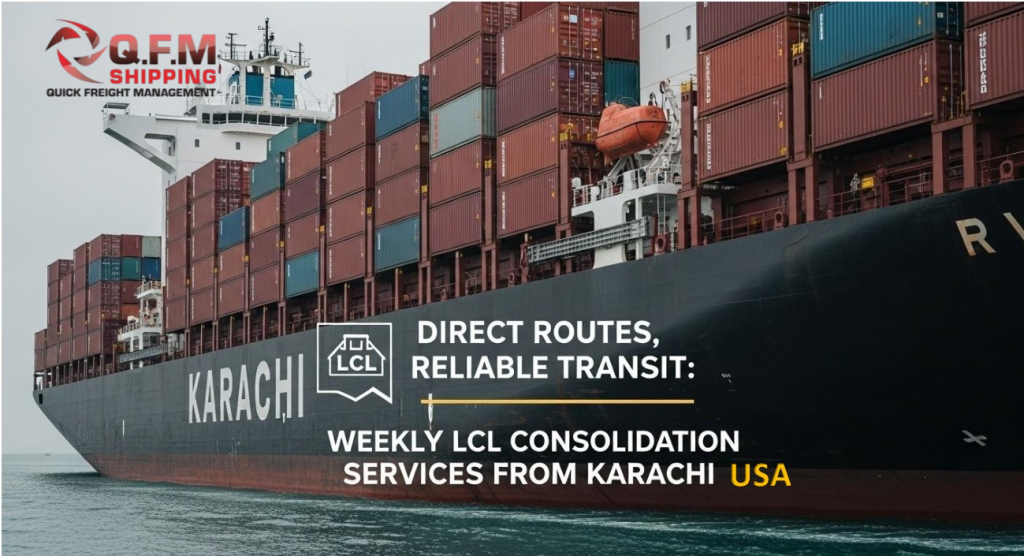
Direct Routes, Reliable Transit: Weekly LCL Consolidation Services from Karachi to the USA by QFM Shipping
In today’s global trade field, visibility, reliability, and cost efficiency are critical—especially for small and medium-sized exporters and importers. For cargo that isn’t large enough to fill an entire container, Less-than-Container Load (LCL) consolidation offers a smart middle ground: you share space with others, but still benefit from regular, dependable sailings. QFM Shipping is now offering weekly LCL consolidation services from Karachi to the USA, with direct routing and transit times that competitors will watch closely.
In this post, I’ll walk you through how QFM’s service works, why it matters, what the benefits and challenges are, and tips to make the most of this solution.
What Is LCL Consolidation & Why It Matters
Before diving into QFM’s offering, let’s reframe what LCL consolidation is and why it’s a valuable tool in global logistics.
-
LCL (Less-than-Container Load) means a freight shipment that doesn’t occupy the full volume of a standard container. Multiple such shipments get aggregated into one container.
-
A freight forwarder or consolidator receives cargo from several shippers, consolidates them at a Container Freight Station (CFS), and then loads them into full containers for onward ocean transport.
-
Because you only pay for the “space you use,” LCL is cost-efficient for smaller volumes.
-
The tradeoff, historically, has been time: transshipment, manual handling, and segmentation of cargo often slow things down and introduce risk.
But carriers and forwarders are innovating. The key is direct sailings (i.e. minimal or zero transshipment) and schedule integrity (i.e. consistent weekly departures). QFM Shipping is promoting exactly that approach for the Karachi → USA corridor. According to a LinkedIn post, they advertise “Direct LCL Consolidation from New York to Karachi Weekly Service | Direct Routing | Transit Time 38–40 Days.”
In their own marketing, QFM also emphasizes how LCL consolidations allow combining cargo from multiple shippers into one container.
QFM’s Weekly LCL Service: What It Promises
Here’s a breakdown of what QFM is offering (or promising) in this service, based on publicly available sources:
| Feature | What QFM Promises / Indicates | Why It’s Important |
|---|---|---|
| Weekly departures / schedule frequency | The marketing profile states QFM offers weekly LCL consolidation services globally. | Frequent sailings reduce waiting time for consolidation and improve flexibility. |
| Direct routing / minimal transshipment | The phrase “Direct Routing” is part of QFM’s pitch. | Fewer transshipment points reduce handling risk, delays, and potential damage. |
| Transit time (Karachi ↔ USA) | Their post to/from New York claims ~ 38–40 days. | That’s competitive for ocean freight with consolidation, especially considering fewer handlings. |
| Network & reach | Their company profile mentions export and import capability via their own offices and global agents. | A broader agent network strengthens end-to-end coverage and local support. |
| Transparency & cost control | QFM’s marketing emphasizes “smart LCL consolidation” and cost savings via combining shipments. | For small shippers, avoiding hidden fees and seeing a clear cost per cubic meter is critical. |
Taken together, QFM aims to deliver a more streamlined, lower-risk LCL service that bridges the gap between small shipments and full-container economies.
Benefits for Exporters / Importers in Pakistan
If you’re shipping smaller volumes from Karachi to the USA, here are major advantages to using QFM’s weekly LCL consolidation:
-
Cost Efficiency at Lower Volumes
You don’t need to fill a 20′ or 40′ container to benefit from sea freight. By sharing container space, you only pay for what you need. -
Consistent Schedule / Predictable Lead Times
Weekly sailings mean you don’t wait weeks for the next available departure. This helps with inventory planning and meeting delivery expectations. -
Reduced Transit & Handling Risk
Direct routing minimizes intermediate transshipment, which can reduce the chance of damage, theft, or customs delays. -
Better Asset Utilization
Smaller exporters whose cargo volume fluctuates won’t have to wait or under-utilize containers. -
Scalability
As your business grows, you can gradually increase your share of the container space, possibly transitioning to partial or full container service if needed. -
Global Reach & Local Support
QFM’s agent network and local offices (e.g. in Karachi) make documentation, customs, and pickup/delivery easier.
Challenges & What to Watch Out For
No solution is perfect, so here are caveats and risks you should manage:
-
Minimum Billable Volume / Dimensional Pricing: Even if your cargo is light, you might pay a minimum cubic meter charge. Also, volumetric (dimensional) weight rules may apply.
-
Port / CFS Congestion: Congestion or delays at Karachi port or at destination ports may still slow things down.
-
Customs Delays / Inspections: Since cargo is consolidated, one problematic item can hold up an entire container.
-
Damage or Misrouting Risks: More handling (loading, unloading, shifting) always introduces some risk. Packaging, labeling, and proper documentation are vital.
-
Coordination & Cut-off Times: You’ll need to meet deadlines for submission, packaging, and delivery to the consolidation point. Missing cut-offs might push you to the next sailing.
-
Hidden Charges / Surcharges: Be clear about origin handling charges, documentation fees, destination charges, peak season surcharges, etc.
-
Transit Variability: Even with a “38–40 day” estimate, weather, port delays, and geopolitical or regulatory shifts can stretch that.
Tips to Maximize Value & Minimize Risk
Here are some practical tips whether you’re new to LCL or upgrading your process:
-
Consolidate & Plan
Try to aggregate multiple smaller shipments into a weekly plan so you fill up more of your share in the container. -
Proper Packaging & Palletization
Use sturdy pallets, padding, braces, and label clearly to reduce damage and ease handling at CFS. -
Documentation Accuracy
Commercial invoice, packing list, certificate of origin, and any special permits must be correct—errors can hold shipments. -
Book Early / Meet Cut-offs
Submit your cargo and documents before the consolidation cut-off. Late submissions often incur delays or extra charges. -
Understand All Cost Components
Ask for a breakdown: origin handling, port fees, customs, inland haulage, destination CFS charges, etc., to avoid surprises. -
Insurance & Coverage
Even with careful handling, cargo in transit might face unexpected incidents. Insure appropriately. -
Track at Every Stage
Use the tracking or visibility tools offered by QFM. Being able to monitor at each CFS, port, and vessel helps you anticipate issues. -
Maintain Good Communication
Stay in touch with your forwarder, agent, and recipient. Align expectations, verify secure handovers, and clear paperwork promptly.
Sample Workflow (Karachi → USA via QFM LCL)
Here’s a simplified flow of how your cargo might move under QFM’s weekly LCL:
-
You (shipper) package your goods and deliver them to QFM’s designated Karachi consolidation warehouse or CFS by the cut-off date.
-
QFM inspects, palletizes, and aggregates your cargo with that of other shippers.
-
The full container is sealed and loaded onto a vessel with minimal or no transshipment.
-
The container sails directly toward the USA (or via minimal stops) under QFM’s routing.
-
Upon arrival at a U.S. port, the container is unloaded at the destination CFS.
-
QFM (or its U.S. partner) completes customs clearance, documentation, and arranges inland transport to final consignee.
-
You or your customer receives the goods.
Throughout this, QFM should provide updates at major milestones—loading, departure, arrival, customs release, and delivery.
Why This Service Marks an Advantage for Pakistani Exporters
For exporters in Karachi, Islamabad, Lahore, or other cities in Pakistan, this service signals a meaningful upgrade in competitiveness:
-
It helps SMEs who don’t have large cargo volumes to compete globally with manageable logistics costs.
-
It strengthens predictability in your supply chain, improving buyer trust.
-
It reduces capital tied up in inventory waiting to fill full containers.
-
It provides a smoother ramping path: as your volume grows, you can gradually scale your share and possibly move to full container loads in the same network.
-
As QFM expands its agent coverage and reputation, such direct LCL services might become a differentiator in Pakistan’s export logistics landscape.
Conclusion & Call to Action
QFM Shipping’s weekly LCL consolidation service from Karachi to the USA is a compelling option for exporters and importers who want reliable, cost-effective international freight without needing full containers. With direct routing, an advertised transit window of ~38–40 days, and an established agent network, it’s positioned to alleviate many of the traditional hassles of LCL shipments.
If you handle smaller volumes or want more frequent, predictable shipments to the U.S., this service deserves a closer look:
-
Reach out to QFM’s Karachi office for their current sailing schedules, cut-off times, and rate sheets.
-
Ask for references or case studies of exports similar to yours.
-
Run a trial shipment to test timing, handling, and communication.
-
Monitor performance against promises (transit time, damage, clarity of billing) and decide whether to adopt it as part of your regular logistics portfolio.
Getting Started is Easy
Ready to simplify your shipping? Contact us today for a free consultation and a custom quote. Our team is ready to design a logistics plan that will save you time, reduce costs, and give you peace of mind.
Contact Us:
-
Email: info@qfmshipping.com
-
Website: www.qfmshipping.com
Tags:
LCL consolidation services, Karachi to USA shipping, weekly LCL service, direct LCL routes, reliable ocean freight, QFM Shipping logistics, less than container load Karachi, cost-effective shipping solutions, LCL freight forwarding, consolidated cargo service, direct routing transit, Pakistan exporters shipping, small business export logistics, affordable sea freight USA, cargo consolidation Karachi,
Karachi to USA LCL, Karachi to New York shipping, Karachi port consolidation, Pakistan to USA weekly shipping, Karachi export services, Karachi international freight, Karachi to Miami LCL shipping, Karachi to Dallas logistics, Karachi to Atlanta freight forwarding, Karachi port to USA destinations, Pakistan to USA trade routes, Karachi container consolidation
