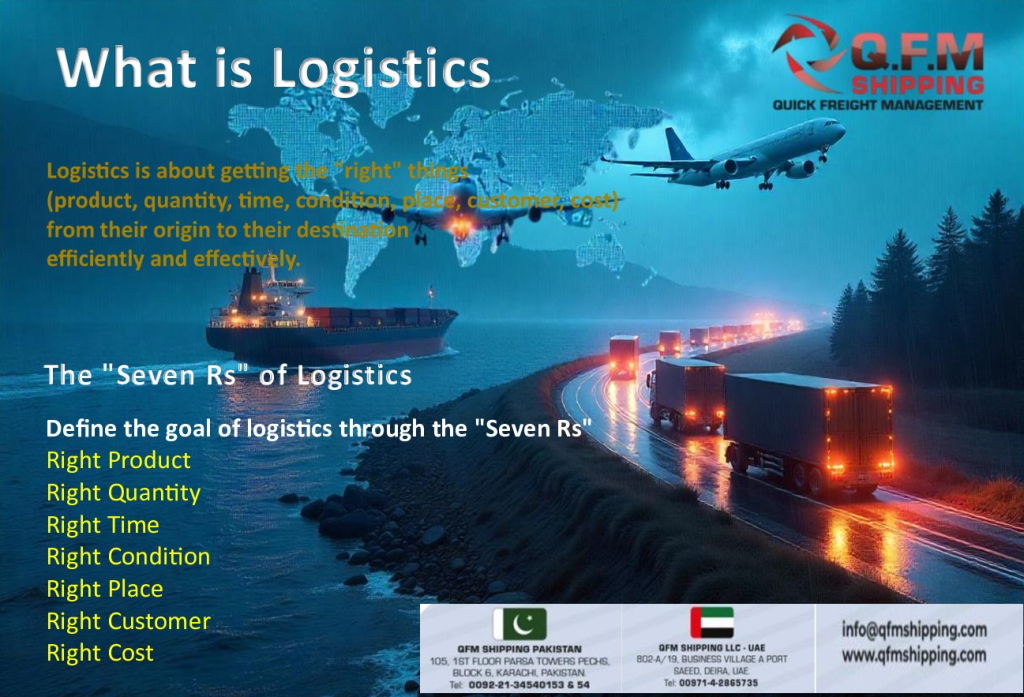
Logistics, at its core, is the detailed coordination and execution of a complex operation involving the movement, storage, and flow of goods, services, and information. It’s about getting the “right” things (product, quantity, time, condition, place, customer, cost) from their origin to their destination efficiently and effectively.
While often used interchangeably with “supply chain management,” it’s crucial to understand that logistics is a vital component within the broader supply chain. The supply chain encompasses the entire network of organizations and activities, whereas logistics focuses specifically on the physical movement and storage aspects.
Let’s break down logistics in detail:
The “Seven Rs” of Logistics
A widely accepted way to define the goal of logistics management is through the “Seven Rs”:
- Right Product: Ensuring the correct item is being moved.
- Right Quantity: Delivering the precise amount needed, avoiding shortages or overstocking.
- Right Time: Getting the product to its destination exactly when it’s required.
- Right Condition: Ensuring the product arrives undamaged and in optimal quality.
- Right Place: Delivering to the exact location where it’s needed.
- Right Customer: Reaching the intended recipient.
- Right Cost: Achieving all the above in the most cost-effective manner possible.
Key Components and Functions of Logistics
To achieve the “Seven Rs,” logistics involves a myriad of interconnected activities:
- Transportation Management: This is arguably the most visible part of logistics. It involves:
- Mode Selection: Choosing the most appropriate transportation method (truck, rail, air, sea, pipeline) based on factors like speed, cost, distance, and product type.
- Carrier Selection: Choosing the specific company that will transport the goods.
- Route Optimization: Planning the most efficient routes to minimize travel time, fuel consumption, and costs.
- Fleet Management: For companies with their own vehicles, managing maintenance, scheduling, and driver performance.
- Shipment Tracking: Monitoring the real-time location and status of goods in transit.
- Freight Auditing & Payment: Verifying invoices and ensuring accurate payment for transportation services.
- Warehousing and Storage: This involves the strategic placement and management of goods:
- Warehouse Design & Layout: Optimizing the physical arrangement of a warehouse for efficient storage, picking, and packing.
- Material Handling: The movement, protection, storage, and control of materials and products throughout the manufacturing, warehousing, distribution, and consumption processes. This includes equipment like forklifts, conveyors, and automated systems.
- Storage Methods: Deciding how goods are stored (e.g., pallet racking, bulk storage).
- Cross-Docking: Directly transferring goods from inbound to outbound transportation without long-term storage, reducing handling and storage costs.
- Inventory Management: This is about having the right amount of product at the right time and place:
- Demand Forecasting: Predicting future customer demand to inform purchasing and production decisions.
- Stock Level Management: Determining optimal stock levels to balance availability with carrying costs.
- Order Point and Replenishment: Triggering new orders when stock reaches a certain level.
- Safety Stock: Holding extra inventory to buffer against unexpected demand spikes or supply disruptions.
- Inventory Control Systems: Using software (like WMS or ERP) to track inventory movement, location, and status.
- Order Fulfillment: The process of receiving, processing, and delivering customer orders:
- Order Processing: Receiving and validating customer orders.
- Picking: Retrieving specific items from warehouse storage to fulfill an order.
- Packing: Preparing items for shipment, including proper protection and labeling.
- Shipping: Handing over packaged orders to the chosen carrier.
- Returns Management (Reverse Logistics): Handling products that customers return, for repair, refund, or disposal.
- Packaging and Unitization:
- Protective Packaging: Designing and using packaging that protects goods from damage during handling and transport.
- Unitization: Grouping or bundling smaller packages into larger, more manageable units (e.g., pallets, containers) for efficient handling and storage.
- Labeling: Ensuring correct and compliant labeling for identification, tracking, and regulatory purposes.
- Information Flow: The effective exchange of data and communication across the logistics network is crucial:
- Data Management: Collecting, storing, and analyzing data related to inventory, shipments, costs, and performance.
- Communication: Ensuring clear and timely communication between all stakeholders (suppliers, carriers, warehouses, customers).
- Technology Systems: Utilizing various software solutions like Transportation Management Systems (TMS), Warehouse Management Systems (WMS), Enterprise Resource Planning (ERP), and Electronic Data Interchange (EDI) to automate and optimize processes.
- Customer Service: While not a direct “movement” function, excellent customer service is a direct outcome of effective logistics:
- Timely and Accurate Information: Providing customers with real-time updates on their orders.
- Addressing Inquiries and Issues: Promptly resolving any problems related to delivery or product condition.
- Meeting Expectations: Ensuring products arrive as promised, leading to customer satisfaction and loyalty.
Importance of Logistics in Business
Logistics is not just a cost center; it’s a strategic differentiator:
- Cost Reduction: Efficient logistics minimizes transportation costs, warehousing expenses, and inventory holding costs.
- Enhanced Customer Satisfaction: Timely and accurate deliveries, coupled with good communication, lead to happy customers and repeat business.
- Competitive Advantage: Companies with superior logistics can offer faster delivery, lower prices, or more reliable service, setting them apart from competitors.
- Improved Efficiency and Productivity: Streamlined processes and optimized resource utilization boost overall operational efficiency.
- Better Inventory Control: Reduces stockouts (lost sales) and overstocking (carrying costs), improving cash flow.
- Risk Management: Proactive logistics planning helps mitigate risks like supply chain disruptions, natural disasters, or unexpected demand changes.
- Global Reach: Effective international logistics enables businesses to expand into new markets and source from a global supplier base.
- Sustainability: “Green logistics” initiatives focus on reducing environmental impact through optimized routes, fuel efficiency, and sustainable packaging.
In essence, logistics is the engine that drives the physical movement of goods throughout the economy, ensuring that products are available where and when they are needed, at the right cost, and in the right condition. It’s a complex, dynamic field that requires meticulous planning, precise execution, and continuous optimization.
Global shipping, made local. Global logistics, made simple.
That’s the QFM promise.
Contact QFM Shipping today and experience logistics reimagined.
