
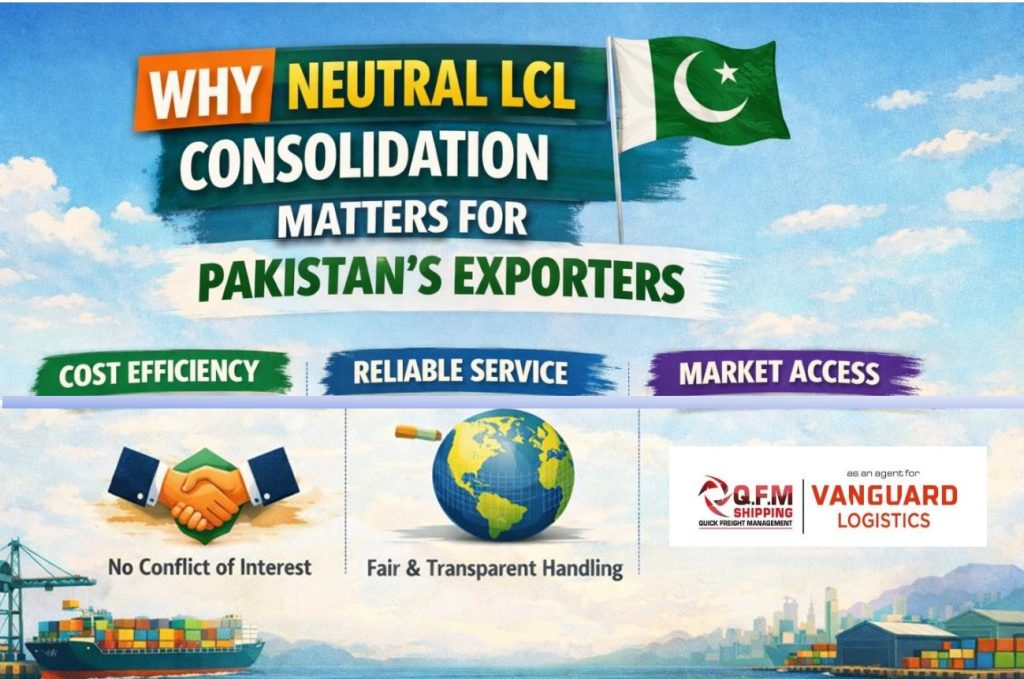
Why Neutral LCL Consolidation Matters for Pakistan’s Exporters
Pakistan’s export sector—spanning textiles, pharmaceuticals, surgical instruments, sports goods, FMCG, and SMEs—relies heavily on Less than Container Load (LCL) shipments. However, not all LCL models are equal. Increasingly, exporters are discovering that Neutral LCL Consolidation is not just a logistics preference, but a strategic necessity.
This article explains why neutral LCL consolidation matters for Pakistan’s exporters, how it differs from traditional models, and the tangible commercial advantages it delivers in global trade.
Understanding Neutral LCL Consolidation
Neutral LCL consolidation refers to a logistics model where the consolidator does not compete with freight forwarders or exporters. Instead, the consolidator operates strictly as a backend service provider—offering consolidation, deconsolidation, and network access without sales interference.
In contrast to carrier-owned or forwarder-owned consolidation programs, neutral consolidators maintain commercial neutrality, ensuring transparency, fairness, and long-term trust.
Key Challenges Faced by Pakistan’s Exporters Without Neutral LCL
Before understanding the benefits, it is important to recognize the pain points Pakistan exporters often face in non-neutral environments:
-
Rate volatility and opaque pricing
-
Cargo rollovers and inconsistent weekly sailings
-
Conflict of interest where consolidators also sell directly to shippers
-
Limited global CFS and destination coverage
-
Dependence on single-origin or single-route solutions
Neutral LCL consolidation directly addresses these structural issues.
Strategic Benefits of Neutral LCL Consolidation for Pakistan
1. Commercial Neutrality and Trust
Neutral consolidators do not solicit exporters directly. This removes fear of client poaching and ensures:
-
No conflict of interest
-
Transparent handling of cargo
-
Long-term partnerships with freight forwarders
-
Stable pricing structures
For Pakistan’s export ecosystem—where relationships and trust are critical—this neutrality is a decisive advantage.
2. Cost Efficiency Without Rate Wars
Neutral LCL consolidation enables:
-
Aggregated cargo volumes across multiple forwarders
-
Better vessel space allocation
-
Predictable cost structures
-
Reduced last-minute surcharges
Instead of artificial rate suppression followed by sudden increases, exporters benefit from sustainable and defensible pricing.
3. Reliable Weekly Sailings and Transit Consistency
Pakistan exporters often suffer from irregular sailings and missed cut-offs. Neutral LCL programs typically offer:
-
Fixed weekly consol departures
-
Consistent routing via major global hubs
-
Reduced cargo rollovers
-
Improved schedule integrity
This reliability is especially critical for time-sensitive exports such as fashion garments, pharmaceuticals, and FMCG.
4. Multi-Origin and Global Market Access
Neutral LCL networks are designed around multi-origin and multi-destination connectivity, enabling Pakistan exporters to:
-
Reach Europe, North America, Middle East, Far East, and Africa efficiently
-
Access multiple CFS locations globally
-
Leverage transshipment hubs without dependency on a single carrier
This flexibility allows exporters to scale into new markets without reengineering their supply chains.
5. Protection of Forwarder–Exporter Relationships
For Pakistan’s export industry, freight forwarders play a critical advisory and operational role. Neutral LCL consolidation:
-
Strengthens the forwarder’s position as the primary service provider
-
Eliminates fear of backend competition
-
Encourages forwarders to invest in exporter growth
-
Creates a stable ecosystem rather than transactional pricing battles
This stability directly benefits exporters through better service quality.
6. Improved Risk Management and Compliance
Neutral consolidators typically operate large, standardized global networks with:
-
SOP-driven CFS operations
-
Better cargo visibility
-
Lower compliance and documentation risk
-
Strong destination handling partners
For exporters facing increasing scrutiny from buyers and customs authorities, this reduces operational and reputational risk.
Why Neutral LCL Is Especially Important for Pakistan
Pakistan’s export base is dominated by SMEs, not mega-shippers. Neutral LCL consolidation empowers these exporters by:
-
Allowing smaller shipment sizes without penalties
-
Offering professional global reach without FCL volumes
-
Supporting gradual market expansion
-
Reducing dependency on single forwarders or carriers
In essence, neutral LCL acts as an export enabler, not just a transport solution.
The Long-Term Impact on Pakistan’s Export Competitiveness
When exporters have access to neutral LCL consolidation, the national export ecosystem benefits through:
-
Lower logistics friction
-
Improved delivery reliability
-
Stronger buyer confidence
-
Greater SME participation in global trade
-
Enhanced supply-chain resilience
As global buyers demand reliability, transparency, and compliance, neutral LCL consolidation becomes a competitive differentiator for Pakistan.
Conclusion
Neutral LCL consolidation is no longer optional for Pakistan’s exporters—it is a strategic requirement. By eliminating conflicts of interest, stabilizing costs, improving reliability, and expanding market access, neutral LCL models directly strengthen Pakistan’s export competitiveness.
For exporters aiming to grow sustainably in volatile global markets, neutral LCL consolidation provides the foundation for trust, scalability, and long-term success.
Ready to explore collaboration opportunities? Reach out to our team to discuss your LCL needs, strategic partnerships, and custom routing options. Let’s build stronger, smarter logistics together.
Email: info@qfmshipping.com
Phone: +92-21-34540153 & 54
+92-21-34540135 & 36
Tags:
neutral LCL consolidation, Pakistan exporters logistics, LCL shipping Pakistan, neutral freight consolidation, Pakistan export shipping, LCL consolidation benefits, global LCL network, SME export logistics Pakistan, QFM Shipping,
