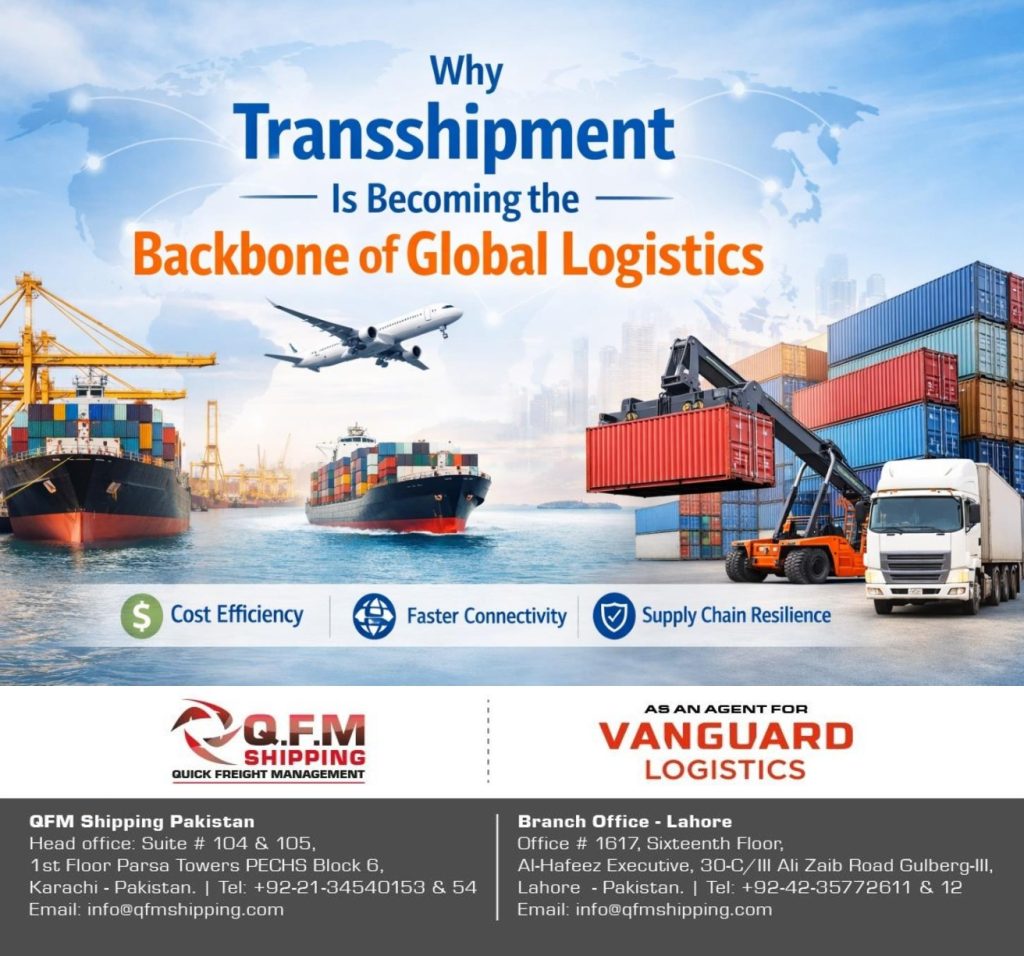
Why Transshipment Is Becoming the Backbone of Global Logistics
A New Era in Global Logistics
Global trade is undergoing a fundamental transformation. Supply chains that once relied on predictable routes and stable transit times are now navigating unprecedented disruptions—from geopolitical tensions to port congestion and volatile freight rates.
In this rapidly evolving environment, transshipment in global logistics is no longer just an operational necessity—it has become a strategic advantage.
Businesses that understand and leverage transshipment are gaining faster transit times, lower costs, and increased flexibility. At the forefront of this shift is QFM Shipping Pakistan, enabling exporters and freight forwarders to capitalize on emerging transshipment opportunities.
What Is Transshipment in Global Logistics?
Transshipment refers to the process of transferring cargo from one vessel to another at an intermediate port before reaching its final destination.
Instead of direct shipping, cargo moves through a transshipment hub, where it is consolidated, redirected, and optimized for onward transport.
Simple Example:
- Cargo from Pakistan → Transshipment hub → Final destination (e.g., Dubai, Oman, Europe)
This model allows logistics providers to:
- Optimize shipping routes
- Consolidate cargo efficiently (especially LCL shipments)
- Reduce overall transportation costs
Why Transshipment Is Rising Rapidly in 2026
1. Global Supply Chain Disruptions
Ongoing geopolitical tensions, particularly in the Middle East, have disrupted traditional shipping routes. Thousands of vessels have faced delays, rerouting, and increased insurance costs.
As a result, companies are shifting toward alternative transshipment hubs that offer safer and more reliable routes.
👉 Key Insight: Transshipment enables cargo rerouting without halting supply chains.
2. Rising Freight Costs & Optimization Needs
Freight rates and fuel prices have surged, pushing businesses to seek cost-efficient logistics solutions.
Transshipment helps by:
- Consolidating cargo (reducing per-unit shipping cost)
- Using optimized routes with better vessel utilization
- Avoiding expensive direct shipping lanes
👉 Result: Lower logistics costs without compromising delivery timelines.
3. Growth of LCL (Less-than-Container Load) Shipping
Small and medium exporters are increasingly relying on LCL shipments. Transshipment is critical for LCL because it allows cargo from multiple shippers to be consolidated efficiently.
Without transshipment, LCL would be economically unviable.
👉 This makes transshipment the backbone of:
- E-commerce logistics
- SME exports
- Multi-country consolidation (MCC)
4. Emergence of New Strategic Hubs
Countries like Pakistan are emerging as powerful transshipment hubs due to:
- Strategic geographic location
- Improved port infrastructure
- Favorable government policies
With recent regulatory developments, Pakistan is now positioned as a gateway for GCC and global trade routes.
Pakistan’s Strategic Role in Transshipment
Pakistan is rapidly gaining importance in global logistics due to its proximity to major trade corridors.
Key Advantages:
- Direct access to Middle East, Asia, and Africa
- Reduced transit time for GCC-bound cargo
- Cost-effective port operations
- Growing neutral consolidation networks
Ports Leading the Shift:
- Karachi Port
- Port Qasim
These ports are becoming critical nodes for transshipment in global logistics, especially for cargo destined for:
- UAE (Dubai)
- Saudi Arabia
- Oman
- Qatar
- Kuwait
How QFM Shipping Pakistan Is Leading This Transformation
QFM Shipping Pakistan is playing a pivotal role in redefining transshipment in the region.
🔹 Key Strengths:
1. Neutral LCL Consolidation
QFM ensures complete confidentiality for global freight forwarders, protecting client relationships while enabling efficient cargo movement.
2. Strategic Partnerships
Strong global network connections allow seamless cargo transitions across multiple trade lanes.
3. Flexible Routing Solutions
QFM offers adaptable transshipment options, helping clients avoid disruptions and delays.
4. Cost Optimization
Through consolidation and route optimization, QFM significantly reduces freight costs.
5. Reliability in Volatile Markets
In uncertain times, QFM provides stable, predictable logistics solutions.
Transshipment vs Direct Shipping
| Factor | Transshipment | Direct Shipping |
|---|---|---|
| Cost | Lower (via consolidation) | Higher |
| Flexibility | High | Limited |
| Transit Time | Optimized (in many cases) | Fixed |
| Risk Management | Better during disruptions | Vulnerable |
| LCL Suitability | Excellent | Limited |
👉 Conclusion: In today’s volatile market, transshipment often outperforms direct shipping.
Key Benefits of Transshipment in Global Logistics
✅ 1. Cost Efficiency
Lower shipping costs through consolidation and optimized routing.
✅ 2. Flexibility
Ability to reroute cargo quickly based on market conditions.
✅ 3. Risk Mitigation
Avoid high-risk zones and unstable routes.
✅ 4. Improved Connectivity
Access to global trade networks via hub ports.
✅ 5. Scalability
Ideal for businesses of all sizes, especially SMEs.
Challenges in Transshipment (And How to Overcome Them)
While transshipment offers significant advantages, it also presents challenges:
❌ Potential Delays at Intermediate Ports
👉 Solution: Work with reliable partners like QFM Shipping
❌ Handling Risks
👉 Solution: Proper packaging and experienced operators
❌ Documentation Complexity
👉 Solution: Expert freight forwarders managing compliance
Future of Transshipment in Global Logistics
The future of transshipment in global logistics is driven by:
Digitalization
AI and data analytics are optimizing route planning and cargo flow.
Smart Ports
Automation is reducing turnaround times and improving efficiency.
E-commerce Growth
Demand for faster, flexible shipping is increasing reliance on transshipment.
Integrated Supply Chains
Transshipment hubs will become central nodes in global logistics networks.
Why Smart Exporters Are Adopting Transshipment
Forward-thinking exporters are leveraging transshipment to:
- Stay competitive in volatile markets
- Reduce operational costs
- Improve delivery reliability
- Expand into new markets
👉 Key Insight: Transshipment is no longer optional—it is essential.
Conclusion: The Backbone of Modern Logistics
In 2026 and beyond, transshipment in global logistics is not just supporting global trade—it is powering it.
From enabling cost efficiency to ensuring supply chain resilience, transshipment has become the backbone of modern logistics.
With strategic hubs like Pakistan emerging and industry leaders like QFM Shipping Pakistan driving innovation, businesses now have access to smarter, faster, and more reliable logistics solutions.
Call to Action
Ready to optimize your cargo movement?
Partner with QFM Shipping Pakistan and leverage the power of transshipment to stay ahead in global trade.
Contact us today to explore smarter shipping solutions.
Partner with QFM Shipping Pakistan today.
Secure your shipments. Protect your clients. Grow your network with confidence.
 Book your next LCL shipment with a trusted neutral partner
QFM Shipping Pakistan
Your Trusted Neutral LCL Consolidation Partner
 Contact us |
  Global Reach |
  Reliable Partnerships
It’s time to move with QFM Shipping Pakistan.
Move Smarter. Ship with Confidence.
QFM Shipping Pakistan
Karachi : Suite # 104 & 105, 1st Floor Parsa Towers PECHS Block 6 Karachi
Tel: 0092-21-34540153 & 54
Lahore: Suite # 1617, 16th Floor, Al Hafeez Executive Gulberg III, Lahore
Tel: 0092-42-35772611 & 12
Email: pricing.pkkhi@qfmshipping.com
Mobile: 0092-321-8280327
Tags:
transshipment in global logistics, transshipment hub Pakistan, LCL transshipment, global shipping disruption, freight forwarding Pakistan, neutral consolidation Pakistan, supply chain optimization, logistics trends 2026
Read More:
3- Neutral Freight Forwarder Pakistan
