
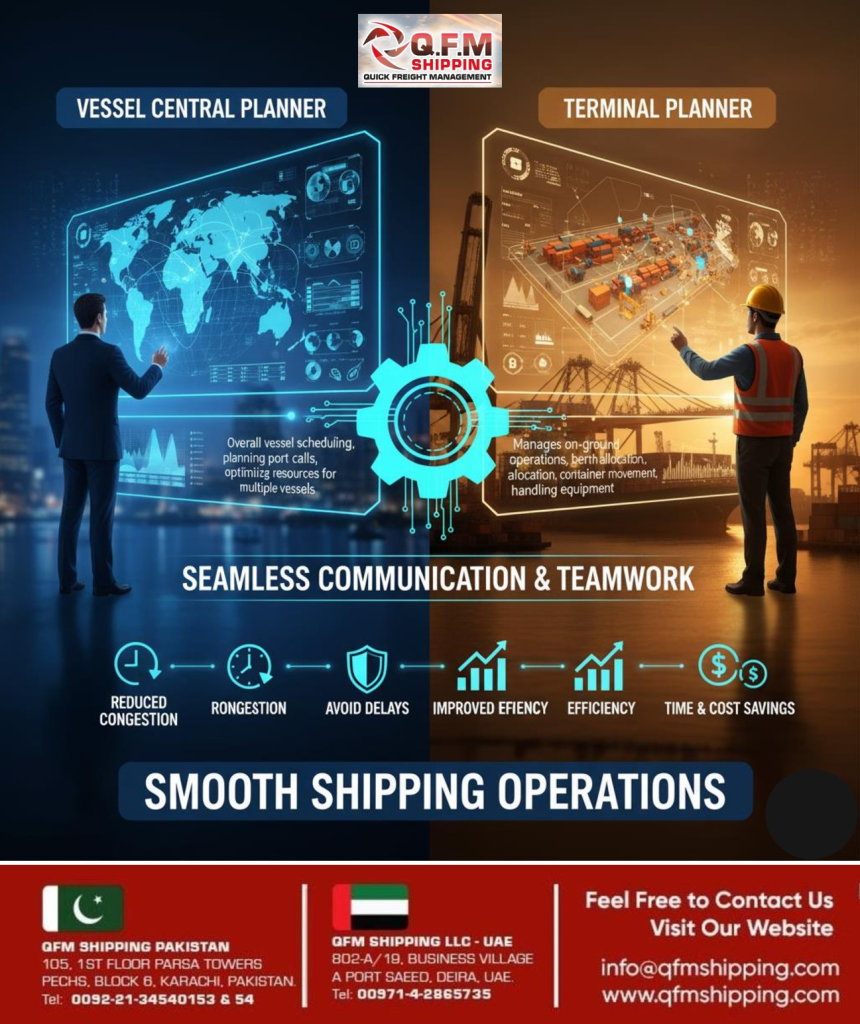
Vessel vs Terminal Planning – The Power of Perfect Coordination
In the high-stakes world of shipping and logistics, time truly is money. Ports are the lifelines of global trade, but their efficiency hinges on one critical factor: coordination between Vessel Central Planners and Terminal Planners. While their roles may seem distinct, the reality is that their success is deeply intertwined. Let’s explore how these two functions complement each other and why seamless collaboration is the backbone of smooth maritime operations.
The Role of the Vessel Central Planner
The Vessel Central Planner operates at the strategic level, ensuring that ships move on schedule and resources are optimized. Their key responsibilities include:
-
Scheduling vessels for timely arrivals and departures.
-
Planning port calls with precision to minimize idle time.
-
Optimizing resources across multiple vessels to reduce costs and improve turnaround.
Think of them as the air traffic controllers of the sea—their focus is on big-picture coordination across fleets.
The Role of the Terminal Planner
On the other hand, the Terminal Planner is responsible for the on-ground realities of port operations. Their responsibilities include:
-
Managing berth allocation so that ships dock efficiently.
-
Overseeing container movements to ensure cargo flows seamlessly.
-
Directing handling equipment to maximize speed and safety.
Terminal Planners are the orchestrators of the port floor—balancing space, equipment, and workforce to keep operations running smoothly.
Why Coordination is Everything
When Vessel Central Planners and Terminal Planners work in isolation, ports risk:
-
Congestion, leading to costly waiting times.
-
Delays, which ripple through supply chains globally.
-
Inefficiencies, that waste resources and erode profitability.
But when both roles sync up, the benefits are immediate and measurable:
✅ Reduced congestion through better scheduling and berth planning.
✅ Avoided delays with real-time communication and updates.
✅ Improved efficiency by aligning strategy with execution.
This synergy doesn’t just save time and costs—it builds trust among shipping lines, terminal operators, and customers.
Beyond Schedules: The Human Element
At its core, effective planning isn’t just about numbers, charts, or software systems. It’s about seamless communication, shared objectives, and teamwork. Vessel and terminal planners must operate as one unit, bridging strategy and ground execution.
When they do, the port ecosystem transforms: vessels move faster, terminals operate smoother, and the global supply chain flows with fewer disruptions.
Final Word
In shipping, perfect coordination is the true competitive edge. A vessel can only be as efficient as the terminal it calls at, and a terminal can only be as effective as the vessels it services. Together, Vessel Central Planners and Terminal Planners create a symphony of efficiency that keeps global trade moving.
In the end, it’s not Vessel vs Terminal Planning—it’s Vessel and Terminal Planning.
Getting Started is Easy
Ready to simplify your shipping? Contact us today for a free consultation and a custom quote. Our team is ready to design a logistics plan that will save you time, reduce costs, and give you peace of mind.
Contact Us:
-
Email: info@qfmshipping.com
-
Website: www.qfmshipping.com
vessel planning, terminal planning, vessel vs terminal planning, port operations planning, maritime logistics coordination, container terminal operations, vessel central planner, terminal planner, port scheduling efficiency, shipping operations optimization, vessel scheduling and port calls, berth allocation in shipping, container handling efficiency, reducing port congestion, avoiding shipping delays, improving port efficiency, maritime supply chain management, port logistics teamwork, vessel and terminal coordination, cost savings in port operations, Karachi port operations, South Asia maritime logistics, global shipping hub Karachi, Middle East port planning, Pakistan vessel and terminal coordination
