
In today’s competitive global trade environment, importers are under constant pressure to reduce logistics costs without compromising delivery reliability. Rising freight charges, warehousing expenses, container shortages, and inventory delays have made traditional shipping methods increasingly expensive for small and medium-sized businesses.
This is where Weekly LCL Consolidation has become a game-changing logistics strategy.
For smart importers, Less than Container Load (LCL) consolidation is no longer just an alternative to Full Container Load (FCL) shipping — it is now a strategic cost-optimization model that improves flexibility, cash flow, and supply chain efficiency.
At QFM Shipping, businesses are increasingly leveraging weekly consolidation services to move cargo efficiently across global trade lanes while significantly lowering operational costs.
What Is Weekly LCL Consolidation?
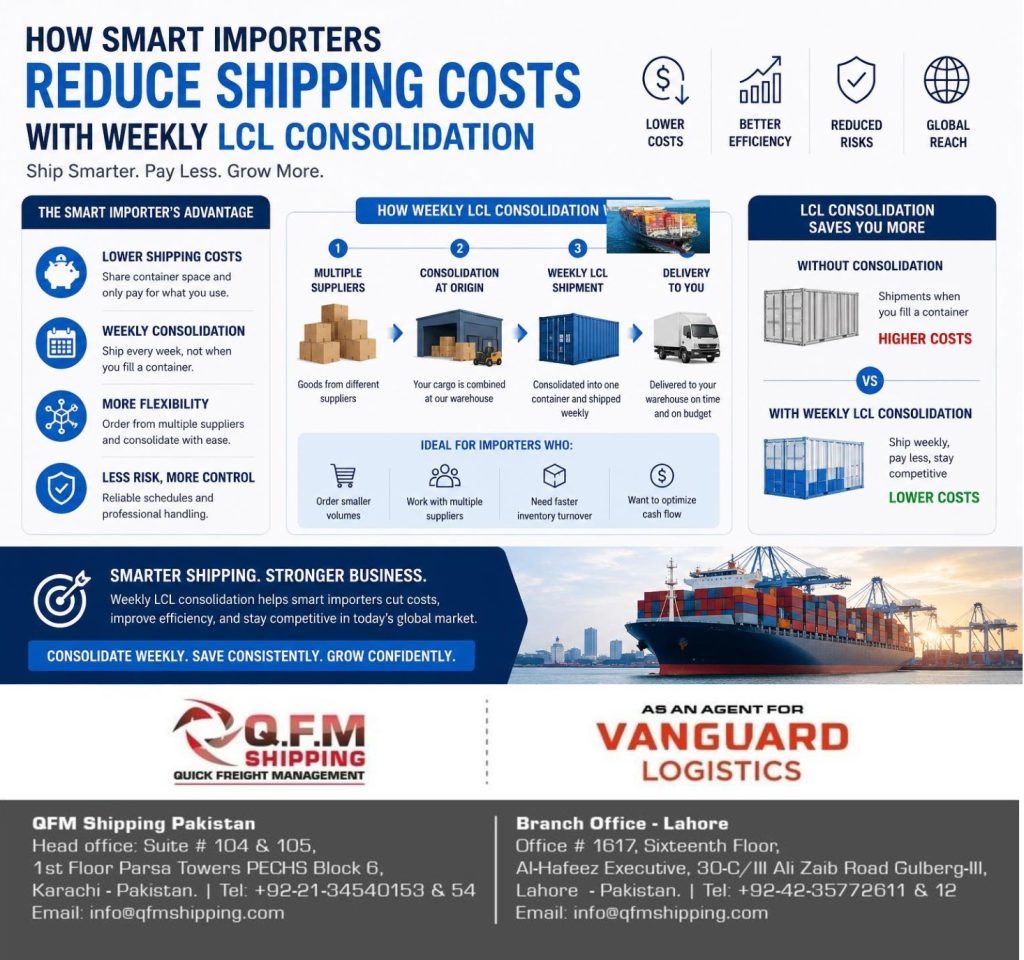
Weekly LCL consolidation is a freight forwarding method where multiple shipments from different importers are combined into one shared container. Instead of paying for an entire container, importers only pay for the space their cargo occupies.
Once consolidated, the shipment moves on a scheduled weekly basis from origin ports to destination ports.
This model is especially beneficial for:
- SMEs importing smaller cargo volumes
- Businesses sourcing from multiple suppliers
- E-commerce brands with frequent inventory needs
- Importers are avoiding high warehousing costs
- Companies seeking faster inventory turnover
Why Smart Importers Prefer Weekly LCL Consolidation
1. Lower Shipping Costs
One of the biggest advantages of weekly LCL shipping is cost efficiency.
With FCL shipping, importers must either:
- Wait until they have enough cargo to fill a container
- Or pay for unused container space
Weekly LCL consolidation eliminates both problems.
Importers share:
- Container costs
- Port handling charges
- Freight expenses
- Destination fees
This significantly reduces per-unit shipping costs.
For growing businesses, this means:
- Better profit margins
- Reduced landed costs
- More competitive pricing in local markets
2. No Need to Wait for Full Container Loads
Traditional import strategies often delay shipments because businesses wait to accumulate enough goods to justify booking a full container.
This creates several issues:
- Delayed inventory availability
- Slower business cycles
- Lost sales opportunities
- Increased storage costs at supplier warehouses
With weekly LCL consolidation, cargo moves every week on fixed schedules.
This allows businesses to:
- Import smaller quantities more frequently
- Maintain steady inventory flow
- Respond quickly to market demand
- Reduce overstock risks
3. Improved Cash Flow Management
Cash flow is critical for importers, especially SMEs.
Booking an entire container requires:
- Higher upfront inventory investment
- Larger shipping budgets
- Increased warehousing expenses
Weekly LCL consolidation allows businesses to import in smaller, manageable volumes.
Benefits include:
- Reduced capital blockage
- Faster inventory turnover
- Better liquidity
- Easier inventory planning
Smart importers understand that efficient cash flow often matters more than bulk purchasing discounts.
4. Consolidating Cargo from Multiple Suppliers
Many importers source products from different suppliers across various cities or countries.
Without consolidation, this often leads to:
- Multiple shipping bookings
- Higher freight costs
- Complex logistics coordination
- Delayed synchronization
LCL consolidation solves this problem by combining cargo from multiple suppliers into one shipment.
At QFM Shipping, consolidated logistics solutions help businesses streamline imports from major global trade hubs while minimizing complexity and costs.
5. Reduced Warehousing and Inventory Costs
Large inventory volumes create unnecessary storage expenses.
Weekly LCL shipping supports lean inventory management by enabling:
- Smaller and more frequent shipments
- Faster stock replenishment
- Reduced warehouse dependency
- Lower inventory holding costs
Businesses can operate more efficiently without tying up resources in excess stock.
6. Faster Market Responsiveness
Global markets change rapidly.
Consumer demand, seasonal trends, and product cycles evolve quickly, especially in industries such as:
- Electronics
- Fashion
- Retail
- Automotive parts
- E-commerce
Weekly LCL consolidation enables importers to:
- Adapt quickly to demand changes
- Test products in smaller batches
- Launch inventory faster
- Reduce unsold stock risk
This flexibility provides a major competitive advantage.
7. Better Supply Chain Predictability
Scheduled weekly consolidations improve supply chain reliability.
Instead of unpredictable shipment timing, importers benefit from:
- Fixed sailing schedules
- Consistent transit planning
- Better forecasting
- Improved inventory control
Reliable logistics reduce operational uncertainty and help businesses plan with confidence.
Industries Benefiting Most from Weekly LCL Consolidation
Weekly LCL services are ideal for businesses dealing with moderate or recurring cargo volumes.
Industries benefiting the most include:
Retail and E-Commerce
Frequent inventory replenishment without excessive storage costs.
Automotive Parts
Consistent supply of spare parts and components.
Consumer Electronics
Fast-moving inventory with shorter product life cycles.
Fashion and Apparel
Seasonal imports require agile supply chain management.
SMEs and Startups
Affordable importing without the financial burden of full containers.
How QFM Shipping Supports Smart Importers
QFM Shipping provides professional weekly LCL consolidation services designed to help importers optimize costs and improve logistics efficiency.
Key advantages include:
- Weekly global consolidation schedules
- Professional cargo handling
- Reliable transit planning
- Multi-supplier cargo consolidation
- Competitive freight solutions
- Efficient customs coordination
- Dedicated customer support
By simplifying international shipping operations, QFM Shipping enables businesses to focus on growth instead of logistics complications.
Weekly LCL Consolidation vs Traditional Shipping
| Feature | Weekly LCL Consolidation | Traditional FCL Shipping |
|---|---|---|
| Shipping Cost | Lower shared cost | Higher full-container cost |
| Inventory Flexibility | High | Limited |
| Cash Flow Efficiency | Better | Lower |
| Shipment Frequency | Weekly | Depends on cargo volume |
| Supplier Coordination | Easier | More complex |
| Storage Costs | Lower | Higher |
| Risk of Overstock | Reduced | Higher |
The Future of Smart Importing
Global supply chains are evolving toward flexibility, efficiency, and scalability.
Smart importers are increasingly moving away from rigid full-container models and adopting agile logistics strategies that prioritize:
- Lower operational costs
- Faster cargo movement
- Inventory optimization
- Better cash flow
- Scalable growth
Weekly LCL consolidation is becoming one of the most effective logistics solutions for modern importers seeking long-term competitiveness.
Final Thoughts
Reducing shipping costs is no longer only about negotiating freight rates. It is about building a smarter, more efficient supply chain.
Weekly LCL consolidation helps businesses:
- Ship smarter
- Reduce unnecessary logistics expenses
- Improve inventory management
- Increase operational flexibility
- Scale globally with confidence
For businesses looking to optimize imports and strengthen supply chain efficiency, QFM Shipping offers reliable weekly consolidation services tailored for modern trade requirements.
Ready to optimize your LCL shipping strategy?
 Request a Shipping Consultation Explore Smarter LCL Solutions Improve Supply Chain Efficiency Today
Connect with QFM Shipping Pakistan
Karachi : Suite # 104 & 105, 1st Floor Parsa Towers PECHS Block 6 Karachi
Tel: 0092-21-34540153 & 54
Lahore: Suite # 1617, 16th Floor, Al Hafeez Executive Gulberg III, Lahore
Tel: 0092-42-35772611 & 12
Email: pricing.pkkhi@qfmshipping.com
Mobile: 0092-321-8280327
Tags:
weekly LCL consolidation, LCL shipping services, reduce shipping costs, smart importers, freight consolidation, international shipping solutions, cargo consolidation services, import logistics optimization, weekly cargo consolidation, LCL freight forwarding, supply chain cost reduction, QFM Shipping, global freight solutions, SME importing solutions, logistics cost optimization
