
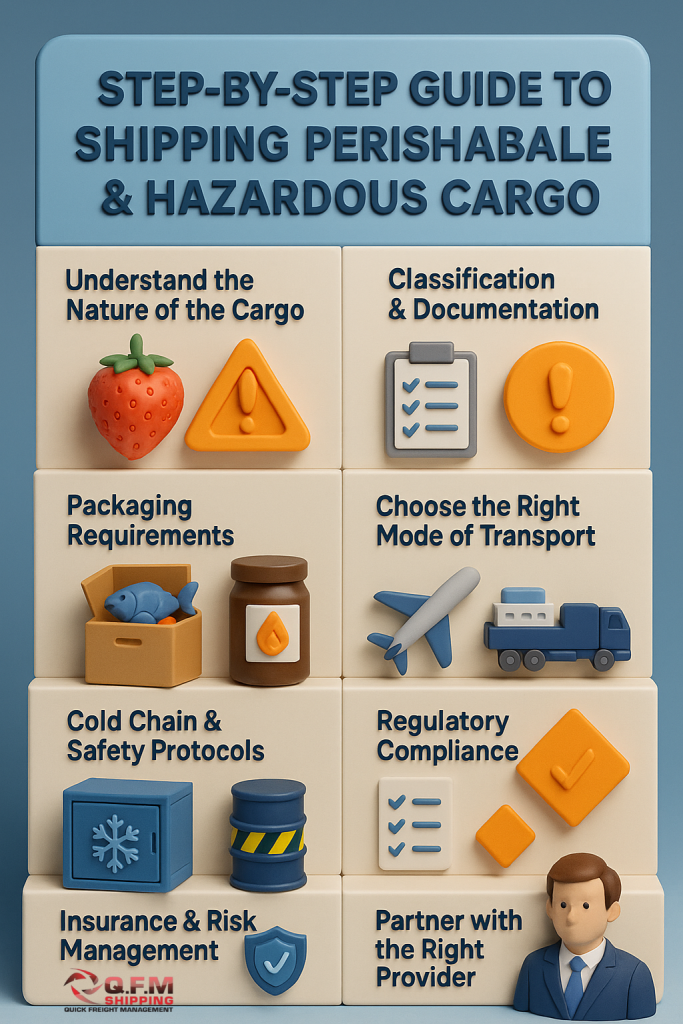
Step-by-Step Guide to Shipping Perishable & Hazardous Cargo
Shipping perishable and hazardous cargo is one of the most challenging areas of global logistics, requiring precision, compliance, and specialized handling at every stage. Unlike standard shipments, perishables such as fresh food, flowers, or pharmaceuticals must be kept within strict temperature and humidity ranges to preserve their quality, while hazardous materials like chemicals, batteries, and flammable goods demand adherence to international safety regulations to protect people, property, and the environment. For businesses, mastering these shipments is not just about moving goods—it’s about safeguarding product integrity, meeting regulatory standards, and ensuring smooth delivery across borders. This guide provides a clear, step-by-step framework to help shippers navigate the complexities of transporting both perishable and hazardous cargo efficiently and responsibly.
Global trade isn’t just about moving containers filled with textiles, machinery, or consumer goods. Many industries rely on the transport of perishable and hazardous cargo—two categories that demand special handling, documentation, and compliance. From fresh seafood exports to dangerous chemicals required in manufacturing, these shipments keep supply chains running but must be managed with utmost care.
This guide breaks down the step-by-step process to successfully ship perishable and hazardous cargo, ensuring compliance, safety, and efficiency
1- Understand the Nature of the Cargo
Perishable Cargo
Includes goods that spoil, decay, or lose value over time such as:
-
Fresh fruits and vegetables
-
Seafood and meat products
-
Dairy and bakery items
-
Flowers and plants
-
Vaccines, medicines, and biotech products
Key requirement: Maintaining temperature and humidity control (cold chain logistics).
Hazardous Cargo
Defined under IMO’s International Maritime Dangerous Goods (IMDG) Code and IATA’s Dangerous Goods Regulations (DGR) for air. Examples:
-
Flammable liquids (paints, alcohols, fuels)
-
Toxic or corrosive chemicals
-
Lithium batteries
-
Gases (oxygen cylinders, propane)
-
Radioactive material
Key requirement: Strict classification, labeling, and compliance with safety protocols.
2- Classification & Documentation
Perishables
-
HS Code identification for customs.
-
Phytosanitary/health certificates for food, plants, and medical cargo.
-
Air Waybill (AWB) or Bill of Lading (B/L) specifying temperature requirements.
Hazardous
-
Material Safety Data Sheet (MSDS) provided by shipper.
-
Dangerous Goods Declaration (DGD) completed according to IMO/IATA rules.
-
Labels & Placards: UN numbers, hazard class diamonds, handling instructions.
3- Packaging Requirements
Perishables
-
Insulated boxes, refrigerated containers (reefers), or dry ice for temperature control.
-
Tamper-proof, food-grade materials.
-
Data loggers for monitoring temperature throughout transit.
Hazardous
-
UN-certified packaging designed for specific classes (explosives, flammable, corrosives).
-
Secondary containment for leaks/spills.
-
Shock-resistant, pressure-tested, and properly sealed.
4- Choose the Right Mode of Transport
-
Air Freight: Ideal for urgent perishables (flowers, seafood, vaccines). Hazardous cargo is possible but highly restricted.
-
Ocean Freight: Common for bulk perishables (bananas, meat) in reefer containers, and for hazardous chemicals in ISO tanks or drums.
-
Road & Rail Freight: Used for regional distribution, often under ADR/RID regulations for dangerous goods.
5- Cold Chain & Safety Protocols
Perishable Cargo
-
Pre-cool cargo before loading.
-
Maintain consistent reefer settings (–25°C for frozen, +2 to +8°C for chilled goods).
-
Use temperature monitoring devices.
Hazardous Cargo
-
Segregation of incompatible substances (e.g., acids vs. bases).
-
Ventilation for gases.
-
Emergency response instructions onboard.
6- Regulatory Compliance
-
Perishables:
-
World Health Organization (WHO) for pharma.
-
National food safety authorities (e.g., USDA, EU, GCC).
-
-
Hazardous:
-
IMO’s IMDG Code (sea).
-
IATA DGR (air).
-
ADR/RID for road and rail in Europe.
-
Local port and customs safety rules.
-
7- Insurance & Risk Management
Both perishable and hazardous cargoes carry high risk of loss.
-
Purchase cargo insurance with clauses for temperature excursion (perishables) and leakage/explosion (hazardous).
-
Evaluate liability coverage for third-party damage.
8- Partner with the Right Logistics Provider
Not all freight forwarders are equipped to handle these shipments. Look for:
-
Certified IATA DGR-trained staff.
-
Access to reefer containers, ISO tanks, and special storage facilities.
-
Global network with customs clearance expertise.
-
Proven record of handling sensitive cargo.
9- Final Checklist Before Shipping
✅ Correct cargo classification and documentation
✅ Certified packaging & labeling
✅ Mode of transport booked with special handling request
✅ Temperature and safety monitoring systems in place
✅ Insurance secured
✅ Trained logistics partner onboard
Conclusion
Shipping perishable and hazardous cargo isn’t just logistics—it’s compliance, science, and risk management combined. From fresh seafood exports in Karachi to chemical shipments, success depends on following regulations, protecting the goods, and ensuring the safety of people and the environment.
By following this step-by-step guide, businesses can safeguard their supply chains, protect their reputation, and maintain compliance across global markets.
When you’re selecting a freight forwarder for perishable or hazardous cargo, reliability, regulatory compliance, and visibility matter just as much as price. QFM Shipping Pakistan (Quick Freight Management) delivers on all of these fronts. With offices in Pakistan, the UAE, and the UK, QFM offers an international reach coupled with local expertise.Their team’s focus on maximum transparency and cargo control means you get clear tracking, frequent updates, and flexibility to make changes when needed—imperative when ship times and safety hinge on precise conditions.
On the compliance side, QFM Shipping has built up solid credentials in both hazardous materials and complex shipments. Their personalized service includes ensuring documentation is in order (dangerous goods declarations, safety data sheets, labeling), aligning with international aviation, maritime, and customs regulations. For perishables, their cold-chain awareness and LCL (less than container load) consolidation options help reduce cost waste while keeping products fresh. All told, for any business in Pakistan needing freight forwarding of sensitive or high-risk goods, QFM Shipping offers a trusted, well-rounded solution with both global reach and local responsiveness.
Getting Started is Easy
Ready to simplify your shipping? Contact us today for a free consultation and a custom quote. Our team is ready to design a logistics plan that will save you time, reduce costs, and give you peace of mind.
Contact Us:
-
Email: info@qfmshipping.com
-
Website: www.qfmshipping.com
Tags:
shipping perishable cargo, hazardous cargo shipping, cold chain logistics, reefer container shipping, dangerous goods regulations, IMDG Code compliance, IATA DGR cargo, shipping perishables Pakistan, hazardous goods transport, QFM Shipping Pakistan, Karachi Port logistics, freight forwarding hazardous cargo, air freight perishable cargo, ocean freight dangerous goods, safe cargo handling,
