
How to Choose Between FCL vs LCL for Ocean Freight – A Detailed Guide for Small Businesses
When small businesses step into international shipping, one of the first big decisions they face is choosing between Full Container Load (FCL) and Less than Container Load (LCL). The choice affects not only your shipping costs but also speed, reliability, and customer satisfaction. This guide will break down the differences, pros and cons, and decision-making factors so you can confidently choose the right method for your business.
What is FCL (Full Container Load)?
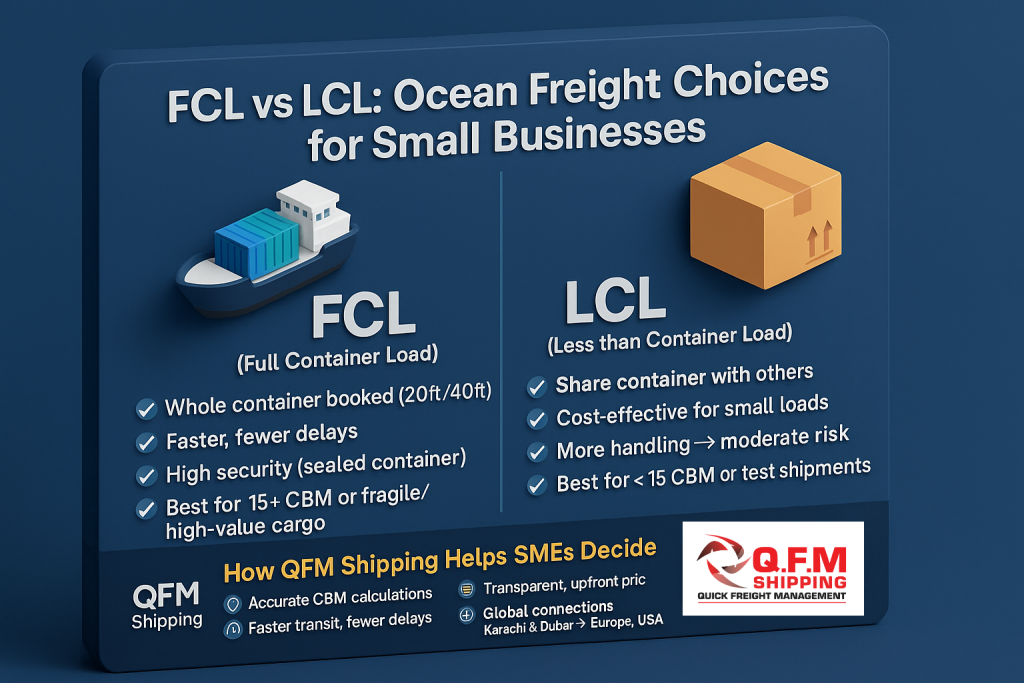
FCL means you book an entire container—20ft, 40ft, or 40ft HC—for your cargo, regardless of whether you fill it completely. The container is sealed at the origin and opened only when it reaches the final destination.
Key benefits of FCL shipping:
-
Faster transit with fewer delays at ports.
-
Reduced handling (lower risk of damage or theft).
-
Better suited for large shipments or fragile, high-value cargo.
What is LCL (Less than Container Load)?
LCL allows you to share container space with cargo from other shippers. Your goods are consolidated at origin and de-consolidated at destination.
Key benefits of LCL shipping:
-
Cost-effective for smaller volumes (usually under 15 cubic meters).
-
Flexible for startups and SMEs with limited inventory.
-
Ideal for testing new markets without committing to bulk shipments.
FCL vs LCL: Key Differences
| Factor | FCL | LCL |
|---|---|---|
| Cost | Higher overall, but cheaper per unit if container is full | Lower upfront, but higher per unit if volume grows |
| Speed | Faster, fewer stops, direct shipping | Slower due to consolidation/deconsolidation |
| Security | High—sealed container, less handling | Moderate—multiple handlings, higher risk |
| Volume | Best for >15–20 CBM | Best for <15 CBM |
| Flexibility | Requires larger order sizes | Flexible for smaller or irregular shipments |
When to Choose FCL
-
Your shipment volume approaches or exceeds half a container.
-
Your goods are fragile, perishable, or high in value.
-
Delivery speed is critical to your supply chain.
-
You want to simplify customs clearance and minimize touchpoints.
When to Choose LCL
-
You’re shipping small batches (startups, SMEs, e-commerce).
-
You’re testing demand in a new market.
-
Your cargo is durable and not highly time-sensitive.
-
You want to keep initial logistics costs low.
Cost Considerations for Small Businesses
-
Break-even point: If your cargo volume is more than 12–15 cubic meters, FCL often becomes more economical.
-
Hidden charges: LCL often includes additional fees (consolidation, handling, warehouse charges). Compare the full landed cost, not just freight rates.
-
Seasonality: During peak seasons, FCL can be more cost-effective due to congestion and higher LCL surcharges.
The Role of QFM Shipping in Managing FCL vs LCL
For small businesses, making the right decision isn’t always straightforward—that’s where QFM Shipping steps in. As a trusted freight forwarder based in Karachi and Dubai, QFM Shipping helps SMEs evaluate shipment size, cost, and urgency to recommend whether FCL or LCL makes the most sense.
How QFM Shipping supports your business:
-
Accurate Volume Assessment: QFM Shipping calculates CBM precisely to determine when you cross the threshold where FCL is cheaper than LCL.
-
Transit Time Optimization: With direct access to major shipping lines and airlines, QFM helps you avoid unnecessary delays common in LCL shipments.
-
Transparent Pricing: Hidden consolidation fees are a common headache in LCL; QFM ensures clear, upfront quotes so you can plan cash flow effectively.
-
Global Reach: From Karachi and Dubai, QFM connects you to key trade lanes in the Middle East, Africa, Europe, and the USA, offering flexibility whether you scale up to FCL or stick to LCL.
-
Tailored Solutions for SMEs: Whether you’re testing new markets with LCL or scaling bulk orders with FCL, QFM provides end-to-end logistics including customs clearance, warehousing, and last-mile delivery.
With the tagline “Fast. Reliable. Global.”, QFM Shipping ensures that small businesses can grow internationally with confidence—choosing the right freight option every time.
Tips for Small Businesses Choosing Between FCL and LCL
-
Know your shipment volume – calculate CBM (cubic meters) and compare against container capacity.
-
Evaluate product type – fragile, urgent, or high-value items may justify FCL even at smaller volumes.
-
Balance cost and speed – LCL saves upfront costs, but FCL saves time and reduces risks.
-
Work with QFM Shipping – leverage expert advice to uncover hidden costs and secure the right option.
-
Think about future growth – if you plan to scale quickly, transitioning to FCL early may save money.
Final Thoughts
For small businesses, the decision between FCL vs LCL ocean freight comes down to shipment size, budget, and urgency. LCL is best for small, flexible, and cost-sensitive shipments, while FCL is ideal for larger, time-sensitive, or high-value cargo.
With the right logistics partner like QFM Shipping, you don’t need to make this choice alone. Their expertise ensures you get the best balance of cost, speed, and reliability—so you can focus on growing your business globally.
Getting Started is Easy
Ready to simplify your shipping? Contact us today for a free consultation and a custom quote. Our team is ready to design a logistics plan that will save you time, reduce costs, and give you peace of mind.
Contact Us:
-
Email: info@qfmshipping.com
-
Website: www.qfmshipping.com
Tags
FCL vs LCL, ocean freight for small businesses, Full Container Load vs Less than Container Load, FCL vs LCL cost comparison, shipping guide for SMEs, QFM Shipping, Logistics,
