
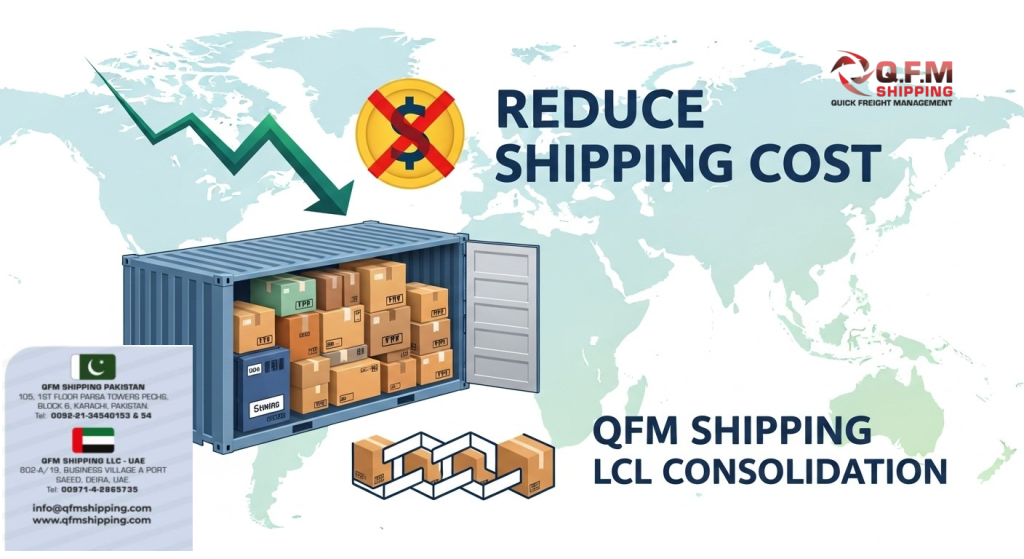
Reduce Shipping Cost With QFM Shipping LCL Consolidation
If your cargo doesn’t fill a full container, paying FCL (Full Container Load) rates is like renting an entire bus for three passengers. Less-than-Container Load (LCL) consolidation fixes that. By pooling compatible shipments into one container, QFM Shipping turns spare space into real savings—without sacrificing reliability or transit time.
Whether you’re an SME exporting from Pakistan/UAE to global markets, an e-commerce brand importing to Karachi or Dubai, or a distributor moving regular small lots, this guide shows exactly how LCL consolidation cuts cost, when it beats FCL, and how QFM makes it simple.
What Is LCL Consolidation
Instead of booking your own 20′ or 40′ box, your cargo shares a container with other shippers. QFM collects cargo at origin (CFS/hub), consolidates compatible shipments into a single FCL, ships on a scheduled service, and deconsolidates at destination for final delivery.
You pay only for what you use—measured in cubic meters (CBM) or metric tons (W/M).
-
CBM = (Length × Width × Height in meters) × number of packages
-
Chargeable = max( Total CBM, Total Weight in kg ÷ 1000 )
Example: 20 cartons, each 0.50×0.40×0.40 m = 0.08 CBM each → 1.60 CBM total.
Weight = 380 kg → 0.38 W/M.
Chargeable = 1.60 CBM (since 1.60 > 0.38).
Where the Savings Come From
-
Space efficiency: You’re billed on CBM/W/M, not a whole box.
-
Network frequency: Weekly (often multi-weekly) LCL departures mean you avoid paying to “wait” for volume.
-
Bundled origin/destination services: Shared handling, documentation, and brokerage spread over many shippers.
-
Negotiated tariffs: QFM’s buying power with carriers/CFS partners keeps per-CBM costs sharp.
-
Smarter routing: Direct consol lanes or optimized transshipment reduce hidden dwell and storage risks.
-
Lower inventory carrying cost: Ship smaller, more often; reduce excess stock and cash tied up in transit.
When LCL Beats FCL (and when it doesn’t)
-
Great for: 0.5–12 CBM shipments; high-mix, lower volume SKUs; trial orders; replenishment; time-sensitive small lots.
-
Borderline zone: ~12–15 CBM (route-dependent). Run the math—sometimes a light FCL wins.
-
Switch to FCL when: Your volume routinely exceeds the lane’s “crossover point” (often ~15–18 CBM for a 20′ depending on rates, season, and surcharges).
Transparent Costing: Sample Comparison (Illustrative)
Assume Karachi → Jebel Ali / Jebel Ali → Europe-type corridors with typical LCL components. Your actual quote will vary by season and carrier.
Scenario A — 6.0 CBM, 1,200 kg (Chargeable: 6.0 CBM)
LCL (illustrative):
-
Ocean freight: $45/CBM × 6.0 = $270
-
Origin CFS: $25/CBM × 6.0 = $150
-
Destination CFS: $35/CBM × 6.0 = $210
-
Docs & handling: $50
-
Fuel/BAF/WRS (example): $10/CBM × 6.0 = $60
Estimated LCL total: $740
FCL 20′ (illustrative “all-in” freight + base port charges): $1,350
Savings with LCL: $610 (≈45%)
Scenario B — 12.0 CBM, 3,000 kg (Chargeable: 12.0 CBM)
LCL (illustrative):
-
Ocean freight $45 × 12 = $540
-
Origin CFS $25 × 12 = $300
-
Destination CFS $35 × 12 = $420
-
Docs/handling = $50
-
Fuel/BAF/WRS $10 × 12 = $120
Estimated LCL total: $1,430
FCL 20′ (illustrative): $1,350
Verdict: At ~12 CBM, FCL begins to compete. QFM will price both so you choose the winner.
How QFM Shipping Makes LCL Work in Your Favor
-
Dense origin hubs in Karachi (Port Qasim/KICT/PICT), Dubai/Jebel Ali, and partner gateways across Asia/EU/US.
-
Fixed weekly LCL sailings on major trade lanes to keep cash flowing and inventory lean.
-
Tight CFS standards: barcoding, photo capture, verified weights (VGM), shrink-wrap/palletization options, and exception reporting.
-
Customs & compliance handled end-to-end (ISPM-15, HS codes, pre-alerts, certificates where required).
-
Predictive routing: lane selection to avoid congestion and reduce rollovers.
-
Shipment visibility: milestone tracking from pickup to POD, with proactive delay alerts.
-
Value-added: buyer’s consolidation, vendor-managed pickup windows, PO-level kitting, and last-mile distribution.
Practical Tips to Maximize LCL Savings
-
Design for CBM:
-
Use tighter cartons and avoid “air.”
-
Choose pallet sizes that cube out well (e.g., EU vs. US pallets) or ship floor-loaded when safe.
-
-
Consolidate smartly:
-
Combine POs in the same week to hit better per-CBM steps.
-
Use buyer’s consolidation: QFM collects from multiple suppliers into one HBL.
-
-
Pack & protect:
-
Export-grade cartons (Edge Crush Test), corner boards, strapping, and moisture barriers.
-
For fragile items, add internal bracing to reduce claims risk.
-
-
Label like a pro:
-
Clear SSCC/PO refs; print CBM & piece counts on labels to speed CFS handling.
-
-
Pick Incoterms wisely:
-
For control and cost clarity, FOB (or EXW with QFM pickup) often suits LCL.
-
Align responsibilities for export clearance and local charges.
-
-
Know your surcharges:
-
BAF/VLS, PSS/Peak, WRS, ISPS, CSA/SCS (security), LSS (low sulfur)—QFM quotes them clearly to avoid surprises.
-
-
Book early in peak season:
-
Lock space 1–2 weeks ahead (Sep–Feb typically tighter on many lanes).
-
Common Misconceptions (and QFM’s Straight Answers)
-
“LCL is always slower.”
Not necessarily. QFM uses direct consol lanes where possible. Properly planned LCL can be competitive with FCL transit times—minus the wait to “fill” a container. -
“Higher damage risk.”
With export-grade packing and QFM’s CFS SOPs (segregation, bracing, photographic proof), LCL damage rates stay low. Always declare fragility and insure. -
“Local charges are unpredictable.”
QFM itemizes origin and destination charges upfront, including any terminal/agency/CFS fees—no surprises.
Sector Snapshots: How Different Businesses Win with LCL
-
E-commerce & retail: frequent small replenishments keep catalogs fresh and reduce stockouts.
-
Industrial MRO & spares: ship “kits” weekly instead of holding expensive safety stock.
-
Apparel & footwear: ship seasonal drops in weekly waves, sync to launches.
-
Electronics & accessories: reduce obsolescence risk by moving smaller lots faster.
-
Temperature-controlled or hazardous: use specialized LCL programs (where available) with proper DG or reefer handling—QFM can advise route-by-route feasibility.
LCL vs Air: The Middle Path
When air freight is too expensive and FCL is too large, LCL bridges the gap:
-
Cost: often 60–85% lower than air (lane-dependent).
-
Speed: faster than waiting to accumulate an FCL if your demand is steady and weekly.
-
Sustainability: markedly lower CO₂/ton-km than air.
What a Clean QFM LCL Quote Includes
-
Pickup terms (EXW/FOB), origin address and cutoff
-
Commodity & HS code, units, weight, dimensioned CBM
-
Origin charges (CFS, docs, VGM if needed)
-
Ocean freight per CBM/W/M + known surcharges (BAF/VLS, PSS, WRS, ISPS, LSS)
-
Destination charges (CFS, handling, delivery/last mile if required)
-
Transit time & ETD/ETA window, routing (direct vs transshipment)
-
Insurance option and claim procedures
-
Validity and space conditions
Pro tip: Share packing lists and estimated dispatch frequency (weekly/bi-weekly). QFM often secures better lane pricing with volume predictability.
Risk Management Essentials
-
Cargo insurance (ICC A/C clauses)—particularly for high-value or fragile items.
-
Photographic evidence at pickup and CFS in/out.
-
Moisture control (desiccants; avoid green timber pallets).
-
Compliance with DG, wood-packing (ISPM-15), and destination market rules.
-
Clear consignee instructions to minimize storage/demurrage on arrival.
Quick FAQ
Q: What’s the minimum for LCL?
A: As low as 0.5 CBM on many lanes. QFM confirms per trade lane.
Q: How are charges calculated?
A: W/M rule: the higher of total CBM or weight/1000 kg, plus origin/destination/CFS and regulatory surcharges, all itemized.
Q: Can I ship from multiple suppliers?
A: Yes—buyer’s consolidation. QFM orchestrates coordinated pickups and a single HBL to cut cost and complexity.
Q: How fast is LCL?
A: Similar to FCL once the container sails. With QFM’s weekly cutoffs, you avoid waiting to build an FCL.
Q: What about customs?
A: QFM supports export clearance, pre-alerts, and destination brokerage coordination to accelerate release.
Your Next Step (and What QFM Needs to Quote You Fast)
Send the following to your QFM representative or via the website form:
-
Pickup location & Incoterm (EXW/FOB)
-
Commodity + HS code, units, total weight, dimensions/CBM
-
Preferred sailing week and delivery ZIP/postcode
-
Special handling: stackable/non-stackable, fragile, DG, temperature, palletization
-
Insurance preference, target budget (if any)
We’ll return a lane-optimized LCL vs FCL comparison so you can pick the best value—no guesswork.
Summary
-
LCL consolidation lets you pay only for the space you use, often saving 20–50% vs. under-filled FCL and 60–85% vs. air.
-
The crossover point where FCL wins depends on your lane and season—QFM always prices both.
-
With weekly departures, clean cost breakdowns, and CFS discipline, QFM turns LCL into a reliable, cost-efficient engine for your supply chain.
Ready to cut freight cost without slowing growth?
Get an LCL quote from QFM Shipping and ship smarter this week or coming weeks.
Fast. Reliable. Global. That’s the promise we bring to every LCL shipment and FCL shipment.
Getting Started is Easy
Ready to simplify your shipping? Contact us today for a free consultation and a custom quote. Our team is ready to design a logistics plan that will save you time, reduce costs, and give you peace of mind.
Contact Us:
-
Email: info@qfmshipping.com
-
Website: www.qfmshipping.com
Tags:
LCL consolidation, reduce shipping cost, QFM Shipping, Karachi LCL, Dubai Jebel Ali LCL, buyer’s consolidation, CBM calculator, ocean freight surcharges, CFS handling, Pakistan export, GCC import
