
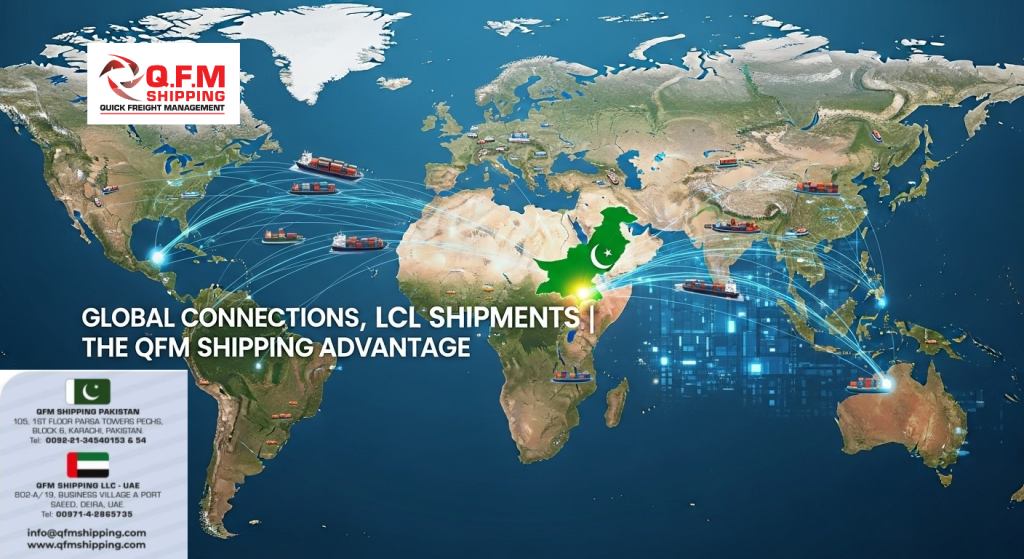
Global Connections & LCL Shipments | The QFM Shippin Advantage
In an increasingly interconnected world, businesses of all sizes need reliable, efficient and cost-effective logistics solutions to move cargo across borders. Less than Container Load (LCL) services have emerged as a flexible alternative to full container shipments, especially when volumes are too small to justify a full container. When paired with a global network and deep logistics expertise, LCL shipping can become a strategic advantage.
At QFM Shipping, we combine global connections with tailored LCL consolidation services to create what we call the QFM Shipping Advantage. In this post, we’ll explore:
-
What LCL shipping is, and why it’s important
-
The challenges and best practices in LCL / consolidated freight
-
How global connectivity enhances LCL services
-
The unique value propositions of QFM Shipping’s LCL / consolidation services
-
Use cases, tips, and FAQs
Let’s dive in.
What is LCL (Less Than Container Load) Shipping?
Definition & Basics
LCL shipping refers to a freight mode in which multiple shippers share space in the same container. Rather than requiring a single party to fill an entire container (FCL), smaller cargoes are consolidated in a shared container. You pay only for the volume your cargo occupies, typically measured in cubic meters (CBM).
Because the container is shared, the shipment must undergo consolidation (stuffing) and deconsolidation (unstuffing) at intermediate container freight stations (CFS).
Why Businesses Use LCL
LCL is attractive for:
-
Cost efficiency for small volumes — You pay only for the space you need, rather than the cost of a full container.
-
More frequent shipment cycles — You don’t have to wait until you have enough goods to fill a container; you can dispatch sooner.
-
Greater flexibility & scalability — Useful for testing new markets or sending smaller orders.
-
Lower inventory holding costs — Smaller, more frequent shipments reduce the need for large stocks.
However, LCL also comes with challenges, which we’ll address next.
Challenges & Best Practices in LCL
Challenges & Risks
-
Longer transit and handling times
Because cargo is consolidated and deconsolidated, additional handling delays can occur. -
Greater risk of damage / mishandling
Shared containers see more touching, shifting, and re-handling, increasing risk. -
Coordination complexity
Multiple shippers, multiple origins/destinations, multiple customs regimes — complexity is higher. -
Hidden / ancillary costs
Fees for CFS operations, documentation, drayage (local trucking), pre- and post-shipment handling can add up. -
Customs delays impacting shared shipments
If one cargo in the consolidation is held up in customs, others may be delayed.
Best Practices to Mitigate Risks
-
Choose a reliable consolidator / forwarder with strong network
Proper handling, scheduling, and coordination matter a lot. -
Optimize packaging & palletization
Use sturdy packing and secure cargo to reduce shifting. -
Ensure clear labeling & documentation
Proper labeling, HS codes, commercial invoices reduce confusion at CFS and customs. -
Use insurance and cargo protection
Especially because of extra handling steps. -
Monitor & track closely
Real-time visibility across nodes helps detect issues early. -
Select efficient consolidation services with minimal intermediate stops
“Direct” LCL or minimal transshipment is better when possible.
As an industry insight, many forwarders are rethinking LCL not just as a fallback but a strategic tool for supply chain resilience.
The Role of Global Connections in LCL Shipping
The strength of an LCL service depends heavily on the global network behind it. Here’s why strong global reach is critical:
-
Agent & partner coverage globally
To consolidate origin shipments and deconsolidate destination shipments, you need trusted agents in many countries. -
Reliable liner / shipping line contracts
To secure regular sailings and favorable space allocations. -
Efficient inland intermodal links (rail, trucking, barge)
Getting goods from factory to port and from arrival port to final consignee is key. -
Customs and compliance knowledge locally
Local regulatory knowledge ensures smooth clearance. -
Transparency & tracking
A connected network with technology to share updates across nodes.
In short, “global connections” make LCL more dependable, faster, and less risky.
The QFM Shipping Advantage: What Sets Us Apart
At QFM Shipping (Quick Freight Management), we embed those global connections into our LCL / consolidation services to deliver real competitive advantage. Below are the pillars of our advantage:
1- Proven Global & Local Network
-
QFM offers weekly global LCL consolidation services through its own offices and a worldwide agents’ network.
-
For exports, QFM covers Upper Gulf, Indian Subcontinent, Red Sea, Mediterranean, and beyond.
-
Deep presence in Pakistan, UAE, Dubai, and the UK ensures strong local-to-international linkage.
2- Seamless End-to-End Service
-
Full freight forwarding services (ocean, air, road) integrated with LCL setups.
-
Customs clearance handled in-house or via trusted agents.
-
Warehousing and CFS capabilities near ports and bonded facilities for deconsolidation.
3- Flexibility & Customer-Centric Approach
-
Because of our global reach and consolidation expertise, we offer scheduling flexibility: your shipment doesn’t have to wait until the container is full.
-
We tailor consolidation plans per customer needs, optimizing transit times and cost.
-
Mid-route changes or routing adjustments are more feasible because of our strong network.
4- Transparency, Monitoring & Control
-
QFM offers visibility over the shipments throughout the supply chain, from origin consolidation, through ocean transit, to destination deconsolidation.
-
Our bonded CFS systems enable secure handling and controlled transitions.
5- Cost Efficiency & Reliability
-
Because of scale and consolidation volume, we can negotiate favorable rates from carriers and pass savings on.
-
We emphasize “zero defects handling” — minimizing damage, loss, or misrouting.
-
Timely delivery history gives clients confidence in commitments.
In sum, the QFM advantage is not just about LCL — it’s about combining LCL with strategic global connectivity, operational excellence, and customer-oriented flexibility.
Use Cases & Examples
| Scenario | Why LCL + QFM is a good fit |
|---|---|
| A small manufacturer exporting test orders to multiple overseas markets | You don’t have volume to fill a container, but you want global coverage. QFM consolidates and routes your shipments efficiently. |
| Seasonal / promotional inventory shipments | When you need to move moderate but not full-container loads quickly, LCL saves cost and time. |
| Supplemental shipments in addition to full container loads | You already have an FCL but want to send overflow cargo; LCL fills the gap. |
| Multisource imports from multiple suppliers | QFM can consolidate from multiple origins into single destination shipments. |
| Network diversification & risk mitigation | Using LCL redundancy helps maintain supply flow even during container or capacity crunches. |
Best Practices & Tips for Clients Using QFM’s LCL Services
-
Plan “just in time” inventory
Use smaller, frequent shipments rather than large stockpiles. -
Provide early and accurate data
Send dimensions, weights, HS codes, and packing details well in advance to avoid delays. -
Use robust packaging & palletization
Ensure items are protected and easy to handle in consolidation. -
Negotiate transit windows
Ask QFM for best routing options, tradeoffs between cost vs speed. -
Use insurance / cargo protection
Especially for high-value or fragile goods. -
Stay in sync with QFM’s tracking & alerts
Provide your own internal tracking oversight in addition to what QFM offers.
FAQs (Frequently Asked Questions)
Q: When should I choose FCL over LCL?
A: If your cargo is large enough to fill a container, or if your volume is close to or exceeding the break-even threshold, FCL may be cheaper and faster. LCL makes sense when your volume is too small for FCL and you need flexibility.
Q: How is the cost of LCL calculated?
A: It’s typically prorated by the volume (in CBM) your cargo occupies. Some minimum volume unit may apply. Additional fees for handling, CFS, drayage, and documentation are extra.
Q: What about customs & duties?
A: Customs clearance must be handled at both ends. Proper documentation (commercial invoice, packing list, HS codes) is crucial. QFM or its agents handle this on your behalf in many cases.
Q: How long does LCL transit take compared to FCL?
A: Typically LCL incurs extra days due to consolidation/deconsolidation. But with efficient routing and minimal transshipment, QFM aims to minimize those delays.
Q: Is there more risk of damage with LCL?
A: Yes, due to more handling steps. That’s why proper packaging, secure loading, and oversight matter greatly when using consolidation.
Get an LCL quote from QFM Shipping and ship smarter this week or coming weeks.
Fast. Reliable. Global. That’s the promise we bring to every LCL shipment and FCL shipment.
Getting Started is Easy
Ready to simplify your shipping? Contact us today for a free consultation and a custom quote. Our team is ready to design a logistics plan that will save you time, reduce costs, and give you peace of mind.
Contact Us:
-
Email: info@qfmshipping.com
-
Website: www.qfmshipping.com
Tags:
Global LCL shipments, LCL consolidation services, QFM Shipping LCL advantage, Less than container load logistics, Global freight forwarding QFM, cost-effective LCL shipments from Pakistan to UAE, cost-effective LCL shipments from Pakistan to The World, weekly LCL consolidation services, why use LCL vs FCL for small exporters,
