
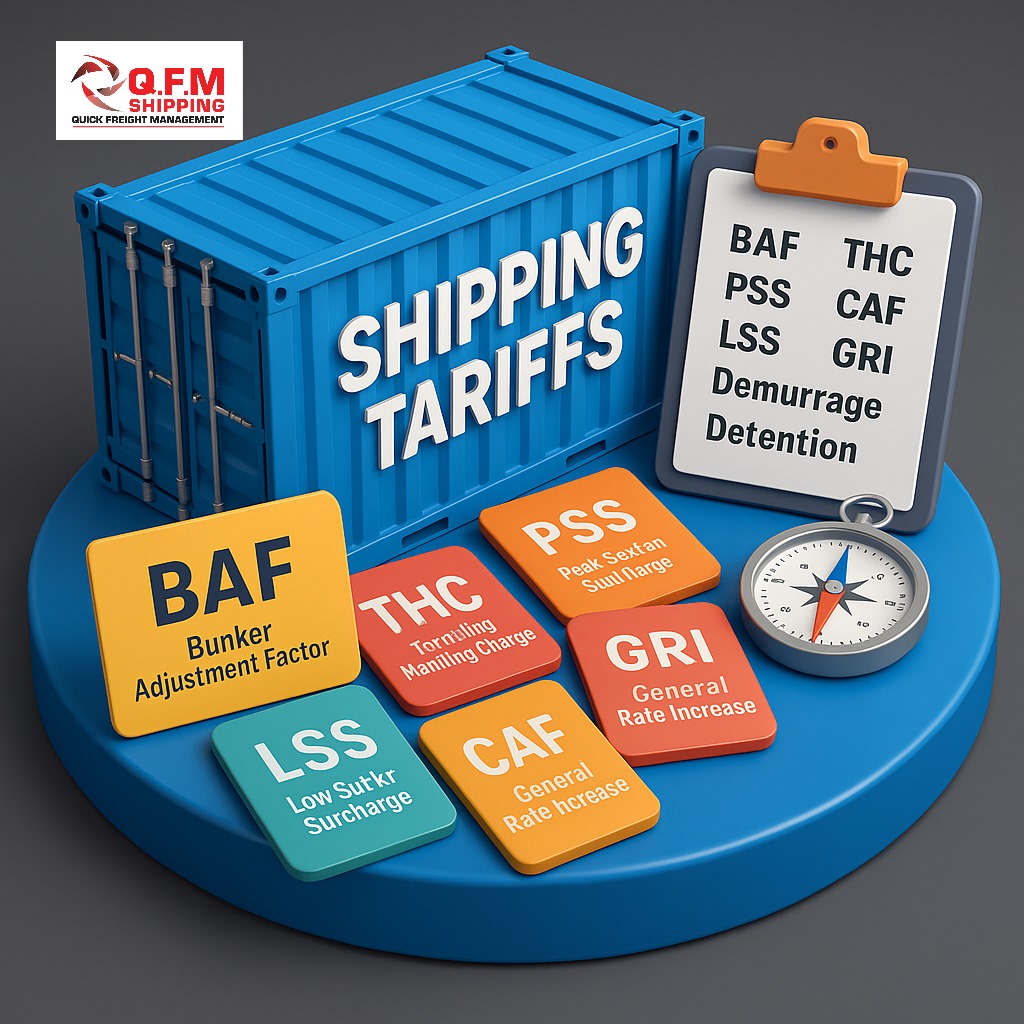
Common Shipping Tariffs You Should Know Before Booking Cargo
Whether you’re moving a single pallet LCL from Karachi to New York, an FCL from Jebel Ali to Rotterdam, or a cross-border e-commerce parcel by air, the “freight rate” you’re quoted is only part of the story. Your final landed cost is shaped by a web of tariffs and surcharges—some predictable, some seasonal, and some entirely avoidable with good planning. This guide breaks down the most common shipping tariffs, how they’re calculated, who charges them, and smart ways to reduce or eliminate them.
1) The Big Picture: How a Freight Quote Is Built
Base Freight (ocean/air/road)
-
Surcharges (fuel, currency, low-sulfur, peak season, war risk, congestion, emergency fees)
-
Origin Charges (THC, documentation, customs handling, export service fees)
-
Destination Charges (THC, delivery order, deconsolidation, customs exam, port/terminal fees)
-
Ancillaries (demurrage, detention, storage, chassis, truck waiting)
Incoterms® matter. Who pays what depends on terms like EXW, FCA, FOB, CFR, CIF, DAP, DDP. For example, under FOB, the buyer pays ocean freight and destination charges; the seller covers origin charges up to onboard vessel. Under DAP/DDP, the seller carries costs to the buyer’s door (DDP adds duty and VAT).
2) Core Ocean Freight Surcharges (Know These First)
| Tariff / Surcharge | Who Charges | Applies To | How It’s Calculated | Why It Exists | Tips to Reduce |
|---|---|---|---|---|---|
| BAF – Bunker Adjustment Factor | Carrier | FCL/LCL | Per container or per W/M* | Fuel price volatility | Book during fuel-stable periods; compare lines |
| LSS – Low Sulfur Surcharge (a.k.a. ECA/IMO2020) | Carrier | FCL/LCL | Per container or W/M | Low-sulfur fuel compliance | Consolidate volume; negotiate when fuel dips |
| CAF – Currency Adjustment Factor | Carrier/Forwarder | FCL/LCL | % uplift on base freight | Exchange-rate risk | Quote in stable currency; short validity windows |
| PSS – Peak Season Surcharge | Carrier | Seasonal | Per container or W/M | High demand/limited capacity | Ship off-peak; forecast early; consider alternate ports |
| GRI – General Rate Increase | Carrier | Seasonal/market | Per container | Capacity/market rebalancing | Lock in long-term contracts where possible |
| EBS – Emergency Bunker Surcharge | Carrier | Market-driven | Per container/W/M | Sudden fuel spikes | Ask for fuel clauses; consider slow steaming services |
| WRS – War Risk Surcharge | Carrier | Region-specific | Per container | Conflict/piracy zones | Route via safer corridors when viable |
| CGS/PCS – Congestion Surcharge | Carrier/Terminal | Port-specific | Per container | Terminal congestion | Use less congested gateways; flexible ETD/ETA |
| OWS – Overweight Surcharge | Carrier | FCL | Per container (over set tonnage) | Extra handling & risk | Distribute weight; use appropriate container type |
*W/M = weight/measure (per 1,000 kg or per 1 CBM, whichever is greater) for LCL.
3) Port & Terminal Charges
| Tariff | Side | Applies To | Typical Basis | Notes |
|---|---|---|---|---|
| THC – Terminal Handling Charge | Both | FCL/LCL | Per container or per CBM | Both origin and destination THCs apply |
| CIC – Container Imbalance Charge | Destination-heavy lanes | FCL | Per container | To reposition empties where demand outstrips supply |
| Port Dues / Wharfage | Port Authority | FCL/LCL | Per container or tonnage | Often embedded but can appear as line item |
| Lift-on/Lift-off (Lo/Lo) | Terminal | FCL | Per lift | Occurs at transshipment points or special moves |
4) Documentation & Admin Fees
| Fee | Who Charges | Applies To | What It Covers |
|---|---|---|---|
| BL Fee (Bill of Lading) | Carrier/Forwarder | FCL/LCL | Issuance of Original BL/Sea Waybill |
| D/O – Delivery Order Fee | Destination agent | FCL/LCL | Release for pickup; unlocking final delivery |
| Amendment/Cancellation | Carrier/Forwarder | All | Name/term/date changes after cut-off |
| ENS/AMS/ACI Filing | Carrier/Forwarder | Lane-specific | Advance manifest security filings (EU/US/CA others) |
| Export/Import Customs Handling | Broker/Forwarder | All | Declarations, HS classifications, clearance |
5) Storage, Free Time, Demurrage & Detention (The Costly Trio)
-
Free Time: Grace period to clear cargo and return equipment without extra charges.
-
Demurrage: Charge for containers sitting inside the terminal beyond free time.
-
Detention: Charge for containers outside the terminal (at your facility) beyond free time.
-
Port Storage/Warehouse Storage: Space charges for LCL or loose cargo not collected.
How to avoid: Pre-file customs, book trucks early, confirm bank/duty payments, negotiate extra free time in the quote. For LCL, pick up promptly after deconsolidation.
6) LCL-Specific Tariffs (Consolidation Cargo)
| Tariff | Basis | What to Watch |
|---|---|---|
| Freight Rate | Per W/M (whichever is higher) | Round up CBM; dense cargo may pay by weight |
| CFS – Container Freight Station | Per CBM | Origin handling + Destination deconsolidation |
| Documentation | Per shipment | BL fee, D/O, handling, security filings |
| Minimum Charges | Flat | Even if W/M is small, minimum applies |
Rule of thumb: If your LCL shipment nears 12–14 CBM, compare against a 20′ FCL; full container may be cheaper and faster.
7) Air Freight Tariffs (Quick Primer)
-
Air Freight: Charged on chargeable weight (the higher of actual kg vs. volumetric weight).
-
Volumetric weight (typical): L × W × H (cm) ÷ 6,000.
-
-
Fuel & Security Surcharges: YQ/YR, screening, terminal fees.
-
AWB Fee, X-ray, DG Handling for dangerous goods.
-
Airport Storage & Airline Demurrage if not collected fast.
8) Incoterms & Cost Responsibility (Snapshot)
| Incoterm | Seller Pays Until | Buyer Pays From | Practical Impact |
|---|---|---|---|
| EXW | Goods at seller’s door | All export, main carriage, import | Buyer bears most costs; risky if inexperience |
| FCA/FOB | Export & handover/onboard | Ocean/air + destination | Balanced; widely used |
| CFR/CIF | Ocean freight (+insurance for CIF) | Destination charges | Watch hidden destination fees |
| DAP | Delivery to buyer’s place | Duty/Taxes (not for DDP) | Great for buyer cash-flow planning |
| DDP | Delivered duty paid | — | Seller controls full chain including duty/VAT |
9) Sample Cost Breakdowns (Illustrative)
A) LCL: Karachi → New York (1.8 CBM, 350 kg)
-
Freight (LCL): Charged on W/M.
-
Weight measure = max(350 kg, 1.8 CBM × 1,000 kg) → max(350, 1,800) = 1,800 kg units
-
If tariff is $55 per W/M (per CBM) → 1.8 × $55 = $99
-
(Some consolidators price per CBM directly; confirm the basis.)
-
-
Origin CFS/Handling: $45
-
Documentation (BL): $35
-
BAF/LSS (if split out): $20
-
Destination CFS/Deconsolidation: $65
-
D/O + THC (LCL share): $60
Estimated total (ex duty/tax, no storage): $99 + 45 + 35 + 20 + 65 + 60 = $324
Tip: If you routinely ship 1.8–2.5 CBM monthly, ask your forwarder for a monthly consolidation rate or explore a dedicated LCL console to cut CFS/admin costs.
B) FCL: Jebel Ali → Rotterdam (20’ GP, 19 tons)
-
Base Ocean Freight (20’): $1,150
-
BAF/LSS (combined): $180
-
THC Origin: $150
-
BL Fee: $50
-
PSS (peak window): $100
-
THC Destination: €175 (assume $185)
-
D/O: $70
-
Chassis & Truck (port → RDC): $260
Estimated total (port-to-door, excl. duty/VAT): $1,150 + 180 + 150 + 50 + 100 + 185 + 70 + 260 = $2,145
Tip: If your weight is close to 20’ limits or your lane applies OWS, check 40’ or flat rack/open top alternatives; sometimes a different unit avoids the overweight penalty.
10) Hidden or Easily Missed Charges
-
VGM (Verified Gross Mass) re-weighing if not properly supplied.
-
Customs Exams/Scans (random or risk-based) and associated port moves.
-
Chassis Split and Drop Fees when equipment and container are in different yards.
-
Waiting Time/Redelivery if trucks are held at site or delivery fails.
-
Return to Shipper costs on refused cargo.
-
Priority Handling / No-roll fee to avoid being rolled during peak weeks.
11) Practical Ways to Lower Your Tariffs
-
Plan early & ship off-peak. Avoid PSS/GRIs by booking 2–3 weeks earlier; pick less congested ports.
-
Negotiate free time up front. Add +7 days at destination to buffer customs or payment delays.
-
Consolidate wisely. Combine LCL shipments or flip to FCL once you cross the 12–14 CBM threshold.
-
Lock currency exposure. Request quotes in your settlement currency or short validity (7–14 days).
-
Pack for density & limits. Avoid OWS by distributing weight; use correct container type.
-
Get accurate paperwork. Clean commercial invoice, packing list, HS codes; reduce exam risk and delays.
-
Use reliable networks. Strong origin/destination agents resolve port surprises faster and cheaper.
-
Ask for an “all-in” quote. Or at least a line-item matrix with validity dates and free-time stated.
12) Quick Glossary
-
All-In Rate: Single figure covering base freight + standard surcharges (check what’s included).
-
Chargeable Weight (Air): Higher of actual vs. volumetric weight.
-
RORO/LoLo: Roll-on/roll-off vs. lift-on/lift-off methods.
-
Teu/Feu: 20-foot equivalent / 40-foot equivalent units.
-
Bonded Warehouse: Duty/tax deferred storage under customs control.
13) Pre-Booking Checklist
-
Confirm Incoterms®, payer of origin/destination charges
-
Ensure HS codes and product descriptions are correct
-
Request line-item quote with BAF/LSS/PSS/THC clearly stated
-
Lock currency and validity dates
-
Align free time (demurrage/detention) with your clearance plan
-
Verify equipment type, weight limits, and hazardous status
-
Share accurate dimensions/weight (avoid re-measure penalties)
-
Pre-book trucking/chassis for tight ports
-
Prepare duty/tax funds and broker instructions in advance
FAQs
Q: Are destination charges avoidable under CIF/CFR?
A: No. CIF/CFR cover main carriage (and insurance for CIF), but destination THC, D/O, CFS and other local fees still fall on the buyer.
Q: Why do two forwarders have different “all-in” rates for the same lane?
A: Each may include/exclude different surcharges or use different free-time and handling policies. Always compare line-by-line.
Q: What’s the difference between demurrage and detention?
A: Demurrage = inside the terminal past free time. Detention = outside the terminal (at your site) past free time.
Final Word
Tariffs aren’t “gotchas” if you know where they come from and how they’re triggered. Ask for transparent, line-item quotations, align responsibilities with Incoterms®, and build time buffers into your plan. Do that—and most surprises disappear before your cargo even reaches the gate.
Getting Started is Easy
Ready to simplify your shipping? Contact us today for a free consultation and a custom quote. Our team is ready to design a logistics plan that will save you time, reduce costs, and give you peace of mind.
Contact Us:
-
Email: info@qfmshipping.com
-
Website: www.qfmshipping.com
Tags:
shipping tariffs, ocean freight surcharges, BAF, THC, PSS, demurrage vs detention, LCL charges, FCL charges, delivery order fee, container imbalance, LSS surcharge, customs handling, Incoterms costs, Karachi to New York LCL, Jebel Ali to Rotterdam FCL, QFM Shipping
