
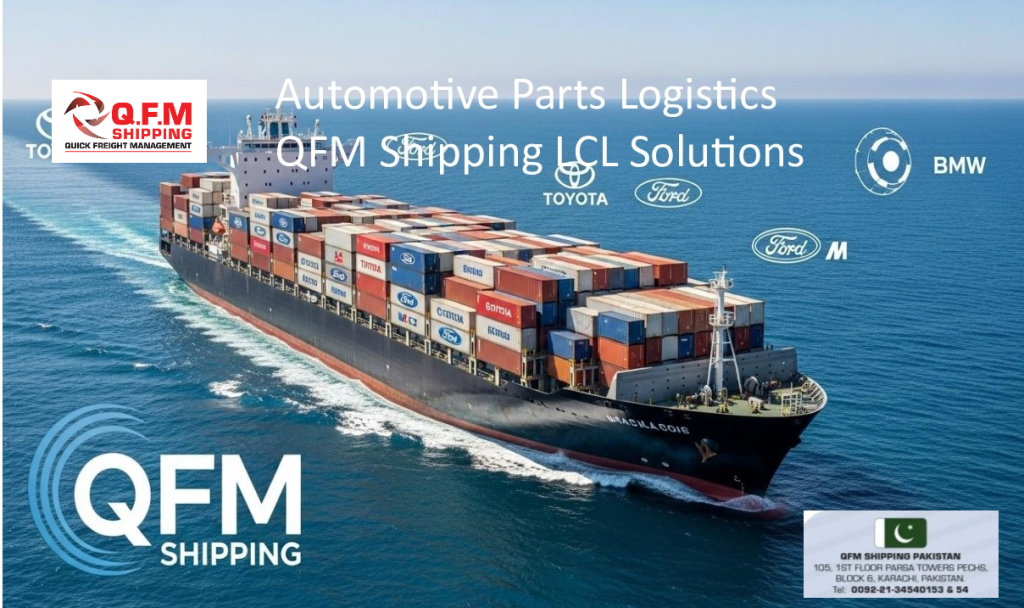
Case Study | How QFM Streamlined Automotive Parts Logistics for a Mid-Size Auto Parts Importer (Pakistan)
Executive Summary
A mid-size auto parts importer supplying Japanese and Korean car components to workshops across Pakistan was struggling with long lead times, customs delays, and inconsistent last-mile deliveries. By shifting to QFM Shipping Automotive logistics solutions, the client consolidated fragmented flows into a single, visibility-first pipeline. Within one quarter, they achieved:
-
18–22% landed-cost reduction across high-turn SKUs
-
5–7 days faster average transit on the → Karachi lane (LCL direct)
-
97% OTIF (On-Time, In-Full) for priority orders
-
30% inventory carrying cost reduction via smaller, more frequent LCL moves
-
Zero penalty charges from improved documentation and customs pre-clearance
Client Profile
-
Client Type: Mid-size auto parts importer & regional distributor
-
Annual Lines: ~3,800 active SKUs (filters, belts, spark plugs, brake pads, ECUs)
-
Origins: Shenzhen, Ningbo, Shanghai; Dubai Jebel Ali as GCC hub
-
Destinations: Karachi (primary), Lahore & Islamabad (secondary), selective GCC re-exports
-
Pain Points: Long lead times, unpredictable customs dwell, damage claims, and lack of SKU-level visibility for multi-origin consolidation
The Challenge
-
Fragmented Inbound Flows
Vendors shipped ad-hoc cartons and partial pallets. Freight varied between air, FCL, and LCL without a planning rhythm—creating peaks, stockouts, and emergency airfreight. -
Customs & Documentation Errors
HS codes, COO certificates, and invoice/packing list mismatches caused holds, re-assessments, and storage charges. -
Transit Time Variability
Transshipments and indirect routings inflated dwell and created planning uncertainty for downstream deliveries to workshops. -
Inventory Carrying Costs
Bulk buying to “beat” uncertainty increased working capital tied in slow-moving items and consumed warehouse space.
QFM Shipping Automotive Logistics Solutions
We deployed a lane-specific playbook built for car parts supply chain control and speed, combining consolidation discipline with documentation excellence.
1) Origin Vendor SOP & Cartonization
-
Issued Vendor Routing Guides (labels, HS mapping, packing rules, moisture & shock protection).
-
Cartonization matrix by SKU (dimensions, stack limits, fragile flags) to minimize damage and improve cube efficiency.
2) Multi-Origin Weekly Consolidation
-
China Hubs (Shenzhen/Ningbo/Shanghai) → Direct LCL to Karachi.
-
Bi-weekly Jebel Ali–Karachi LCL for fast movers; weekly China consolidations to a fixed cut-off calendar.
3) Proactive Customs Pre-Clearance
-
HS code validation with item master.
-
Pre-submission of invoice/packing/COO & e-Docs; anomaly checks before sailing.
-
Preferential duty optimization where applicable via correct COO issuance.
4) Bonded Hub & Cross-Docking in GCC
-
Short-term bonded storage for split-by-market needs.
-
SKU-based cross-dock rules to build Pakistan-bound vs GCC-bound flows without double handling.
5) Milestone-Level Visibility
-
SKU-level ASN (Advance Ship Notice) and event milestones: Vendor ready → Hub received → Container loaded → Depart/Arrive → Customs released → Last-mile dispatched.
-
Exceptions dashboard for variance >24 hours or documentation gaps.
6) Last-Mile & Return Flows
-
Door deliveries in Karachi/Lahore/Islamabad using vetted carriers.
-
RMA loop for defective electronics: light-touch export and vendor returns via Jebel Ali.
Implementation Timeline
-
Weeks 1–2: Discovery & data cleansing (SKU master, HS map, MOQ rules), SOP sign-off with top 12 vendors.
-
Weeks 3–4: Pilot two consolidated sailings China→Jebel Ali→Karachi; parallel test customs pre-clearance.
-
Weeks 5–6: Scale to full vendor list; activate bonded hub logic for GCC splits.
-
Weeks 7–8: Roll out dashboards, variance SLAs, claim protocol, and quarterly cost-to-serve reports.
Results & KPIs (Quarter 1)
| Metric | Before QFM | After QFM | Gain |
|---|---|---|---|
| Avg. Jebel Ali → Karachi Transit (port-to-port) | 6–9 days | 2–3 days LCL direct | −4 to −6 days |
| OTIF (priority SKUs) | 81% | 97% | +16 pts |
| Landed Cost / Unit (weighted) | Baseline | −18–22% | Cost down |
| Customs Holds per 100 Shipments | 8–10 | 1–2 | −75–88% |
| Damage/Short Claims (ppm) | 1,200 | 300 | −75% |
| Inventory Turns (fast movers) | 7x | 10x | +43% |
Notes: Gains stem from direct LCL frequency, pre-clearance accuracy, cartonization, and disciplined cut-offs.
What Made the Difference
-
Direct, High-Frequency LCL
Fixed-day departures cut idle time. The client shipped smaller, more frequent lots, aligning inbound flow with workshop demand. -
Documentation Intelligence
A validated HS code registry plus COO governance eliminated rework, avoided penalties, and sped up release. -
Lane-Crafted Handling for Auto Parts
Moisture-barrier, shock foam, stack rules, and “fragile electronics” protocols reduced hidden scrap and warranty noise. -
Data-Driven Replenishment
ASN + milestone visibility enabled event-based ordering; supply met sales velocity instead of calendar guesses.
Process Snapshot: End-to-End Flow
Vendors (CN/KR/JP) → QFM China Hub (label & scan) → Jebel Ali Bonded Hub (split/consolidate) → Direct LCL to Karachi → Customs pre-cleared release → QFM DC → Door deliveries (Karachi/LHE/ISB) → RMA/returns loop via Jebel Ali when needed.
Risk & Compliance Controls
-
Incoterms: For predictable costs we recommend DAP for domestic branches and CIF/CIP for vendor-managed insurance when appropriate.
-
Insurance: Project cargo and high-value ECUs covered with declared value, photo evidence at each hand-off.
-
Trade Compliance: HS code master with periodic audits; controlled dual-use screening where applicable.
-
Contingency: Alternative sailings and safety stock guidance for peak seasons; storm and port-congestion playbooks.
Cost-to-Serve Insights (Sample)
-
Freight Mix: Shift 22% of emergency air to express LCL; save 60–70% while meeting service windows.
-
Cube Efficiency: Cartonization lifted average container fill on LCL pallets by 9–12%, trimming per-unit freight.
-
Dwell Avoidance: Pre-clearance cut storage & demurrage to near-zero on compliant files.
Voice of the Client (Paraphrased)
“QFM turned our chaos into cadence. Our buyers now plan to the sailing calendar, our finance team can forecast duties accurately, and our branches receive kits when the mechanic needs them—not weeks later.”
What This Means for Automotive Importers & Distributors
If you manage thousands of fast-moving SKUs across multiple origins, the winning formula is frequency + accuracy + visibility. QFM Shipping Automotive logistics solutions bring these together so you can scale margins and service—without bloating inventory.
Call to Action
Want the same outcomes on your car parts supply chain?
-
Ask for a free lane assessment (China/GCC → Pakistan).
-
Get a cut-off calendar tailored to your vendors.
-
Receive a custom HS code & documentation audit within two business days.
Book Your Space Today
Contact Us:
Email: info@qfmshipping.com
Phone: +92-21-34540153 & 54
+92-21-34540135 & 36
Website: www.qfmshipping.com
Tags:
Automotive logistics case study, QFM Shipping Automotive logistics solutions, Car parts supply chain, QFM Shipping, China Karachi LCL, China–Pakistan LCL, door-to-door auto parts logistics, bonded warehousing, customs brokerage Pakistan.
