
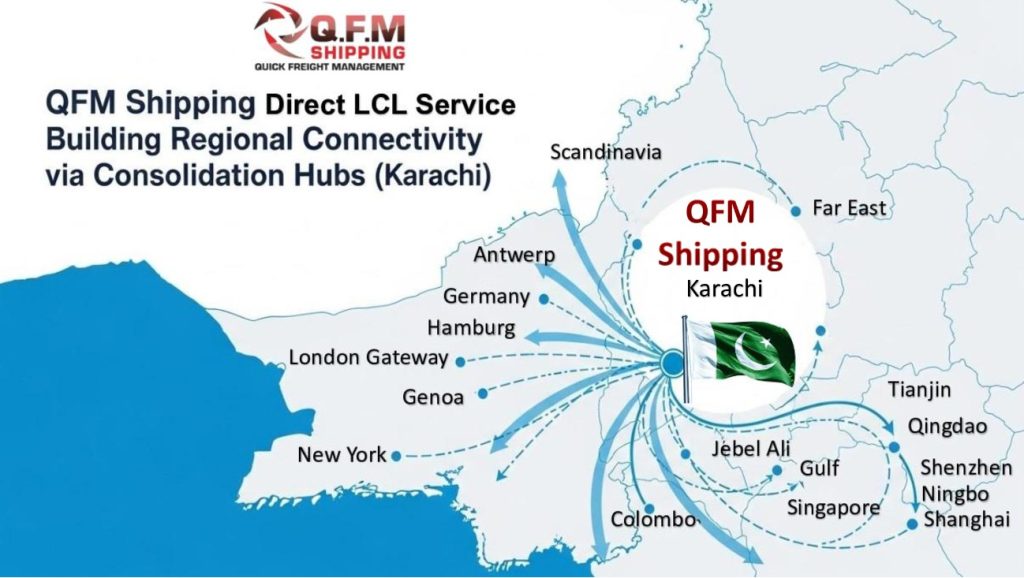
QFM Shipping’s Role in Building Regional Connectivity via Consolidation Hubs
In a world where supply chains are shifting from “global-and-fragile” to “regional-and-resilient,” consolidation hubs have become the connective tissue of modern trade. QFM Shipping uses a hub-and-spoke model—anchored by strategic gateways like Karachi with extensions across China, Europe, Africa, and the Americas—to knit together reliable LCL (Less-than-Container Load) flows for SMEs and large shippers alike. This post breaks down how QFM Shipping consolidation hubs create speed, predictability, and cost efficiency—while reducing cargo risk and unlocking new market access for customers.
What is a Consolidation Hub—and Why It Matters
A consolidation hub is a central gateway where multiple small shipments from different origins are combined into optimally filled containers before moving onward to regional or final destinations. Done right, it transforms fragmented cargo into streamlined, schedule-driven services. For shippers, this means:
-
More departures, shorter lead times through predictable weekly/bi-weekly sailings.
-
Lower landed cost by sharing container space and spreading surcharges.
-
Less handling risk via fewer touchpoints and direct routing options.
-
Easier market entry with door-to-door visibility and simplified documentation.
QFM Shipping Hub-and-Spoke Design: Local Strength + Global Reach
QFM Shipping consolidation architecture blends origin efficiency, transshipment agility, and destination reliability.
Primary Hubs (Examples)
-
Jebel Ali (Dubai): Gulf gateway linking South Asia, Middle East, and Africa—ideal for rapid cross-GCC and Indian Ocean connections.
-
Karachi: South Asian node with strong ties to GCC, China, and Europe, enabling direct LCL lanes and reliable deconsolidation.
Feeder Spokes (Illustrative)
-
China: Shenzhen, Shanghai, Ningbo—weekly LCL uplift to hubs.
-
Europe: Antwerp, Hamburg—steady flows to South Asia and Gulf.
-
Africa & Levant: Jeddah, Mombasa, Dar es Salaam—regional reach through Jebel Ali.
-
The Americas: East/West coast connections via transshipment to hubs for Pakistan/GCC.
This network ensures that an SME in Shenzhen can reach a buyer in Karachi or Lahore on a reliable, weekly direct LCL; or a consolidator in Antwerp can feed steady volumes into Karachi without tying up capital in under-utilized FCLs.
How QFM Shipping Runs a High-Reliability LCL Program
1) Predictable Schedules
-
Fixed weekly/bi-weekly sailings published lane-by-lane, with buffer for peak seasons.
-
Load plans driven by demand forecasts and committed allocations with vessel operators.
2) Capacity Assurance
-
Tiered carrier partnerships (Maersk, ZIM, and others as available) to lock space on popular weeks and maintain alternatives during disruptions.
3) Direct vs. Transshipment Logic
-
Direct LCL whenever feasible to reduce dwell, transshipment risk, and handling damage.
-
Smart transshipment via Jebel Ali or Karachi when it meaningfully improves transit or cost.
4) Cargo Care & Risk Controls
-
Vendor-neutral packing standards, shock/tilt indicators for sensitive cargo, and reduced touches through hub bypass options.
-
Consolidation by commodity class when needed (e.g., textiles vs. electronics) to minimize cross-contamination and claims.
5) Digital Visibility
-
Milestone tracking from origin CFS to hub to destination CFS/door, with proactive exception alerts (rollovers, customs holds, weather contingencies).
Why Consolidation Hubs Improve Regional Connectivity
Faster Market Access
By aggregating smaller shipments into steady departures, QFM turns sporadic demand into clock-like frequency, shrinking the “go-to-market” timeline for SMEs and e-commerce exporters.
Lower Cost to Serve
Shared container space = lower per-CBM rates, while hub-level optimization reduces empty space and minimizes BAF/VLS/PSS exposure.
Trade Lane Resilience
When a single port or service is disrupted, QFM can re-route via a hub and keep cargo moving, preserving factory cycles and retailer shelf dates.
Customs & Compliance Simplified
Pre-advice, document harmonization, and hub-based pre-clearance checks reduce errors and cut dwell time at destination.
Signature QFM Shipping LCL Lanes (Illustrative)
1) Shenzhen → Karachi (Direct LCL)
-
Profile: Electronics, components, fashion accessories.
-
Benefit: Weekly departures; direct routing reduces handling and shortens transit compared to multi-stop transshipment.
2) Shanghai → Karachi (Direct LCL)
-
Profile: Machinery parts, textiles, consumer goods.
-
Benefit: High reliability for planned replenishment cycles; predictable ETAs for retail and manufacturing.
3) Antwerp → Karachi (Consolidation to South Asia)
-
Profile: Industrial goods, specialty chemicals (non-haz), machinery spares.
-
Benefit: Stable Europe–South Asia pipeline without committing to full container loads; harmonized documentation via hub.
4) Karachi ↔ Jebel Ali (Bi-Weekly; Rapid Turn)
-
Profile: Cross-GCC and Pakistan trade (FMCG, auto parts, pharma packaging).
-
Benefit: 2–3 day transit (typical sea/feeder turnaround) enabling replenishment and regional redistribution.
Net effect: An SME can plan weekly cargo readiness, ship partial volumes with confidence, and scale without the FCL burden.
The QFM Shipping “Less-Handling” Philosophy
Every extra handoff invites risk: mis-sorts, carton crush, moisture ingress, or pilferage. QFM prioritizes:
-
Direct hub pairings when volumes allow.
-
CFS discipline: pallet integrity, strap/wrap specs, humidity control, and loading patterns by weight and fragility.
-
Claims prevention: photo capture at build/break, discrepancy logs, and exception workflows.
Result: Fewer claims, better shelf-ready quality, and stronger brand trust for our customers.
Documentation, Customs, and Duty Optimization
Consolidation is only as strong as its paperwork:
-
Pre-Alert & Data Hygiene: Commercial invoice/SO, packing list, HS codes validated before cargo hits the hub.
-
Country-specific nuances: Certificates of origin, preferential trade benefits, and importer registrations cleared early to avoid destination surprises.
-
Tax planning: Where permissible, QFM helps align Incoterms and valuation practices to the correct leg of the journey, minimizing downstream disputes.
Sustainability and Cost Advantages Go Hand-in-Hand
-
Higher container fill = fewer voyages per unit shipped, reducing emissions intensity.
-
Route rationalization avoids unnecessary detours and idle time.
-
Packaging optimization cuts void fill and damage, lowering both claims and waste.
Consolidation isn’t just cheaper; it’s leaner and greener.
What Good Looks Like: KPIs We Track
-
On-time departure % / On-time arrival % (per lane and season)
-
CBM utilization (container fill factor)
-
Average dwell at hub CFS (hours)
-
Damage/claims rate per 1,000 CBM
-
Exceptions resolved pre-arrival (%)
QFM Shipping shares lane-level performance snapshots so customers can plan production and promotions with real confidence.
Who Benefits Most
-
SMEs & D2C brands needing weekly cadence without FCL volume.
-
Procurement teams managing multi-supplier inbound to a single DC.
-
Exporters launching into new markets with uncertain demand.
-
Enterprises seeking risk-balanced supply chains across GCC, South Asia, and China–Pakistan corridors.
Getting Started with QFM Shipping Consolidation
-
Share your lanes & forecasts (even rough CBM).
-
Pick your service tier: direct vs. via-hub based on transit vs. cost trade-off.
-
Standardize your pack & docs (we provide templates and checklists).
-
Book to the nearest CFS, receive labels and milestones.
-
Track & deconsolidate at destination CFS or go straight port-to-door.
Frequently Asked (Quick)
Is LCL too slow for my replenishment model?
Not with a hub network—weekly/bi-weekly departures and direct lanes keep cycles tight.
Will my carton be safe among mixed cargo?
Yes—commodity zoning, build/break photos, and reduced touches lower damage rates versus multi-stop routings.
Can I switch lanes mid-season?
Absolutely. QFM Shipping hub architecture flexes capacity and reroutes when volumes or priorities change.
The Bottom Line
Regional connectivity isn’t just about more ports—it’s about smarter connections. By orchestrating consolidation hubs with disciplined CFS operations, direct LCL where it counts, and transparent schedules, QFM Shipping delivers a faster, safer, and more economical path to growth across South Asia, the Gulf, China, Europe, Africa, and beyond.
Ready to turn fragmented shipments into a reliable regional network?
Let’s map your lanes and launch your weekly LCL program.
Contact Us:
Email: info@qfmshipping.com
Phone: +92-21-34540153 & 54
+92-21-34540135 & 36
Website: www.qfmshipping.com
Tags:
QFM Shipping, Regional Connectivity, Consolidation Hubs, LCL consolidation service, direct LCL shipping, global logistics network, supply chain efficiency, SME shipping solutions, regional logistics gateway, weekly LCL service, cargo consolidation, freight forwarding network, shipping route optimization, container utilization efficiency, sustainable logistics solutions, LCL service
