
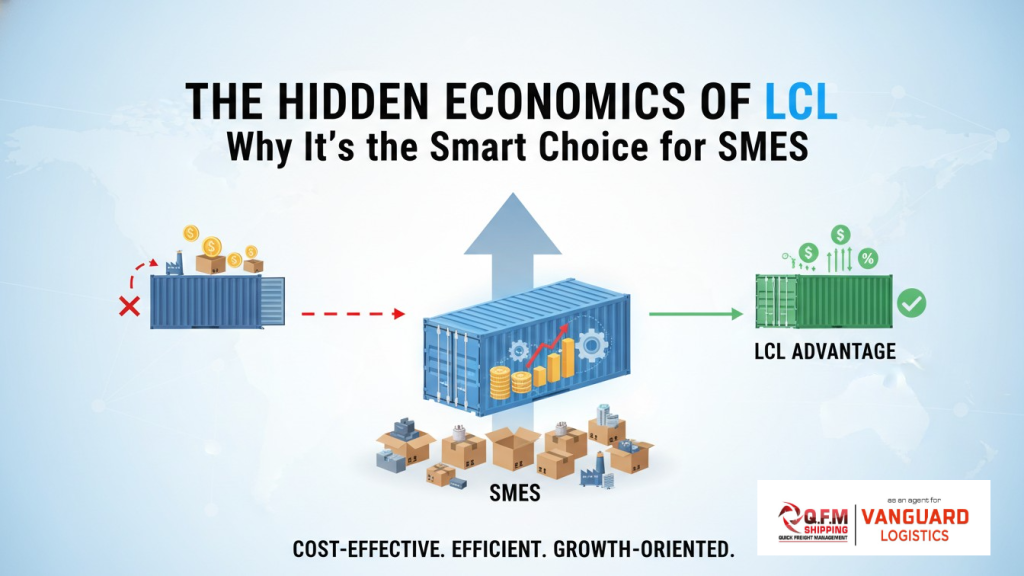
The Hidden Economics of LCL – Why It’s the Smart Choice for SMEs
Small and medium enterprises (SMEs) form the backbone of global trade, especially in emerging economies like Pakistan, the UAE, India, and Southeast Asia. Yet many SMEs still struggle with one major barrier: high logistics costs. Full Container Load (FCL) shipments often remain out of reach due to high volume requirements and volatile freight rates. This is where Less-than-Container Load (LCL) becomes a game-changing solution—unlocking affordability, flexibility, and reliability without compromising on global reach.
Below, we break down the hidden economics of LCL that every SME needs to understand in 2026.
1- No Need to Wait for Full Volumes
LCL eliminates one of the biggest operational delays for SMEs: waiting to accumulate enough stock to fill a 20’ or 40’ container.
Why This Matters
-
Faster inventory turnover
-
Reduced warehousing cost
-
Improved cash flow cycles
-
Lower risk of stockouts for e-commerce and retail businesses
In modern volatile markets, speed is profitability. LCL aligns perfectly with just-in-time supply chains.
2- Predictable, Transparent Costs
LCL charges SMEs only for the CBM they use, not for the whole container. This creates a clear price structure without hidden surcharges.
Cost Advantages
-
No fluctuations from full container price swings
-
Easy budgeting for smaller shipments
-
Avoid paying for unused container space
-
Perfect for high-mix, low-volume SKUs
With global freight rates still adjusting post-2024 volatility, this predictability gives SMEs a strategic financial advantage.
3- Global Reach Through Consolidation Hubs
LCL networks (like those run by top consolidators and QFM Shipping partners) rely on weekly sailings, fixed schedules, and multi-port combinations.
Popular lanes include:
-
Karachi → Jebel Ali (weekly LCL)
-
Shanghai → Karachi
-
Shenzhen → Karachi
-
Antwerp → Karachi
-
New York → Karachi
Benefits to SMEs
-
Guaranteed weekly departures
-
Fewer rollovers
-
Reduced lead times
-
Consistent routing and transit performance
LCL gives SMEs the global presence that used to be possible only for large exporters.
4- Lower Inventory Risk in Uncertain Markets
The economic landscape of 2025–2026 is marked by price swings, inflation pressures, and fluctuating demand. Shipping smaller batches helps SMEs:
-
Avoid overstocking
-
Ship based on live demand
-
Reduce the financial burden of unsold goods
-
Expand into new markets with minimal risk
This is why LCL is now a risk-mitigation tool, not just a logistics product.
5- Enhanced Flexibility for Multi-Destination Shipments
LCL gives SMEs supply chain agility by allowing them to split shipments across markets. You can ship:
-
Part load to GCC
-
Part load to Europe
-
Part load to North America
All without paying the full container price.
This flexibility is fuelled by advanced consolidation networks—something FCL simply cannot offer without extremely high costs.
6- SMEs Gain Competitive Edge in Export Markets
With the rise of cross-border e-commerce and marketplace sellers, fast replenishment cycles have become central to competitiveness.
LCL helps SMEs achieve:
-
Faster order fulfillment
-
More frequent restocking
-
Improved customer commitment
-
Lower landed cost per unit on smaller batches
For markets like textiles, handicrafts, auto parts, food items, and electronics—this advantage is critical.
Conclusion: LCL Is Not a Backup Option—It’s a Smart Strategy
In 2026, the economics of global shipping rewards companies that stay lean, agile, and adaptable. LCL is the perfect logistics strategy for SMEs who want cost control, flexibility, and predictable supply chains without large inventory commitments.
For Pakistan’s exporters—especially Karachi-based SMEs—LCL consolidation hubs provided by top forwarders like QFM Shipping open global doors that were once accessible only to large corporations.
If your business wants to scale exports in a sustainable, cash-flow-friendly way, LCL is not just an option—it’s the smartest choice.
Tags:
LCL shipping, LCL for SMEs, LCL consolidation, less than container load, SME exports Pakistan, LCL freight economics, Karachi LCL services, cost-effective shipping, LCL benefits, freight forwarding for SMEs, QFM Shipping Pakistan
