Pakistan’s LCL Growth in 2026 – What’s Driving the Surge?
Less-than-Container Load (LCL) shipping used to be a “backup option” in Pakistan’s export and import playbook. In 2026, that’s no longer true.
From Karachi to Port Qasim, more shippers – especially SMEs, startups and e-commerce brands – are pivoting to LCL as a strategic first choice, not a last resort. Tight margins, volatile freight rates and faster product cycles mean businesses can’t afford to wait for a full container anymore.
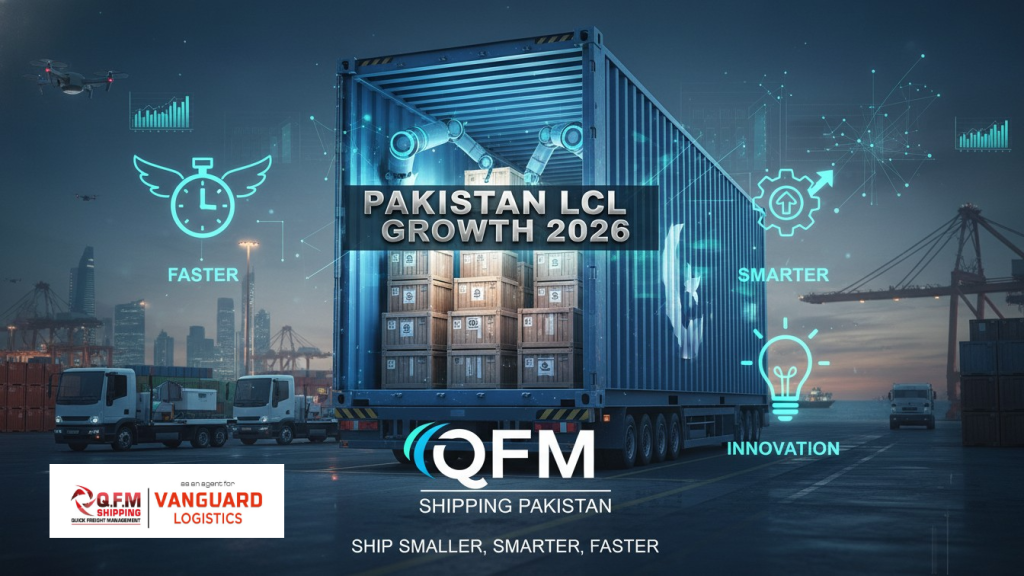
In this article, we break down what’s driving Pakistan’s LCL growth in 2026 and how smart consolidation partners like QFM Shipping Pakistan are helping customers ship smaller, smarter and faster.
1- SMEs and Startups Are Re-Writing Pakistan’s Export Story
Pakistan’s export base is diversifying beyond bulk textiles and commodities. Small and mid-sized businesses in:
-
Value-added textiles and fashion
-
Sports goods and accessories
-
Home décor and handicrafts
-
Processed foods and specialty items
-
Automotive parts and light engineering
…are increasingly shipping smaller, frequent orders to the GCC, Europe, North America and East Asia.
For these businesses, waiting to fill a full container (FCL) often means:
-
Missed seasonal demand
-
Lost repeat orders
-
Cash stuck in inventory
LCL solves this instantly:
-
Lower volume threshold: Ship 1–10 CBM instead of 1 full 20’/40’ container.
-
Faster market entry: Test new buyers and markets without big freight commitments.
-
Better cash flow: Convert inventory into cash more frequently.
As Pakistan’s SME ecosystem matures in 2026, LCL growth naturally follows – and consolidation specialists like QFM Shipping Pakistan sit at the heart of that shift.
2- E-Commerce and Omni-Channel Retail Need Smaller, Faster Shipments
Pakistan’s exporters aren’t just shipping bulk to wholesalers anymore. They’re shipping:
-
To online marketplaces and fulfilment centres (Amazon, Noon, regional platforms).
-
To 3PL fulfilment hubs in Dubai, Jebel Ali, Europe and the US.
-
To regional distribution centres that serve multiple markets from one hub.
These models rely on lean inventory and short replenishment cycles, making LCL a natural fit:
-
Restock bestsellers quickly instead of over-stocking.
-
Combine SKUs from multiple suppliers into one LCL console.
-
Respond rapidly to online demand spikes (sales, promotions, viral products).
In 2026, e-commerce and omni-channel retail are powerful engines behind Pakistan’s LCL growth, especially on key trade lanes like Karachi–Jebel Ali, Karachi–Europe and Karachi–US via transhipment hubs.
3- Freight Rate Volatility Makes LCL a Risk-Management Tool
Global freight has not fully stabilised. Even in 2026, shippers face:
-
Rate fluctuations driven by carrier alliances and capacity decisions
-
Surcharges linked to fuel, geo-political disruptions and port congestion
-
Blank sailings and schedule changes on major East–West and North–South routes
For many Pakistani exporters, committing to full containers in such a climate is risky. LCL offers:
-
Smaller financial exposure per shipment – less capital tied to one sailing.
-
Easier cost control – pay for actual volume/weight instead of unused container space.
-
Flexibility to split cargo across multiple sailings and destinations.
Instead of “all-in” bets on FCL, shippers can diversify their freight strategy: use FCL for stable, predictable volumes and LCL for variable, growth or new-market demand. That hybrid approach is a key driver of LCL demand in 2026.
4- Better Consolidation Infrastructure in Karachi and Beyond
A decade ago, many shippers complained that LCL in Pakistan meant:
-
Poor visibility
-
Long dwell times
-
Cargo damage due to rough handling
That picture is changing fast. Modern LCL operators now offer:
-
Dedicated consolidation warehouses near ports.
-
Standardised stuffing and segregation procedures for mixed cargo.
-
Improved tracking and documentation, including digital pre-alerts and status updates.
-
Special handling for fragile, high-value or temperature-sensitive goods (where applicable).
QFM Shipping Pakistan, for example, focuses on well-planned console schedules and careful cargo handling, allowing exporters to trust LCL as a reliable, repeatable solution – not a one-off last resort.
5- Trade with GCC, China and Europe Favors LCL Consoles
Pakistan’s trade ties with key partners continue to deepen, especially:
-
GCC & Middle East – Dubai/Jebel Ali as a regional hub
-
China – multiple ports feeding Pakistan via sea
-
Europe – steady demand for textile, leather, sports and engineering goods
These corridors are ideal for fixed-day LCL consolidation services, such as:
-
Weekly or twice-weekly LCL departures from Karachi
-
Regular inbound LCL consoles for imports and cross-trade
-
Hub-and-spoke distribution using Jebel Ali and other transhipment hubs
The more stable and predictable these services become, the more shippers plan their supply chains around LCL, further fueling Pakistan’s LCL growth in 2026.
6- Supply Chain Agility Beats Bulk Volume
Buyers worldwide increasingly demand:
-
Shorter lead times
-
Smaller but more frequent deliveries
-
The ability to tweak orders based on real-time sales
This shift – from bulk forecasting to agile, demand-driven supply chains – heavily favours LCL.
For Pakistani exporters, the benefits are clear:
-
Reduce warehouse space requirements in destination markets.
-
Respond quickly to changing designs, colours, SKUs and packaging.
-
Decrease obsolescence and over-stocking risk.
Instead of chasing the cheapest per-unit rate with FCL, many businesses in 2026 now focus on total landed cost + agility, where LCL often comes out ahead once inventory and risk are factored in.
7- Digitalisation Makes LCL Easier to Manage
Historically, LCL meant more paperwork and coordination. In 2026, digitalisation is changing that:
-
Online bookings and digital BL instructions
-
Automated rate quotes for LCL lanes
-
Visibility tools and proactive status alerts
-
Instant document sharing with buyers and customs brokers
As digital tools improve, the perceived complexity of LCL shrinks, encouraging more Pakistan-based shippers to embrace LCL for both exports and imports.
8- How QFM Shipping Pakistan Supports LCL Growth
At QFM Shipping Pakistan, we have positioned our services around this LCL transformation. Our focus is simple:
“One Place. Worldwide LCL.”
Here’s how we help Pakistani businesses leverage the LCL surge in 2026:
a) Strategic LCL Trade Lanes
-
Regular LCL console services ex-Karachi to key hubs and destinations
-
Competitive transit times with reliable schedules
-
Strong agent and partner networks at destination ports
b) SME-Friendly Solutions
-
Support for first-time exporters and small volumes
-
Guidance on packaging, documentation and HS classification
-
Transparent, easy-to-understand charges – no hidden surprises
c) Consolidation Expertise
-
Professional stuffing and segregation in secure facilities
-
SOPs designed to minimise damage and mis-handling
-
Flexible options for multi-destination and multi-buyer shipments
d) End-to-End Visibility
-
Clear sailing schedules and cut-off times
-
Proactive updates from cargo receipt to final delivery
-
Coordination with destination agents for smooth handover
9- Is LCL Right for Your Business in 2026?
Consider LCL if:
-
Your shipment is below FCL capacity (e.g., under 15–18 CBM for a 20’).
-
You’re entering new markets or testing new buyers.
-
You need to ship frequently but can’t commit to full containers.
-
You want to protect cash flow and avoid large inventory blocks.
In many cases, the slightly higher per-CBM freight cost of LCL is more than offset by:
-
Lower inventory risk
-
Faster sales cycles
-
Reduced storage and financing costs
That’s why LCL isn’t just growing in Pakistan – it’s becoming a core pillar of smart, resilient supply chains.
Final Thoughts: Turning LCL Growth into Your Competitive Edge
Pakistan’s LCL growth in 2026 is no accident. It’s the result of SME expansion, e-commerce, volatile freight markets, better consolidation infrastructure and digital logistics all moving in the same direction.
The winners will be the businesses that:
-
Think strategically about shipment size and frequency
-
Use LCL to enter new markets and serve new buyers
-
Partner with experienced LCL consolidators who understand Pakistan’s trade reality
If you’re ready to see how LCL can work for your business, QFM Shipping Pakistan is here to help – from the first cubic metre to your long-term global growth.
Tags:
Pakistan LCL growth 2026, LCL shipping Pakistan, LCL exports Pakistan, SME exporters Pakistan, LCL consolidation Karachi, QFM Shipping Pakistan, flexible freight solutions, Pakistan logistics 2026
