
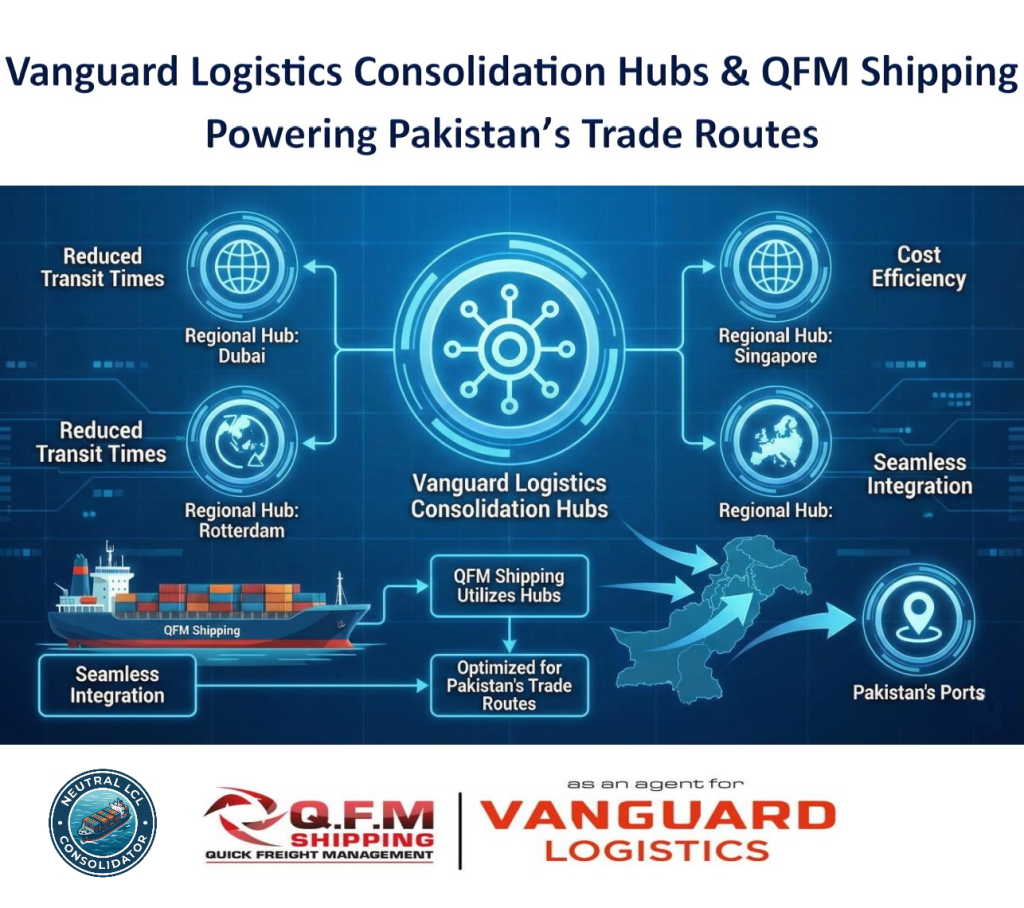
Vanguard Logistics Consolidation Hubs & QFM Shipping: Powering Pakistan’s Trade Routes
1- Why Consolidation Hubs Matter for Pakistan’s Trade
As Pakistan’s import and export volumes grow, especially on key lanes like Middle East, China, Europe, and North America, shippers are under pressure to move cargo faster, more reliably, and at competitive rates. For many SMEs and even large importers, a full container (FCL) is not always feasible. This is where LCL (Less than Container Load) consolidation hubs become critical.
Through its partnership with Vanguard Logistics, one of the world’s leading neutral LCL providers, QFM Shipping Pakistan taps into a global network of consolidation hubs to offer structured, predictable, and cost-effective LCL services for Pakistan’s trade routes.
This post explains in clear terms:
-
What consolidation hubs are
-
How Vanguard Logistics operates them
-
How QFM Shipping uses this network for Pakistan-bound and Pakistan-origin cargo
-
The practical benefits for importers, exporters, and freight forwarders in Pakistan
2. What Is a Consolidation Hub in LCL Shipping?
A consolidation hub is a strategic warehouse or logistics facility where LCL cargo from multiple shippers is:
-
Received and checked
-
Sorted by destination
-
Consolidated into shared containers
-
Dispatched on fixed weekly or multiple-weekly sailings
Instead of each small shipment moving separately (which would be expensive and inefficient), the hub combines many small shipments into full containers, creating:
-
Better freight rates (cost shared among multiple shippers)
-
Higher frequency (regular weekly cut-offs and sailings)
-
Network reliability (standard processes, fixed schedules, and trackable cargo flows)
For global LCL specialists like Vanguard Logistics, consolidation hubs are the backbone of their service model, connecting origin and destination ports through a planned, repeatable network of sailings.
3. How Vanguard Logistics’ Consolidation Hubs Operate
Vanguard’s consolidation hubs operate on a standardized, process-driven model. While each location has its own local specifics, in general the workflow looks like this:
3.1 Cargo Receiving & Documentation
-
Cargo arrives from different shippers and freight forwarders.
-
Warehouse team verifies:
-
Piece count and weight
-
Packaging condition
-
Labelling and markings
-
Documentation (commercial invoice, packing list, HS code, etc.)
-
3.2 Sorting by Destination & Sailing
Cargo is then sorted based on:
-
Destination country and port (e.g., Karachi, Lahore dry port, Port Qasim)
-
Service lane (e.g., Shanghai–Jebel Ali–Karachi, Antwerp–Jebel Ali–Karachi, direct China–Pakistan where available)
-
Sailing date (weekly or multiple weekly departures)
3.3 Consolidation into Containers
The hub then consolidates cargo into containers that follow fixed, published services:
-
LCL containers are planned to optimize space while maintaining cargo safety.
-
Specific commodities may be separated (e.g., DG vs non-DG, high-value cargo, temperature-sensitive where applicable).
-
Cargo is stuffed according to best-practice stowage patterns to reduce damage risk and improve container stability.
3.4 Final Checks, Sealing & Dispatch
Before dispatch to the port:
-
The container is sealed with a unique seal number.
-
The container loading plan is finalized.
-
Documentation and data are updated in the system for end-to-end tracking and visibility.
For shippers and consignees in Pakistan, this translates into predictable LCL departures and arrivals, managed through a single point of contact like QFM Shipping, acting locally on top of Vanguard’s global infrastructure.
4. Where QFM Shipping Fits In: Pakistan’s Gateway to Vanguard’s Global LCL Network
QFM Shipping Pakistan acts as a dedicated local partner and agent for Vanguard Logistics, connecting Pakistan’s importers, exporters, and freight forwarders to Vanguard’s worldwide consolidation hubs.
4.1 Origin Consolidation for Pakistan-Bound Cargo
For imports into Pakistan, QFM Shipping taps into Vanguard’s key consolidation hubs in:
-
Middle East – especially Jebel Ali as a regional transshipment and consolidation hub
-
China – major export origins such as Shanghai, Shenzhen, Ningbo, Qingdao
-
Europe – hubs like Antwerp / Rotterdam / Hamburg for EU origin cargo
-
North America – major gateways consolidating cargo bound for South Asia and the Middle East
At these hubs, Pakistan-bound shipments are:
-
Identified and grouped for Karachi, Port Qasim, and relevant ICDs.
-
Consolidated into specific Pakistan-destined LCL containers.
-
Shipped on fixed schedules that QFM can publish and commit to with customers.
4.2 Destination Handling & Deconsolidation in Pakistan
Once the consolidated containers arrive in Pakistan:
-
They are moved to designated CFS (Container Freight Stations) or bonded warehouses.
-
Cargo is deconsolidated (stripped from the container).
-
Each shipment is separated according to consignee, customs status, and final delivery point.
-
QFM coordinates with consignees or their appointed customs brokers for:
-
Clearance
-
Duty/tax payment
-
Final delivery to warehouse, shop, or project site
-
This end-to-end process allows even smaller shipments (1–2 pallets, a few CBM) to benefit from a global, premium network at a cost and frequency that would not be possible on a standalone basis.
5. Key Pakistan Trade Routes Where Consolidation Hubs Add Value
By leveraging Vanguard’s consolidation hubs, QFM Shipping can strengthen Pakistan’s major trade corridors. Typical examples:
5.1 China–Pakistan LCL Services
-
Origins: Shanghai, Shenzhen, Ningbo, Guangzhou, Qingdao
-
Via: Direct or via regional hubs (e.g., Jebel Ali)
-
Destinations: Karachi, Port Qasim and key inland points
Benefits:
-
Competitive rates for smaller shipments
-
Regular departures, reducing waiting time for full-container booking
-
Reduced risk courtesy of professional stuffing and network control
5.2 Middle East–Pakistan (Jebel Ali as a Strategic Hub)
Jebel Ali is a major consolidation and transshipment hub for cargo heading to Pakistan and the wider region. For Pakistan-bound cargo:
-
Multiple origins feed into Jebel Ali (GCC, Africa, sometimes Europe and US cargo).
-
LCL containers are consolidated specifically for Pakistan.
-
Short transit times plus high departure frequency make it an ideal route for time-sensitive cargo.
5.3 Europe–Pakistan via Vanguard Hubs
From European exporters to Pakistan:
-
Cargo can be consolidated at key European hubs.
-
Pakistan-destined shipments are grouped, creating a reliable LCL pipeline to Karachi and beyond.
-
This supports industrial imports, machinery, pharmaceuticals, and consumer goods for the Pakistan market.
5.4 North America–Pakistan
While transit times are naturally longer from North America, consolidation hubs help:
-
Aggregate smaller orders into efficient Pakistan-bound containers.
-
Provide better visibility and schedule reliability.
-
Help importers reduce per-unit landed cost by using shared containers.
6. Benefits of Vanguard Consolidation Hubs for QFM Shipping Customers in Pakistan
When QFM Shipping uses Vanguard’s consolidation hubs, customers in Pakistan gain several practical advantages:
6.1 Cost Efficiency for Smaller Volumes
Instead of waiting to fill a full container, shippers can move cargo in smaller lots while still enjoying:
-
Competitive LCL rates
-
Shared container costs
-
Lower capital tie-up in inventory
6.2 Improved Transit Time & Frequency
Because services are based on fixed weekly or multiple-weekly departures, shippers do not have to wait for random space. This helps:
-
Shorten supply chain cycle times
-
Align shipments more closely with purchase orders and production needs
-
Reduce stockouts and urgent airfreight situations
6.3 Global Reach Through a Single Local Partner
By working with QFM Shipping in Pakistan, customers tap into:
-
Vanguard’s global LCL footprint
-
Consistent service standards across multiple origins
-
A single, locally available point of contact for tracking, documentation, and issue resolution
6.4 Lower Risk and Better Cargo Handling
Professional consolidation hubs typically offer:
-
Standardized handling processes
-
Better stowage planning
-
Reduced risk of damage compared to poorly managed, ad-hoc groupage
Combined with QFM’s local oversight and communication, this results in smoother end-to-end cargo flows.
7. How the Process Works for a Typical Pakistan Importer
To make this more concrete, here is how a standard shipment might move using Vanguard hubs and QFM Shipping:
-
Booking
-
The importer in Pakistan places an LCL booking with QFM Shipping.
-
QFM coordinates with the overseas supplier and the relevant Vanguard origin office or hub.
-
-
Cargo Delivery to Origin Hub
-
Supplier delivers cargo to Vanguard’s designated warehouse / CFS at the origin (e.g., Shanghai, Antwerp, Jebel Ali).
-
Vanguard teams take over receiving and consolidation.
-
-
Consolidation & Export
-
Cargo is consolidated into a Pakistan-destined LCL container.
-
The container is sealed and shipped on a planned vessel.
-
-
Arrival & Deconsolidation in Pakistan
-
At Karachi / Port Qasim, the LCL container is moved to the destination CFS.
-
Deconsolidation happens, and cargo is separated by consignee.
-
-
Customs Clearance & Delivery
-
QFM Shipping coordinates with the consignee / broker for clearance.
-
Cargo is released and delivered to the final destination (warehouse, plant, store, etc.).
-
At every step, QFM is the local interface, while Vanguard’s hub network provides the global backbone.
8. Who Should Use These LCL Consolidation Services in Pakistan?
This model is particularly valuable for:
-
Importers and exporters with regular but not full-container volumes
-
SMEs testing new suppliers or markets
-
E-commerce and retail companies needing frequent, smaller replenishment
-
Project and industrial buyers who need partial shipments of machinery, parts, or spares
-
Freight forwarders and logistics intermediaries who want neutral LCL capacity for their customers
If your typical shipment size is between 1 CBM and 15–20 CBM, a consolidation hub-based LCL solution through QFM and Vanguard can be more economical and flexible than relying only on FCL or airfreight.
9. How QFM Shipping Adds Value Beyond the Hub Network
While Vanguard provides the global consolidation infrastructure, QFM Shipping adds value at several critical points:
-
Local advisory on the best routing, cut-offs, and transit times for Pakistan
-
Proactive scheduling information for key trade lanes
-
Support with documentation to avoid delays and customs issues
-
Coordination for final-mile delivery and, where needed, special handling
-
Customer service in the local time zone, with understanding of Pakistan’s business context and industry requirements
This combination of a global network plus local Pakistan expertise is what turns the consolidation hub model into real, day-to-day competitive advantage for shippers.
10. Conclusion: Turning Global LCL Hubs into a Pakistan Advantage
Consolidation hubs are not just warehouses; they are the nerve centers of modern LCL logistics. Through its partnership with Vanguard Logistics, QFM Shipping Pakistan connects local businesses to a highly structured global network of these hubs, transforming how Pakistan imports and exports smaller shipments.
For Pakistani importers, exporters, freight forwarders, and SMEs, this means:
-
Better rates for smaller volumes
-
Predictable schedules and transit times
-
Access to global origins via a single local partner
-
Reduced risk and improved handling
If you are moving LCL cargo on any major route – from China, the Middle East, Europe, or North America into Pakistan, or vice versa – leveraging Vanguard’s consolidation hubs through QFM Shipping can help you build a faster, more flexible, and more competitive supply chain.
You can now take this post, add your own specific service lanes (e.g., “Shanghai–Karachi weekly LCL”, “Jebel Ali–Karachi express LCL”), transit times, and contact details for QFM Shipping, and publish it directly on your website or LinkedIn for maximum SEO impact.
Tags:
Vanguard Logistics, consolidation hubs, LCL consolidation Pakistan, QFM Shipping Pakistan, global LCL network, Pakistan import export routes, Karachi consolidation hub, Jebel Ali LCL, China to Pakistan LCL, Europe to Pakistan LCL
