
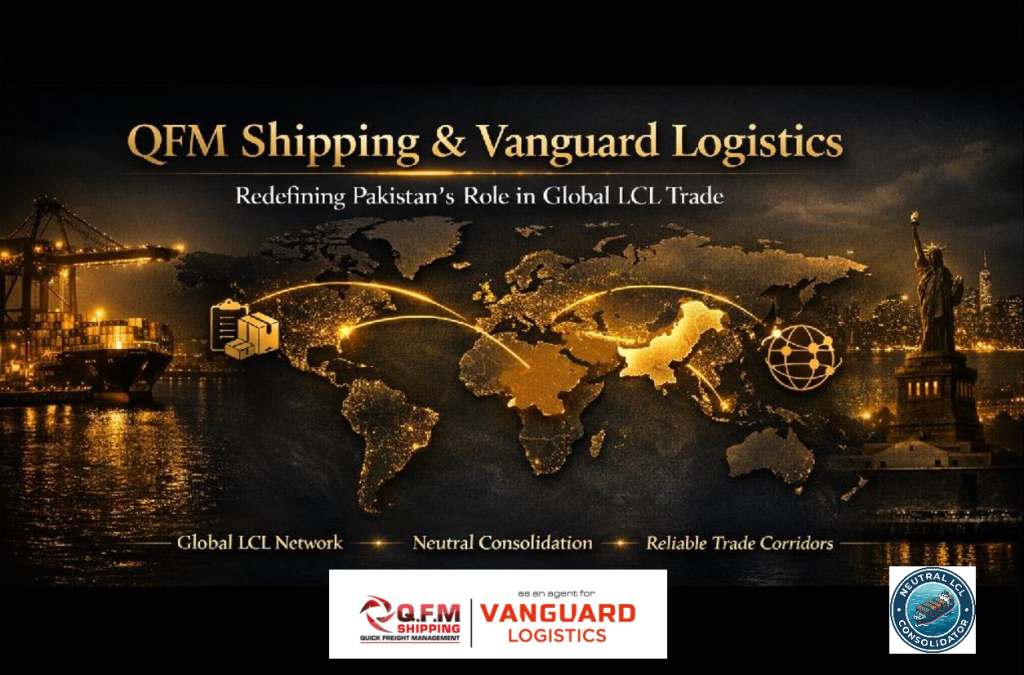
QFM Shipping and Vanguard Logistics: Redefining Pakistan’s Role in Global LCL Trade
Pakistan’s trade is evolving fast—driven by new buyer markets, diversified sourcing, and greater demand for consistent, mid-volume shipments. Yet for many exporters, importers, and freight forwarders, one constraint keeps showing up: reliable Less-than-Container Load (LCL) capability at global standards.
That is precisely where QFM Shipping and Vanguard Logistics are changing the equation.
Through a partner-led operating model and access to a mature global consolidation network, QFM Shipping and Vanguard Logistics are helping Pakistan move beyond “origin-only” shipping constraints and into a more strategic position in international LCL corridors—where predictability, frequency, compliance, and visibility matter as much as cost.
This article explains how QFM Shipping and Vanguard Logistics strengthen Pakistan’s LCL competitiveness, what this means operationally for forwarders and BCOs (beneficial cargo owners), and how the model supports growth across Europe, North America, the Middle East, and beyond.
Why Pakistan’s LCL Trade Needs a New Operating Standard
LCL is not simply “small cargo.” It is a system: consolidation discipline, cutoff control, accurate documentation, warehouse process integrity, and network coordination from origin to destination.
In developing trade lanes, LCL pain points often include:
-
Inconsistent consolidation schedules and sailing frequency
-
Cargo rollovers due to weak cutoff management
-
Mixed cargo handling risks and weak warehouse controls
-
Documentation errors that trigger customs delays
-
Limited routing options when disruptions hit a lane
-
Poor milestone visibility for freight forwarders and shippers
For Pakistan-based exporters and importers, these risks translate into lost time, higher landed costs, and reduced competitiveness—especially in sectors where delivery windows are tight.
QFM Shipping and Vanguard Logistics address these weaknesses by aligning Pakistan’s origin execution with global LCL best practices.
The Core Advantage of QFM Shipping and Vanguard Logistics in Pakistan
The strength of QFM Shipping and Vanguard Logistics comes from combining:
-
Local execution capability in Pakistan (origin handling, shipper coordination, documentation, customer support)
-
Global LCL network access (consolidation lanes, destination deconsolidation, transshipment options, standardized processes)
This partnership is particularly relevant for Pakistan because it elevates LCL from a “spot movement” into a repeatable trade product—one that forwarders can confidently sell and scale.
What “redefining Pakistan’s role” looks like in practice
With QFM Shipping and Vanguard Logistics, Pakistan’s LCL flows can be positioned as:
-
More schedule-driven rather than purely ad-hoc
-
Better standardized across handling and documentation
-
More connected to multi-region routing options
-
More scalable for forwarders building recurring LCL volumes
How QFM Shipping and Vanguard Logistics Improve LCL Performance End-to-End
1) Origin consolidation discipline that reduces avoidable delays
The LCL journey succeeds or fails at origin. QFM Shipping and Vanguard Logistics strengthen origin discipline through:
-
Cargo receiving controls (carton condition, labeling readiness, packing checks where applicable)
-
Cutoff and booking coordination to minimize last-minute rollovers
-
Structured consolidation planning to reduce cargo dwell time
-
Clear communication for forwarders on receiving windows, documentation timelines, and sailing alignment
For freight forwarders, this means fewer surprises and more predictable ETDs.
2) Neutral consolidation support for freight forwarders
Many forwarders need neutral handling—where cargo is processed professionally without compromising commercial relationships.
QFM Shipping and Vanguard Logistics are well-positioned to support forwarders who require:
-
Neutral LCL consolidation practices
-
Process consistency that aligns with international expectations
-
Professional milestone communication suitable for forwarder-to-customer reporting
This is particularly valuable for forwarders who want to expand LCL volumes while protecting their customer ownership.
3) Better routing optionality through global network connections
LCL networks win when they can adapt—especially when ports face congestion, capacity changes, or schedule disruptions.
Because QFM Shipping and Vanguard Logistics operate with global network connectivity, shipments can often benefit from:
-
Alternate feeder / mainline combinations
-
More stable transshipment planning
-
Destination support in major markets through network-aligned partners
The practical outcome is improved resilience in lanes that would otherwise be fragile.
4) Documentation and compliance readiness that protects transit time
LCL delays often have a paperwork cause: invoice/packing inconsistencies, HS code issues, missing consignee details, or shipment description mismatches.
A key strength of QFM Shipping and Vanguard Logistics is improving export readiness through:
-
Document verification workflows aligned to LCL timelines
-
Clear SOP-driven checklists for shipper documentation
-
More structured communication to reduce last-minute corrections
For customers, this reduces customs friction and improves on-time performance.
5) Destination deconsolidation alignment for smoother final delivery
Origin is only half the story. LCL cargo must be efficiently deconsolidated and released at destination.
QFM Shipping and Vanguard Logistics support a more complete LCL journey by aligning origin execution with how cargo is handled at destination—helping reduce:
-
Destination holds due to incomplete documentation
-
Mismatched cargo marking that slows deconsolidation
-
Delays in cargo availability notices and release workflows
Key Pakistan Trade Lanes Where QFM Shipping and Vanguard Logistics Add Value
Different lanes stress different parts of the LCL system. Here is where QFM Shipping and Vanguard Logistics are especially relevant:
Pakistan to Europe (LCL)
Europe lanes often require tight process control due to strict import requirements and customer expectations. Benefits typically include:
-
Stronger cutoff discipline
-
More predictable consolidation cycles
-
Better end-to-end milestone reporting for forwarders
Pakistan to USA / North America (LCL)
US-bound cargo is highly documentation-sensitive. Forwarders operating this lane need process maturity. QFM Shipping and Vanguard Logistics support:
-
Documentation accuracy to reduce clearance delays
-
Better predictability for ETDs and cargo readiness milestones
-
A scalable model for consistent weekly/monthly programs
Pakistan to GCC / Middle East (LCL)
Regional lanes can be fast-moving but vulnerable to congestion and schedule changes. The network-oriented approach of QFM Shipping and Vanguard Logistics improves:
-
Routing flexibility
-
Schedule stability through planning and network coordination
-
Fast communication for forwarders managing multiple shippers
Who Benefits Most From the QFM Shipping and Vanguard Logistics Model?
Freight Forwarders
Forwarders benefit when they can sell LCL as a repeatable product, not a one-off service.
QFM Shipping and Vanguard Logistics help forwarders by enabling:
-
Consistent consolidation processes
-
Reliable shipment planning and documentation workflows
-
A professional operating standard they can confidently present to clients
Exporters (SMEs and scaling manufacturers)
Exporters that cannot always fill containers need LCL that behaves like a predictable supply chain.
They benefit from:
-
More frequent shipping opportunities
-
Reduced operational friction
-
Improved delivery reliability for overseas buyers
Importers and BCOs managing mixed origins
Importers often require consolidated inbound flows across multiple suppliers. A stable LCL model helps by:
-
Reducing variability
-
Improving planned inventory replenishment
-
Supporting multi-supplier shipment coordination
What “Redefining Pakistan’s Role” Means for the Next Phase of Trade
Pakistan’s competitiveness increasingly depends on supply chain credibility—especially for higher-value products, time-sensitive replenishment models, and international buyers expecting stable delivery performance.
By strengthening LCL discipline and expanding network connectivity, QFM Shipping and Vanguard Logistics enable Pakistan to participate more meaningfully in:
-
Multi-market distribution models
-
Smaller, more frequent shipment strategies
-
International procurement programs that require consistency
-
Trade corridors where reliability is a competitive advantage
In short: QFM Shipping and Vanguard Logistics are not just moving cargo—they are improving Pakistan’s position in global trade workflows where process maturity matters.
Operational Checklist: How to Start Shipping LCL Through QFM Shipping and Vanguard Logistics
If you are a forwarder or shipper evaluating the model, use this checklist to onboard efficiently:
-
Share your trade lane(s), cargo type, and expected monthly CBM
-
Confirm documentation requirements (invoice, packing list, shipper/consignee details)
-
Align cargo receiving and cutoff schedules
-
Standardize labeling/marking requirements for deconsolidation efficiency
-
Set reporting expectations (milestones, POD, exception handling)
-
Define neutral handling needs (if you are a freight forwarder)
Conclusion
Pakistan’s global trade future will be shaped by reliability, network reach, and operational discipline—especially in LCL, where complexity is high and customer expectations are rising.
QFM Shipping and Vanguard Logistics provide a practical pathway for freight forwarders, exporters, and importers to scale LCL with greater confidence: stronger origin execution, network-enabled routing, improved documentation readiness, and better end-to-end alignment.
If your business depends on smaller, frequent shipments—or you want to expand your LCL footprint across Europe, North America, and the Middle East—QFM Shipping and Vanguard Logistics represent a modern operating standard for Pakistan’s next phase in global LCL trade.
CTA (Conversion-Focused)
Want to optimize your LCL shipments from Pakistan with predictable cutoffs, reliable consolidations, and global network reach? Contact QFM Shipping to discuss your lanes, cargo profile, and a scalable LCL program with Vanguard Logistics.
Partner with QFM Shipping & Vanguard Logistics Services — and take your global forwarding business to the next level.
Connect with Us
Ready to explore collaboration opportunities? Reach out to our team to discuss your LCL needs, strategic partnerships, and custom routing options. Let’s build stronger, smarter logistics together.
Email: info@qfmshipping.com
Phone: +92-21-34540153 & 54
+92-21-34540135 & 36
Website: www.qfmshipping.com
Tags:
Pakistan LCL trade, LCL consolidation Pakistan, Vanguard Logistics agent Pakistan, freight forwarder Pakistan LCL, export LCL Pakistan, import LCL Pakistan, Pakistan to Europe LCL, Pakistan to USA LCL, neutral consolidation, deconsolidation services, global LCL network, documentation support LCL, consolidation hub Pakistan, cargo consolidation services,
