
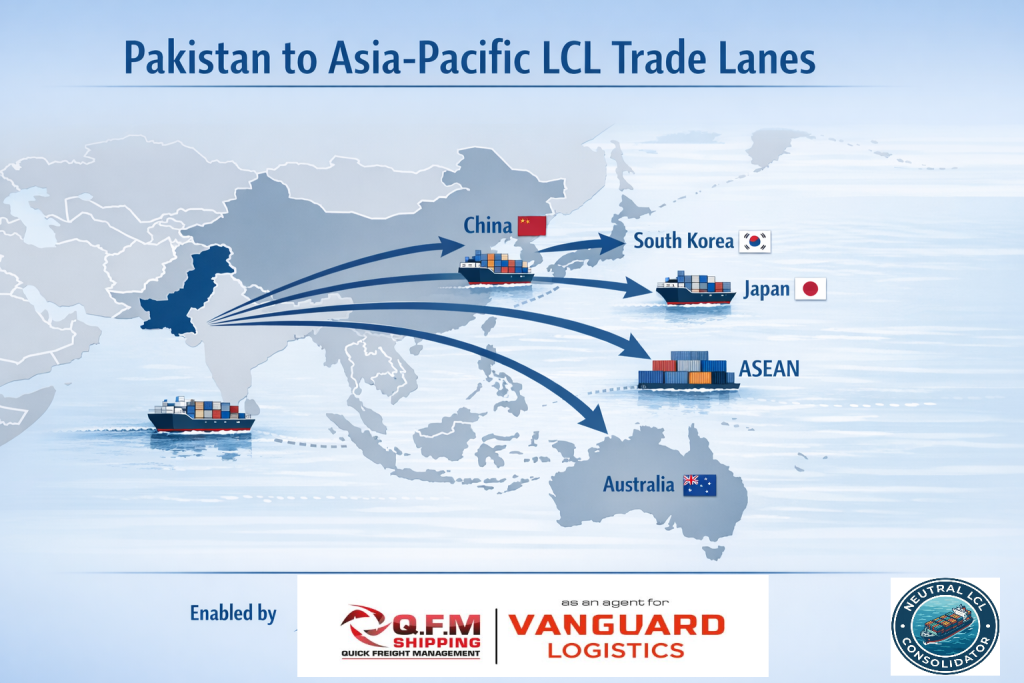
Pakistan to Asia-Pacific LCL Trade Lanes Enabled by QFM Shipping & Vanguard Logistics
Pakistan’s trade with Asia-Pacific is accelerating—driven by manufacturing supply chains, retail replenishment cycles, project cargo, and cross-border e-commerce. Yet for many shippers and freight forwarders, the challenge remains consistent: how to move smaller volumes cost-effectively, reliably, and with predictable transit performance across multiple Asia-Pacific destinations.
That is precisely where LCL (Less-than-Container Load) consolidation becomes strategic—and where QFM Shipping, as Vanguard Logistics’ agent in Pakistan, enables structured, scalable Pakistan to Asia-Pacific LCL trade lanes through a globally aligned consolidation network.
This post explains how these lanes work, what forwarders and shippers gain, and how QFM + Vanguard’s operating model helps reduce friction across documentation, consolidation, routing, and destination handling.
Why Asia-Pacific LCL Matters for Pakistan’s Exporters and Importers
Asia-Pacific is not one market—it is a dense mosaic of high-frequency trade nodes: the Gulf-to-ASEAN transshipment ecosystem, South Asia manufacturing clusters, Far East distribution corridors, and Oceania specialty-import networks. For Pakistan-based exporters and importers, this creates two realities:
-
Demand is fragmented: orders are often smaller, more frequent, and multi-destination.
-
FCL isn’t always viable: cost, cash flow, demand volatility, and product variety often make full containers inefficient.
For these use cases, a disciplined LCL lane structure—built on weekly cut-offs, documented consolidation SOPs, and standardized destination handling—becomes the difference between “shipping when we can” and “shipping as a system.”
The QFM + Vanguard Advantage: A Network-Engineered LCL Model
When you move LCL, your shipment quality depends on the consolidation network, not just the ocean leg. The QFM Shipping + Vanguard Logistics model is designed to deliver:
1) Predictable consolidation routines (not ad-hoc stuffing)
-
Planned receiving windows and cut-offs
-
Consistent cargo handling and segregation
-
Controlled consolidation practices to reduce damage and mis-sorts
2) Standardized documentation and compliance flow
-
Cleaner HBL/MBL alignment
-
Better milestone visibility for forwarders and shippers
-
Fewer exceptions at destination due to mis-declared cargo data
3) Multi-destination flexibility across Asia-Pacific
-
Access to a broader lane matrix without forcing FCL economics
-
Easier routing to secondary ports via transshipment and hub-spoke distribution
4) Forwarder-friendly execution
-
Neutral consolidation support
-
Scalable solution for forwarders serving multiple clients and industries
-
Operational clarity and repeatability for weekly lane planning
Key Pakistan to Asia-Pacific LCL Trade Lanes (Typical Routing Patterns)
While exact routings vary by carrier schedules, seasonal constraints, and destination port conditions, Asia-Pacific LCL lanes from Pakistan typically operate via major regional hubs (for example, Gulf or Southeast Asia transshipment points) before feeding into destination ports.
A) Pakistan to Southeast Asia (ASEAN) LCL lanes
Typical demand drivers
-
Textiles and garments
-
Sports goods and leather products
-
Light engineering items
-
FMCG, packaging materials, spare parts
Why LCL performs well here
-
High frequency demand with smaller orders
-
Multi-country distribution (one exporter serving multiple buyers)
-
Growing SME trade volumes
Operational focus
-
Tight cargo receipt discipline (to meet weekly sailings)
-
Strong HS alignment and invoice/packing quality to avoid destination delays
B) Pakistan to Far East / North Asia LCL lanes
Typical demand drivers
-
Industrial components and spare parts
-
Trading cargo and mixed SKUs
-
Chemical/non-hazard shipments (where permitted and documented correctly)
-
Import-side: electronics accessories, machinery parts, general cargo
Why a network approach matters
These markets often require higher documentation accuracy and consistent destination handling. A networked LCL program reduces exceptions, improves release timelines, and supports repeat shipments.
C) Pakistan to Australia & Oceania LCL lanes
Typical demand drivers
-
Specialty textiles
-
Homeware, décor, and retail replenishments
-
Spare parts and aftermarket items
-
Boutique imports and distributor supply
Why LCL is a strategic fit
Oceania routes frequently involve longer lead times and careful destination processing. LCL works best when:
-
Consolidation is structured
-
Cargo labeling is robust
-
Documentation is “destination-ready” the first time
D) Pakistan to South Asia / Regional Asia-Pacific connections
For regional Asia-Pacific flows (where available via scheduled feeder services), LCL is often used for:
-
Short-cycle procurement
-
Multi-supplier consolidations
-
Small but recurring production inputs
The winning factor here is speed-to-booking and operational repeatability—so shippers can plan procurement and inventory cycles with fewer disruptions.
What Shippers and Forwarders Gain: Practical Commercial Outcomes
1) Better cost-control without waiting for FCL volumes
You ship based on sales and production—rather than stockpiling to fill a container.
2) Higher frequency and better inventory rhythm
Weekly or scheduled consolidation cycles reduce “dead time” in warehouses.
3) Reduced risk through standardized handling
Damage, misrouting, and documentation exceptions often stem from weak consolidation discipline. Network-aligned processes materially reduce that exposure.
4) Clearer lane planning for freight forwarders
Forwarders can build service promises around known cut-offs, routing logic, and operational controls—rather than managing every shipment as a one-off.
Common LCL Pain Points—and How This Model Helps
Problem: “My cargo misses the sailing.”
Fix: structured receiving windows, cut-offs, and export readiness checks.
Problem: “Destination charges are unpredictable.”
Fix: better pre-advice discipline and standardized destination handling expectations.
Problem: “Cargo gets delayed due to paperwork.”
Fix: cleaner documentation SOPs; fewer exceptions due to HS/invoice mismatches.
Problem: “I need multi-destination distribution.”
Fix: Asia-Pacific coverage via a consolidation network, enabling hub-to-spoke LCL flows.
Who Should Use Pakistan to Asia-Pacific LCL Lanes?
This model is particularly effective for:
-
SMEs exporting mixed SKUs (textiles, sports goods, homeware, accessories)
-
Trading companies with multi-buyer or multi-country distribution
-
Importers with frequent replenishments (spares, packaging, components)
-
Freight forwarders needing neutral LCL consolidation and predictable execution
-
Businesses scaling into new Asia-Pacific markets without committing to FCL
Best Practices to Maximize LCL Performance on Asia-Pacific Lanes
To keep shipments moving smoothly, the best-performing LCL shippers and forwarders standardize:
-
Packaging suited for consolidation (stackable, labeled, moisture-protected)
-
Accurate HS codes and consistent product descriptions
-
Clean packing lists (cartons, weights, dimensions matched to cargo)
-
“Ready-to-receive” shipment discipline (no last-minute changes after cut-off)
-
Early communication for any special handling requirements
Conclusion: Turning Asia-Pacific LCL into a Competitive Advantage
Asia-Pacific trade is increasingly about speed, flexibility, and reliability—not just freight rates. With QFM Shipping enabling Pakistan origin execution as Vanguard Logistics’ agent, businesses gain access to a structured LCL model designed for consistency: predictable consolidation cycles, network-aligned routing, cleaner documentation flow, and scalable multi-destination reach.
If your business is expanding into Asia-Pacific—or you are a freight forwarder supporting clients across multiple Asia markets—LCL lanes built on a consolidation network are no longer an option. They are an operating advantage.
Optional CTA (you can use this verbatim)
Planning Pakistan to Asia-Pacific LCL shipments? Connect with QFM Shipping to align your routing, cut-offs, documentation flow, and destination handling—backed by Vanguard Logistics’ global consolidation network.
Partner with QFM Shipping & Vanguard Logistics Services — and take your global forwarding business to the next level.
Connect with Us
Ready to explore collaboration opportunities? Reach out to our team to discuss your LCL needs, strategic partnerships, and custom routing options. Let’s build stronger, smarter logistics together.
Email: info@qfmshipping.com
Phone: +92-21-34540153 & 54
+92-21-34540135 & 36
Website: www.qfmshipping.com
Tags:
Pakistan to Asia-Pacific LCL, Pakistan LCL shipping, Asia-Pacific LCL trade lanes, QFM Shipping LCL, Vanguard Logistics LCL, Pakistan to Asia freight, LCL consolidation Pakistan, Asia-Pacific freight forwarding
