
What Is MCC (Multi-Country Consolidationin) Logistics and Why It Is Critical for Pakistan Trade
Introduction: Why MCC Matters More Than Ever for Pakistan
In today’s fragmented global supply chains, shippers are under constant pressure to reduce costs, improve transit reliability, and access multiple sourcing markets simultaneously. For Pakistan—a country heavily dependent on imported raw materials and export-driven manufacturing—traditional single-country consolidation models are no longer sufficient.
This is where MCC logistics Pakistan (Multi-Country Consolidation) becomes a strategic enabler rather than just an operational option.
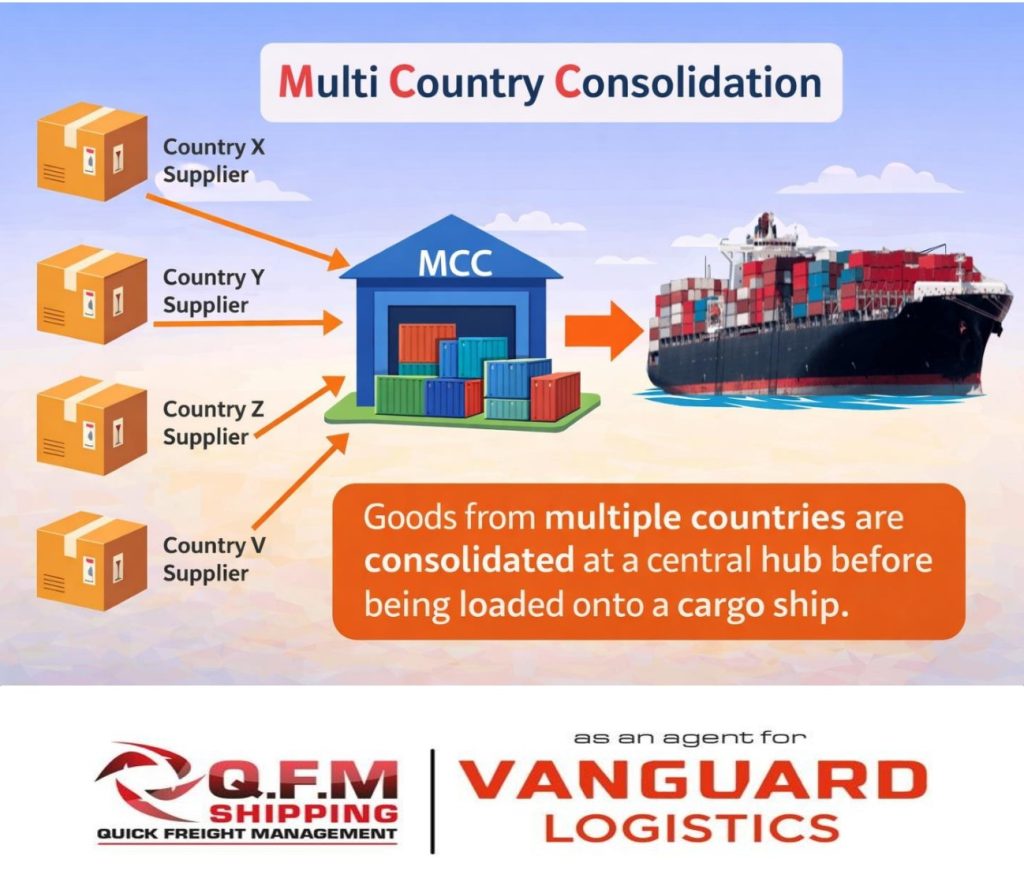
MCC allows cargo from multiple origin countries to be consolidated at a regional hub and shipped together to Pakistan as a single, optimized consignment. The model has become critical for Pakistan’s trade competitiveness in sectors such as textiles, automotive parts, electronics, pharmaceuticals, and FMCG.
What Is MCC (Multi-Country Consolidation) in Logistics?
Multi-Country Consolidation (MCC) is a logistics strategy in which less-than-container-load (LCL) or partial shipments from multiple countries are:
-
Collected from different origin suppliers
-
Routed to a designated MCC hub (regional consolidation center)
-
Consolidated into a single shipment
-
Shipped to the destination country—in this case, Pakistan
Instead of shipping separate LCL consignments from each origin, MCC combines them into one cost-optimized, schedule-controlled movement.
This model is widely used by global forwarders and neutral consolidators to serve emerging markets with complex sourcing patterns.
How MCC Logistics Works for Pakistan
A typical MCC logistics Pakistan flow looks like this:
-
Supplier A ships cargo from China
-
Supplier B ships cargo from Vietnam
-
Supplier C ships cargo from Turkey
-
Supplier D ships cargo from Malaysia
All shipments move to a regional MCC hub such as Dubai, Singapore, Colombo, or Port Klang. At the hub:
-
Cargo is consolidated
-
Documentation is harmonized
-
A single sailing is booked to Pakistan
-
Cargo arrives as one optimized import
This approach minimizes fragmented arrivals, delays, and cost inefficiencies.
Why MCC Logistics Is Critical for Pakistan Trade
1. Pakistan’s Import Structure Demands MCC
Pakistan imports from multiple sourcing countries simultaneously, especially for:
-
Textile machinery & accessories
-
Yarn, dyes, chemicals
-
Auto & motorcycle parts
-
Electronics & components
-
Packaging materials
Shipping each origin separately leads to:
-
Higher LCL costs
-
Multiple port clearances
-
Inventory mismatch
MCC logistics Pakistan solves this by synchronizing inbound cargo flows.
2. Cost Optimization in a High-Freight Environment
Ocean freight volatility has made cost predictability a priority.
MCC enables:
-
Shared container space
-
Lower per-CBM freight rates
-
Reduced documentation and handling fees
-
Better leverage with carriers
For Pakistani importers, this can mean 10–25% landed cost savings compared to fragmented LCL shipments.
3. Improved Transit Time Reliability
With traditional LCL:
-
Different origins = different sailings
-
Missed connections are common
-
Partial arrivals disrupt production
MCC offers:
-
Fixed hub cut-off schedules
-
Planned consolidation windows
-
Single sailing into Pakistan
This reliability is especially important for just-in-time manufacturing and export-driven industries.
4. Reduced Congestion and Port Inefficiencies
Pakistan’s ports frequently face:
-
Yard congestion
-
Examination delays
-
LCL de-consolidation bottlenecks
MCC cargo typically arrives:
-
Better packed
-
Properly manifested
-
With fewer House Bills
This reduces clearance friction and speeds up customs processing.
5. Strategic Advantage for Pakistani Exporters
MCC is not limited to imports.
Pakistani exporters can:
-
Combine outbound LCL cargo with regional networks
-
Access multiple destination markets via one MCC hub
-
Reduce export freight costs
This strengthens Pakistan’s export competitiveness, especially for SMEs.
MCC vs Traditional LCL for Pakistan
| Aspect | Traditional LCL | MCC Logistics Pakistan |
|---|---|---|
| Origins | Single country | Multiple countries |
| Cost efficiency | Lower | Significantly higher |
| Transit reliability | Inconsistent | Planned & stable |
| Documentation | Multiple sets | Harmonized |
| Port congestion impact | High | Reduced |
| Scalability | Limited | Highly scalable |
Key MCC Hubs Serving Pakistan
Pakistan-focused MCC networks commonly operate via:
-
Dubai / Jebel Ali
-
Singapore
-
Colombo
-
Hamburg
-
China
These hubs offer:
-
High sailing frequency
-
Advanced CFS infrastructure
-
Strong carrier connectivity
Selecting the right MCC hub is critical for performance.
Role of Neutral LCL Consolidators in MCC
MCC logistics Pakistan works best when handled by neutral consolidators who:
-
Do not compete with local forwarders
-
Operate multi-origin networks
-
Maintain consistent consolidation standards
-
Offer transparent pricing
Neutral MCC partners ensure fair access, network stability, and long-term reliability for Pakistan-bound cargo.
Challenges in MCC Logistics (and How to Mitigate Them)
While powerful, MCC requires expertise to manage:
-
Cut-off coordination
-
Multi-origin documentation alignment
-
Accurate HS coding
-
Hub congestion risk
These challenges are mitigated through:
-
Strong hub management
-
Digital visibility tools
-
Standard operating procedures (SOPs)
-
Experienced Pakistan-focused operators
Why MCC Will Define Pakistan’s Trade Future
As Pakistan integrates further into global value chains, MCC logistics will become a necessity rather than an option.
Key trends supporting this shift:
-
Multi-country sourcing strategies
-
Growth of SME imports
-
Rising freight cost sensitivity
-
Demand for predictable supply chains
MCC logistics Pakistan enables scale, resilience, and competitiveness in an increasingly complex global trade environment.
Conclusion
MCC logistics Pakistan is not just a freight concept—it is a strategic trade enabler.
By consolidating cargo from multiple countries into a single, optimized shipment, MCC:
-
Reduces costs
-
Improves reliability
-
Enhances port efficiency
-
Strengthens Pakistan’s import and export ecosystem
For businesses trading with Pakistan, MCC is rapidly becoming the most efficient path forward in global logistics.
Ready to explore collaboration opportunities? Reach out to our team to discuss your LCL needs, strategic partnerships, and custom routing options. Let’s build stronger, smarter logistics together.
Email: info@qfmshipping.com
Phone: +92-21-34540153 & 54
+92-21-34540135 & 36
Tags:
MCC logistics Pakistan, multi country consolidation Pakistan, MCC in logistics, LCL consolidation Pakistan, Pakistan import consolidation, neutral LCL MCC, multi origin shipping Pakistan
