
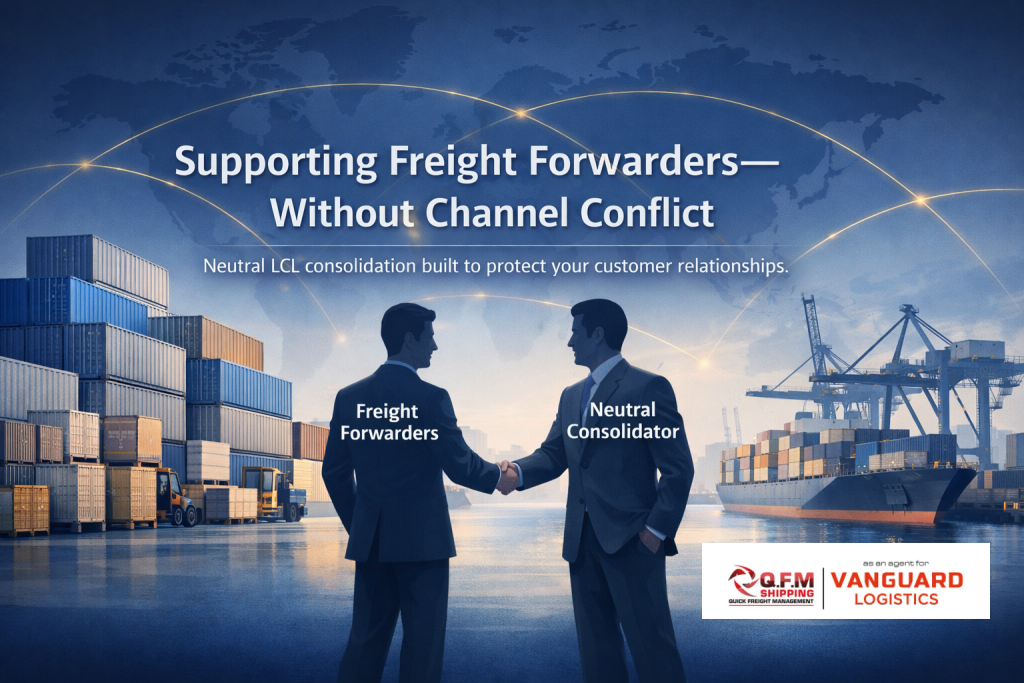
How QFM Shipping Supports Freight Forwarders Without Channel Conflict
Freight forwarders win business by owning relationships, understanding shipper needs, and delivering reliable execution. The moment a service partner tries to “go direct,” that trust breaks—often permanently. This is why channel conflict is one of the most sensitive risks in the forwarding ecosystem, especially in LCL where multiple parties touch the cargo, documentation, and data.
A neutral partner does not merely claim neutrality; it must be engineered into operating design, staff behavior, documentation controls, pricing discipline, and information governance. This is where neutral LCL consolidation becomes more than a service type—it becomes a business model.
This article explains what channel conflict looks like in freight forwarding, why it happens, and the practical operating mechanisms that prevent it. It also outlines how QFM Shipping supports freight forwarders using a “forwarder-first” approach built around neutral LCL consolidation—so forwarders can grow volumes without risking customer ownership.
What “Channel Conflict” Means in Freight Forwarding
Channel conflict occurs when a service provider that should act as a back-end operator (consolidator, co-loader, carrier-adjacent service, or warehouse partner) begins competing with its own customers (freight forwarders). In practice, it can show up as:
-
Direct marketing to shippers or BCOs using operational visibility gained from forwarder shipments
-
Sales outreach based on shipper names discovered through documentation, labels, or shipping instructions
-
Rate undercutting by bypassing the forwarder and approaching the shipper directly
-
Branding on cargo, packaging, or communications that confuses the shipper about “who owns the shipment”
-
Control of critical data (contacts, emails, routing history) used for commercial targeting
In LCL specifically, the risk rises because neutral LCL consolidation involves handling multiple forwarders’ cargo in shared facilities, shared cut-offs, shared documentation workflows, and shared exception management. Without strong guardrails, a consolidator can easily become a competitor.
Why Neutral LCL Consolidation Is the Anti-Conflict Model
A true neutral LCL consolidation operator is designed to serve forwarders, not replace them. The forwarder remains the commercial owner; the consolidator remains the execution engine. When neutrality is real, forwarders gain three strategic advantages:
-
Scale without investment: access consolidation, routing options, and operational muscle without building it in-house
-
Consistency across lanes: standardized LCL processes that reduce exceptions and delays
-
Customer ownership protection: the forwarder stays “front-stage,” while the neutral operator stays “behind the curtain”
Neutrality is therefore not a slogan. It is a measurable operating discipline that can be audited through SOPs, documentation templates, communications rules, and data-handling policies.
How QFM Shipping Implements Neutrality in Daily Operations
QFM Shipping operates as a Pakistan-based consolidator built to support forwarders through neutral LCL consolidation. Below are the operating mechanisms that protect forwarders from channel conflict—organized as controls you can recognize, validate, and operationalize.
1) Customer Ownership Is Protected by Design
The most effective way to prevent conflict is to remove the incentive and ability to “go direct.” In a forwarder-first setup:
-
The forwarder remains the named commercial point of contact
-
Communications are structured so the forwarder stays in control
-
Operational touchpoints avoid shipper-facing messaging unless explicitly authorized
In neutral LCL consolidation, this means QFM Shipping focuses on operational outcomes (space, cut-off, consolidation, documentation readiness, departures, arrival coordination) while the forwarder retains customer-facing narrative, rate structure, and relationship management.
Practical outcome: the forwarder can confidently scale LCL volumes without worrying that operational visibility becomes sales intelligence.
2) Neutral Documentation and Messaging Rules
Documentation is where “data leakage” commonly starts. Shipping instructions, invoices, packing lists, labels, and certificates can expose shipper identities and contact details. A neutral operator controls how that information is handled and who sees what.
In a neutral LCL consolidation environment, best-practice controls include:
-
Standardized SI templates with clear fields, role separation, and controlled distribution
-
Consignee/shipper visibility controls to ensure only required parties access sensitive data
-
No commercial messaging embedded in operational email traffic
-
Forwarder-labeled milestones (where appropriate) so the forwarder remains the primary identity
Practical outcome: documentation flow supports compliance and accuracy without becoming a channel-conflict pathway.
3) Separation Between Operations and Sales Functions
Many channel-conflict incidents happen when sales teams have access to operational systems or exception logs. A neutral operator enforces functional separation:
-
Operations teams handle cargo execution and exception resolution
-
Commercial teams handle forwarder account servicing (not shipper acquisition)
-
Access rights restrict shipper data exposure outside operational necessity
This separation is a core governance principle in neutral LCL consolidation. It ensures the organization is structurally aligned with forwarder success.
Practical outcome: forwarders can share shipment data required for execution without fear of it being repurposed commercially.
4) Rate and Quotation Integrity
Forwarders avoid partners who play pricing games—offering unsustainably low rates to “win volume,” then increasing charges later, or using hidden add-ons. Neutral consolidation depends on predictable, transparent rate discipline.
A forwarder-first neutral LCL consolidation model typically includes:
-
Clear rate structures (base + documented surcharges)
-
Consistent applicability rules (weight/measure, minimums, cut-off dependencies)
-
Clear demurrage/detention responsibility boundaries
-
Documented amendment rules for late changes and rework
Practical outcome: the forwarder can quote confidently and protect margin, rather than firefighting cost surprises.
Operational Controls That Keep the Forwarder in Control
Neutrality is best proven through controls a forwarder can evaluate quickly. Here are the controls that matter most in neutral LCL consolidation.
A. Communication Protocols
A neutral partner should operate on a simple principle: “We communicate operationally with the forwarder, not commercially with the shipper.” Typical protocols include:
-
All milestone updates routed via the forwarder (unless the forwarder requests otherwise)
-
Exception handling (rollovers, customs holds, documentation gaps) directed to forwarder operations teams
-
No direct marketing emails, calls, or outreach to shipper domains discovered through paperwork
B. Data Access Controls and Confidentiality
In consolidation, data is as valuable as space. Controls should include:
-
Role-based access in operational systems
-
Restrictions on exporting contact lists or customer fields
-
Audit trails for sensitive record access
-
Staff confidentiality training and contractual obligations
In neutral LCL consolidation, these controls convert “trust” into enforceable practice.
C. Facility and Cargo Handling Neutrality
Even physical handling can create channel confusion if branding or visibility is mishandled. Neutral best practice includes:
-
Generic container/facility labeling policies (avoid shipper-facing branding that implies ownership)
-
Controlled photo sharing and cargo visibility
-
Clear cargo segregation and identification to prevent mix-ups
Practical outcome: the forwarder’s customer experiences a consistent identity—owned by the forwarder, supported by the backend.
What Freight Forwarders Should Expect From a Neutral Partner
If you are evaluating a provider for neutral LCL consolidation, the following deliverables are reasonable expectations:
Service Deliverables
-
Predictable cut-offs and sailing schedules
-
Consistent consolidation and deconsolidation handling
-
Exception management with defined escalation paths
-
Documentation accuracy with version control and traceability
Governance Deliverables
-
Written neutrality statement + confidentiality undertakings
-
Clear organizational separation between operations and commercial activities
-
Data-handling policies that prevent re-use of shipper identity for acquisition
Performance Deliverables
-
KPI reporting: on-time departures, documentation error rate, damage ratio, claims handling time
-
Root-cause analysis for exceptions
-
Continuous improvement feedback loops with forwarder ops teams
In strong neutral LCL consolidation, these deliverables form the basis of an operational partnership rather than a transactional vendor relationship.
How QFM Shipping Fits Into the Forwarder-First Ecosystem in Pakistan
Pakistan’s export/import environment makes LCL execution particularly sensitive: changing cut-offs, documentation dependencies, customs coordination, and fluctuating port conditions all require disciplined handling. Forwarders often need a partner that can run consolidation effectively while respecting customer ownership.
QFM Shipping supports forwarders by focusing on the operational role within neutral LCL consolidation:
-
Back-end execution discipline (process, cut-offs, documentation readiness)
-
Forwarder-centric communications and escalation
-
Controls intended to reduce channel conflict risk
-
Operational consistency designed to help forwarders scale LCL volumes
The central principle remains: the forwarder owns the shipper relationship; the neutral operator owns execution quality. That is the only stable foundation for neutral LCL consolidation at scale.
Common Myths About Neutral LCL Consolidation
Myth 1: “Neutrality is just a promise.”
Reality: In mature neutral LCL consolidation, neutrality is enforced through SOPs, access control, templates, escalation rules, and auditability.
Myth 2: “If the consolidator is efficient, conflict doesn’t matter.”
Reality: Efficiency without neutrality can destroy forwarder trust. Long-term viability depends on both.
Myth 3: “Data sharing is unavoidable, so conflict is inevitable.”
Reality: Data minimization and role-based access can dramatically reduce exposure while still enabling execution.
Practical Checklist: Reduce Channel Conflict Risk
Use this checklist when selecting or reviewing a neutral LCL consolidation partner:
-
Written neutrality and confidentiality policy exists and is shareable
-
Operations and commercial roles are separated, including system access
-
Documentation workflow prevents unnecessary shipper contact exposure
-
Communication protocol keeps forwarder as the primary interface
-
Rate structure is consistent and transparent
-
KPI reporting is available and reviewed regularly
-
Exceptions are escalated to forwarder ops, not to shipper contacts
-
Facility practices avoid creating “who owns the shipment” confusion
FAQ: Freight Forwarders and Channel Conflict
What is the safest operating model for LCL partnerships?
A forwarder-first, backend-only neutral LCL consolidation model with clear SOPs, data controls, and communication rules.
How can a forwarder verify neutrality?
Ask for documented neutrality policies, review system access roles, validate communication protocols, and request KPI reporting and audit trails for sensitive fields.
Why is channel conflict more common in LCL than FCL?
Because consolidation requires shared handling and deeper documentation exposure, making neutral LCL consolidation governance essential.
Conclusion
Forwarders do not need a partner that “also competes.” They need a backend operator designed to protect relationships while improving execution. Channel conflict is not an abstract concern; it is a structural risk that must be prevented with operational guardrails.
When engineered properly, neutral LCL consolidation enables forwarders to scale—more lanes, more frequency, more reliability—without sacrificing trust or customer ownership. QFM Shipping’s role, in this context, is to operate behind the scenes with controls that keep the forwarder in control and the end customer protected.
Ready to explore collaboration opportunities? Reach out to our team to discuss your LCL needs, strategic partnerships, and custom routing options. Let’s build stronger, smarter logistics together.
Email: info@qfmshipping.com
Phone: +92-21-34540153 & 54
+92-21-34540135 & 36
Tags:
neutral LCL consolidation, channel conflict in freight forwarding, neutral consolidator Pakistan, LCL consolidation Pakistan, freight forwarder support, co-loader operations, forwarder-first logistics model, customer ownership protection, data privacy in logistics, LCL documentation workflow, consolidation SOP, deconsolidation network, LCL rate integrity, neutral freight forwarding partner
