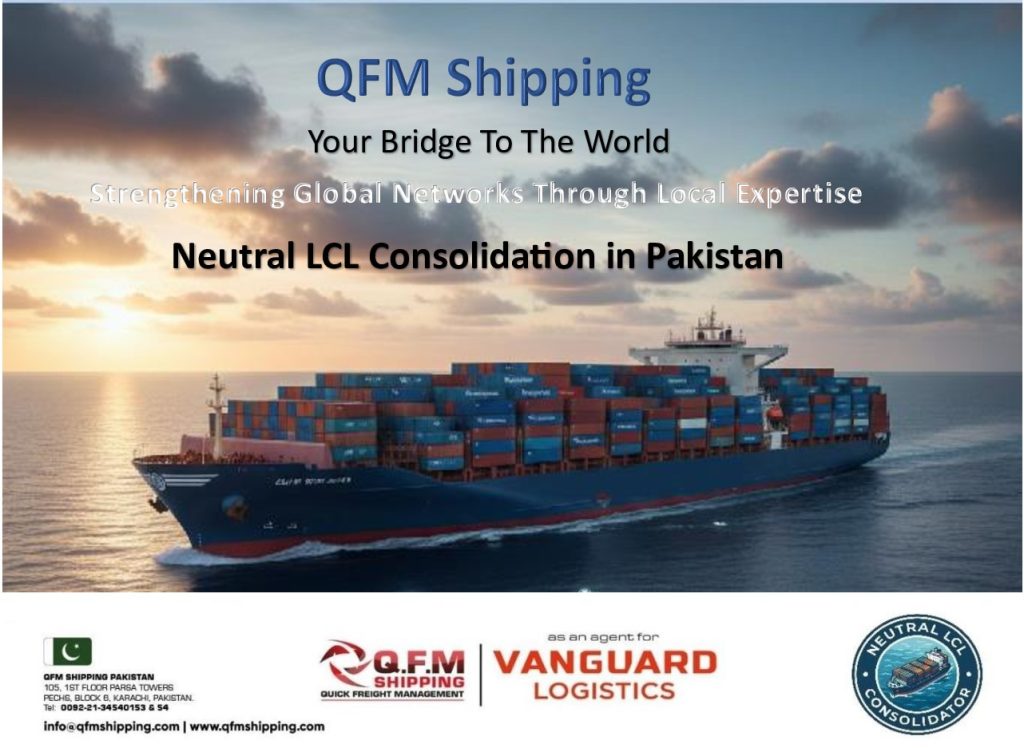
QFM Shipping Strengthening Global Networks Through Local Expertise
In global freight, “network” is not a buzzword—it’s the operating system. Your cargo may move through multiple origins, transshipment hubs, carriers, consolidations, and destination handovers before it reaches a consignee. What determines whether it moves smoothly (or becomes delayed, rolled, or cost-inflated) is the quality of the network behind it—and the local expertise that keeps that network reliable day after day.
QFM Shipping sits at that intersection: strengthening global logistics networks through on-ground execution in Pakistan, with a service mindset built around neutral LCL consolidation, disciplined documentation, predictable handovers, and consistent stakeholder visibility. For overseas forwarders, NVOCC partners, and shippers moving in and out of Pakistan, local competence isn’t optional—it’s the difference between “booked” and “delivered.”
This post explains how local expertise translates into measurable network strength—and how QFM Shipping supports that outcome across trade lanes, routing, and consolidation models.
1) Why “Local Expertise” Is a Network Advantage (Not Just a Destination Detail)
Most international problems don’t start internationally. They start locally:
-
An export is delayed due to packing non-compliance or missing VGM.
-
A container is rolled because cutoff and gate-in weren’t secured.
-
A consignee faces demurrage because clearance steps weren’t coordinated early.
-
Cargo misses a consolidation window because vendor pickups were not synchronized.
These issues weaken the entire network, creating downstream disruption across carriers, transshipment points, and receiving warehouses.
Local expertise strengthens the network by preventing “last-mile-to-port” failures—and by ensuring that what is planned globally can be executed locally with precision.
2) Pakistan as a Strategic Node: Complexity + Opportunity
Pakistan’s import/export environment is dynamic: multiple ports, diverse commodity flows, varying shipper maturity, and high sensitivity to documentation quality. That makes it an ideal test of operational discipline.
In this context, a strong Pakistan partner must be able to:
-
Coordinate vendor cargo readiness across multiple origin points
-
Consolidate efficiently without mixing conflicts (especially in neutral models)
-
Manage documentation accuracy and timing
-
Maintain predictable handovers to shipping lines/NVOCC networks
-
Provide visibility and responsiveness that overseas partners can rely on
QFM Shipping’s role is to act as the local control tower for those expectations—so global partners can scale with confidence.
3) Neutral LCL Consolidation: Network-Centric by Design
Neutral consolidation is fundamentally a network service. It requires trust, process separation, and a strict operational stance that protects partner relationships.
When handled properly, neutral LCL consolidation delivers:
-
More consistent consolidation windows and sailing options
-
Better utilization of feeder and mainline connections
-
Cleaner SOP-driven receiving, tally, and segregation
-
Fewer disputes because cargo integrity is protected
-
A reliable environment for overseas forwarders to route Pakistan through a neutral hub
QFM Shipping’s consolidation-first approach is designed for long-term partner ecosystems—where forwarders need a Pakistan-side operator that acts as a neutral extension of their network, not a competitor.
4) Global Networks Need Local Execution That’s “Audit-Ready”
In freight, the operational truth is the paperwork trail:
-
When was cargo received?
-
What was the condition?
-
Was tally performed and recorded?
-
Were discrepancies communicated immediately?
-
Were cutoff and gate-in timelines met?
-
Were BL instructions aligned and confirmed?
Strong networks run on repeatable, documented processes. QFM Shipping strengthens partner networks by making local execution traceable and predictable—so exceptions are managed early and performance becomes repeatable, not improvisational.
5) Multi-Origin Routing: Making Network Flexibility Practical
Modern supply chains rarely operate from one origin. Even “Pakistan-bound” cargo may originate from:
-
Multiple supplier cities
-
Mixed packing formats
-
Different readiness dates
-
Different compliance maturity
QFM Shipping supports network agility by coordinating:
-
Vendor readiness and cargo staging
-
Consolidation timing discipline
-
Multi-origin planning to protect sailing commitments
-
Communication flow between overseas forwarders, shippers, and consignees
This is how global networks scale: by converting complexity into managed workflow.
6) Visibility and Communication: The Currency of Network Trust
Global partners don’t just want updates—they want signal quality:
-
What changed?
-
Why did it change?
-
What’s the impact?
-
What’s the next action and by when?
QFM Shipping’s value in a network environment is timely, decision-ready communication—not generic status messages. That reduces partner workload, speeds up resolution, and improves customer confidence at the shipper/consignee level.
7) Service Design for Overseas Forwarders: The Pakistan Partner Model
For overseas forwarders and network operators, the ideal Pakistan-side partner should deliver:
-
Neutral handling (especially for consolidation services)
-
Fast, consistent response with escalation ownership
-
Document discipline (BL instructions, HS guidance support, commercial alignment)
-
Cargo integrity at receiving, warehousing, and handover
-
Trade-lane knowledge and carrier familiarity
-
Predictable SOPs so the relationship scales beyond individuals
QFM Shipping strengthens global networks by aligning operations to this partner model—so overseas agents can confidently route Pakistan volumes without operational friction.
8) Where Local Expertise Improves Network Outcomes Most
Here are the real-world impact areas where local execution upgrades network performance:
A) Reduced delays at consolidation and port cutoffs
By controlling cargo readiness coordination and warehouse intake discipline.
B) Lower demurrage/detention exposure
By improving pre-alert quality, clearance alignment, and delivery coordination.
C) Fewer documentation disputes
Through structured BL instruction workflows and confirmation loops.
D) Better customer experience for importers/exporters
Because exceptions are handled early, not discovered at the last minute.
E) More stable routing options
By building consistent consolidation cycles and carrier coordination.
9) The Bigger Picture: Networks Win When Local Nodes Are Strong
Global logistics is a chain of nodes. When a local node is weak, the network becomes fragile. When a local node is strong—operationally disciplined, communication-driven, and partner-aligned—the entire network gains resilience.
That’s the positioning behind “QFM Shipping Strengthening Global Networks Through Local Expertise”:
-
Global reach is enabled by network partners
-
Network performance is protected by local execution
-
Local execution becomes a strategic asset when it is neutral, repeatable, and visible
Closing: Build Global Confidence Through Pakistan-Ready Execution
If you are an overseas forwarder, NVOCC partner, or shipper moving cargo in/out of Pakistan, the question isn’t whether you have a global network—you do.
The question is: Is your Pakistan node strong enough to protect the network?
QFM Shipping operates to be that node: network-centric, consolidation-minded, and locally expert—so global partners can scale Pakistan volumes with confidence.
Ready to explore collaboration opportunities? Reach out to our team to discuss your LCL needs, strategic partnerships, and custom routing options. Let’s build stronger, smarter logistics together.
Email: info@qfmshipping.com
Phone: +92-21-34540153 & 54
+92-21-34540135 & 36
Tags:
QFM Shipping Pakistan, global logistics networks, local shipping expertise Pakistan, neutral LCL consolidation, Pakistan freight forwarder, LCL consolidation Karachi, international freight networks, network-centric logistics, Pakistan import export logistics, NVOCC partner Pakistan
