Why Neutral Logistics Models Will Define the Next Decade
A Strategic Perspective from QFM Shipping Pakistan
Introduction: A Structural Shift in Global Logistics
The global logistics industry is entering a decisive phase. Traditional, asset-heavy and vertically controlled models are increasingly unable to meet the demands of modern trade—demands defined by volatility, transparency, collaboration, and speed. In this environment, neutral logistics models are emerging as the dominant framework for the next decade.
For markets like Pakistan—strategically positioned between Asia, the Middle East, Europe, and Africa—neutrality in logistics is not just a trend. It is a competitive necessity. This is where QFM Shipping Pakistan has positioned itself: not as a competitor to freight forwarders, but as an enabler of a broader, fair, and scalable logistics ecosystem.
What Are Neutral Logistics Models?
Neutral logistics models are built on a simple but powerful principle: the logistics provider does not compete with its customers.
Instead of selling directly to shippers or controlling cargo ownership, neutral operators focus on:
-
Infrastructure and network access
-
Consolidation and deconsolidation
-
Process efficiency and compliance
-
Technology-driven visibility
In practice, this means supporting freight forwarders, NVOCCs, and logistics intermediaries without conflict of interest.
Why Traditional Models Are Reaching Their Limits
Over the past decade, several structural weaknesses have become clear in non-neutral logistics models:
1. Conflict of Interest
When consolidators or carriers also act as forwarders, customers face uncertainty around pricing, capacity allocation, and data usage.
2. Reduced Trust
Forwarders hesitate to share volume or customer data with partners who may also be competitors.
3. Limited Scalability
Closed networks struggle to absorb multi-origin cargo flows and regional complexity.
4. Fragility Under Disruption
Pandemics, port congestion, geopolitical instability, and regulatory shifts have exposed how rigid models fail under stress.
These pressures are accelerating the shift toward neutral logistics models that prioritize collaboration over control.
Why Neutral Logistics Models Will Define the Next Decade
1. Trust Will Become the Primary Currency
In the next decade, logistics success will be defined less by asset ownership and more by trust-based partnerships. Neutral logistics providers create safe environments where forwarders can collaborate without fear of displacement.
2. Network Effects Will Outperform Vertical Integration
Neutral models scale horizontally. Each new participant strengthens the network rather than competing within it. This creates:
-
Higher sailing frequencies
-
Better consolidation ratios
-
More stable transit times
3. Multi-Origin Trade Will Become the Norm
Shippers increasingly source from multiple countries simultaneously. Neutral LCL and consolidation platforms are uniquely suited to aggregate cargo from:
-
China
-
Europe
-
Southeast Asia
-
Middle East hubs
and route them efficiently into Pakistan and beyond.
4. Regulatory and Compliance Complexity Is Rising
Neutral logistics providers can specialize in documentation integrity, customs readiness, and audit trails—without commercial bias—making them ideal partners in regulated trade environments.
QFM Shipping Pakistan’s Neutral Logistics Philosophy
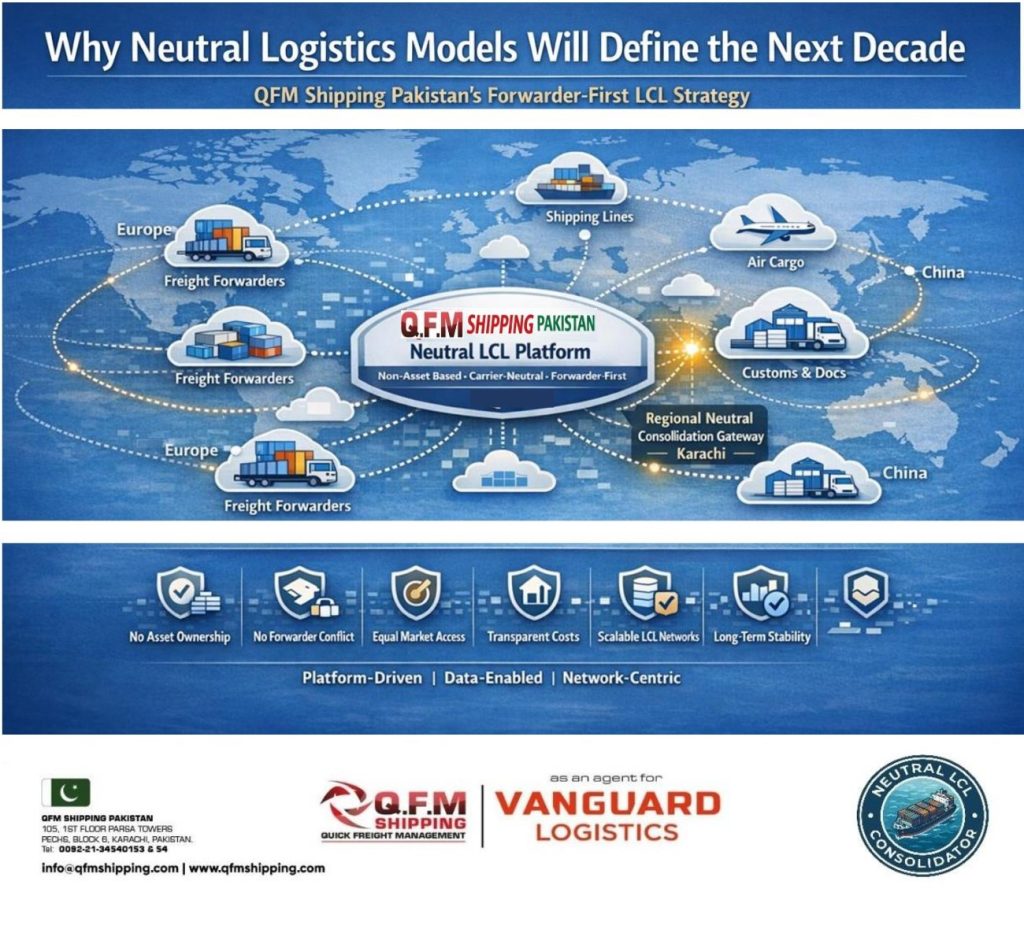
QFM Shipping Pakistan has deliberately structured its operations around neutrality. This approach allows the company to serve as a logistics backbone rather than a market competitor.
Key Principles of QFM’s Neutral Model
1. Forwarder-First Strategy
QFM works with freight forwarders, not against them—supporting their growth in Pakistan’s import and export markets.
2. Neutral LCL Consolidation
By focusing on LCL consolidation without shipper-facing sales, QFM ensures:
-
Data confidentiality
-
Fair capacity allocation
-
Transparent cost structures
3. Multi-Trade Lane Enablement
QFM facilitates neutral routing across key global corridors, supporting consistent access to Pakistan through trusted international networks.
4. Ecosystem Thinking
Rather than building closed pipelines, QFM invests in relationships, processes, and systems that allow multiple stakeholders to coexist and scale together.
Karachi’s Role in the Neutral Logistics Future
Karachi is emerging as a natural regional consolidation and redistribution point. Neutral logistics models amplify this advantage by:
-
Enabling multi-origin cargo aggregation
-
Supporting smaller and mid-sized forwarders
-
Improving predictability for inland distribution
QFM Shipping Pakistan’s neutrality aligns directly with Karachi’s potential as a collaborative logistics hub rather than a controlled gateway.
Business Impact: Who Benefits from Neutral Logistics Models?
| Stakeholder | Benefit |
|---|---|
| Freight Forwarders | No channel conflict, scalable access |
| SMEs & Importers | More routing options, stable pricing |
| Global Networks | Reliable local execution partner |
| Ports & Customs | Cleaner documentation flows |
| End Markets | Faster, more resilient supply chains |
The Next Decade: From Competition to Coordination
The coming decade will reward logistics providers that understand one truth: no single player can dominate global trade alone.
Neutral logistics models represent a structural evolution—from fragmented competition to coordinated ecosystems. Companies that embrace neutrality will be better positioned to handle:
-
Demand volatility
-
Capacity shocks
-
Regulatory change
-
Multi-country sourcing
QFM Shipping Pakistan’s strategy reflects this future-focused mindset—building infrastructure, trust, and partnerships that allow the entire logistics community to grow.
Conclusion: Neutrality Is Not Optional—It Is Inevitable
Neutral logistics models are no longer an alternative. They are becoming the foundation of modern supply chains.
As global trade grows more complex and interconnected, neutrality delivers what the market increasingly demands: trust, scalability, and resilience. Through its forwarder-centric, non-competing approach, QFM Shipping Pakistan exemplifies how neutrality can be transformed into a long-term strategic advantage.
The next decade of logistics will not be defined by who owns the most assets—but by who enables the strongest ecosystems.
For businesses seeking dependable access to global markets, Karachi—powered by QFM Shipping—offers a scalable and future-ready consolidation platform at the heart of regional trade.
QFM Shipping is a Pakistan-based neutral LCL consolidator and freight-forwarding partner focused on network-centric logistics, exporter-first service design, and reliable multi-origin routing to global markets.
Ready to explore collaboration opportunities? Reach out to our team to discuss your LCL needs, strategic partnerships, and custom routing options. Let’s build stronger, smarter logistics together.
Email: info@qfmshipping.com
Phone: +92-21-34540153 & 54
+92-21-34540135 & 36
Tags:
Neutral logistics models, neutral freight forwarding, neutral LCL consolidation, logistics ecosystem, supply chain neutrality, multi-origin consolidation, Karachi logistics hub, LCL shipping Pakistan
